
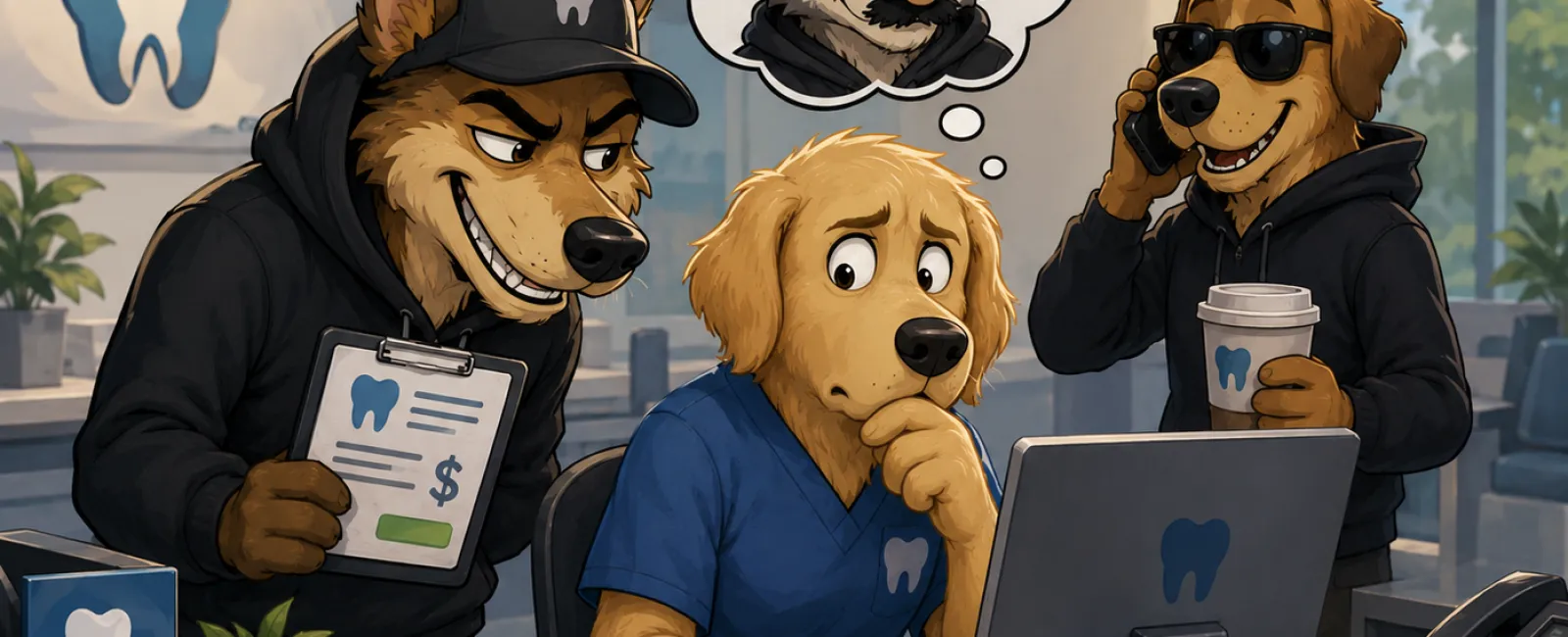
These Scams Don't Look Like Scams Anymore — and Dental Offices Are Where They Work Best
Most dental teams
already know not to click "obviously bad" emails.
That's not the
problem anymore.
The incidents that
shut practices down, trigger insurance reviews, or force patient notifications
usually start with something that looks completely normal:
- A file share
- A payment
update
- A lab or vendor
request
- A routine login
prompt
The failure isn't
intelligence or effort.
It's that modern scams are designed to fit seamlessly into dental workflows.
The question isn't "Would
my team fall for a scam?"
It's "Do we have guardrails for a normal, rushed Tuesday?"
One Incident Pattern We See Over and Over
This pattern shows
up repeatedly across dental offices of all sizes:
An office manager
receives a DocuSign or OneDrive notification that appears to come from a real
vendor. They log in using their Microsoft or Google credentials. Nothing
happens immediately. Two weeks later, insurance claims start failing, vendors
report changed payment instructions, or unusual logins appear across systems.
No ransomware. No
dramatic breach screen.
Just quiet access that spreads.
By the time it's
noticed, the question becomes: What controls were in place to prevent this?
That's the lens
insurers, compliance reviewers, and attorneys use.
The 5‑Step Minimum Security Baseline for Dental Offices
This is the minimum
baseline a dental practice should have. Each step has a clear owner.
Step 1: Lock Down How Payments Are Changed
Owner: Practice Owner
No payment changes — vendors, labs, or clearinghouses — are accepted via email
alone. Every request requires verbal confirmation using a known phone number
already on file.
Step 2: Control File‑Sharing Behavior
Owner: Office Manager
If a file share from systems like Microsoft OneDrive, Google Drive, DocuSign,
or Dropbox is unexpected, staff do not click the email link. They log into the
platform directly to verify the file exists.
Step 3: Enforce Role‑Based Access
Owner: IT / Managed
Provider
Front desk, clinical staff, and billing do not share logins. Access to PMS
systems (Dentrix, Eaglesoft, Open Dental), billing portals, and lab portals is
limited strictly by role.
Step 4: Monitor Logins and Sharing
Owner: IT / Managed
Provider
Alerts are enabled for unusual logins, new external file shares, and forwarding
rule changes in email accounts.
Step 5: Train for Verification, Not Fear
Owner: Practice Owner
Staff are trained to slow down only when money, credentials, or patient
data are involved — not for everything else.
This baseline
removes single‑click failure points without slowing the practice down.
Scripts Your Team Can Use Immediately
These remove
hesitation and guesswork.
Payment Change
Verification Script
"Hi, we received a request to change payment details. Before we process it, we
need to confirm verbally. Can you confirm the request and the last invoice
number?"
Unexpected File
Share Script
"Hi, we received a file notification from your system but weren't expecting it.
Can you confirm you sent it and what it contains before we open anything?"
Urgent Request
Pushback Script
"I can help with that. First, I need to verify this request through our
standard process."
Scripts protect
staff from pressure and protect the practice from mistakes.
If Someone Clicks: What to Do in the First 30 Minutes
This matters more
than the click itself.
Immediately
- Disconnect the
affected computer from Wi‑Fi or Ethernet
- Do not shut it
down unless instructed
Within 15 Minutes
- Reset the
user's email and system passwords
- Revoke active
sessions in Microsoft or Google
- Disable email
forwarding rules
Within 30 Minutes
- Contact your IT
provider
- Check for
access to PMS, billing platforms, and lab portals
- Preserve logs —
do not "clean up" yet
Fast, structured
response often prevents escalation and preserves insurance eligibility.
A One‑Page Internal Policy You Can Copy and Use
Dental Office
Security Quick Policy
- No payments or
banking changes via email alone
- No clicking
unexpected file‑share links
- All credential
or data requests require second‑channel verification
- Logins are
individual, never shared
- Incidents are
reported immediately, without blame
This policy fits on
one page and is defensible under review.
Why This Matters Beyond "Security"
When something goes
wrong, the evaluation isn't emotional.
Insurance carriers
ask:
- Were reasonable
controls in place?
- Was access
limited by role?
- Was
verification required?
Regulators ask:
- Were safeguards
documented?
- Was response
timely?
- Was exposure
minimized?
This blog isn't
about fear.
It's about readiness.
One Action to Take This Week
Pick one
workflow — file sharing, payment changes, or vendor requests — and document
exactly how it should be verified. Share it with the team. That single step
eliminates the most common failure path.
What to Do If You Want to Confirm You're Covered
Schedule your 10
minute discovery call to confirm whether your current setup meets insurance and
compliance expectations for dental practices. We'll review access controls,
verification gaps, and incident readiness so you know where you stand and what
actually matters. One conversation. Clear answers. Mention 911IT once, then
move forward with confidence.


