
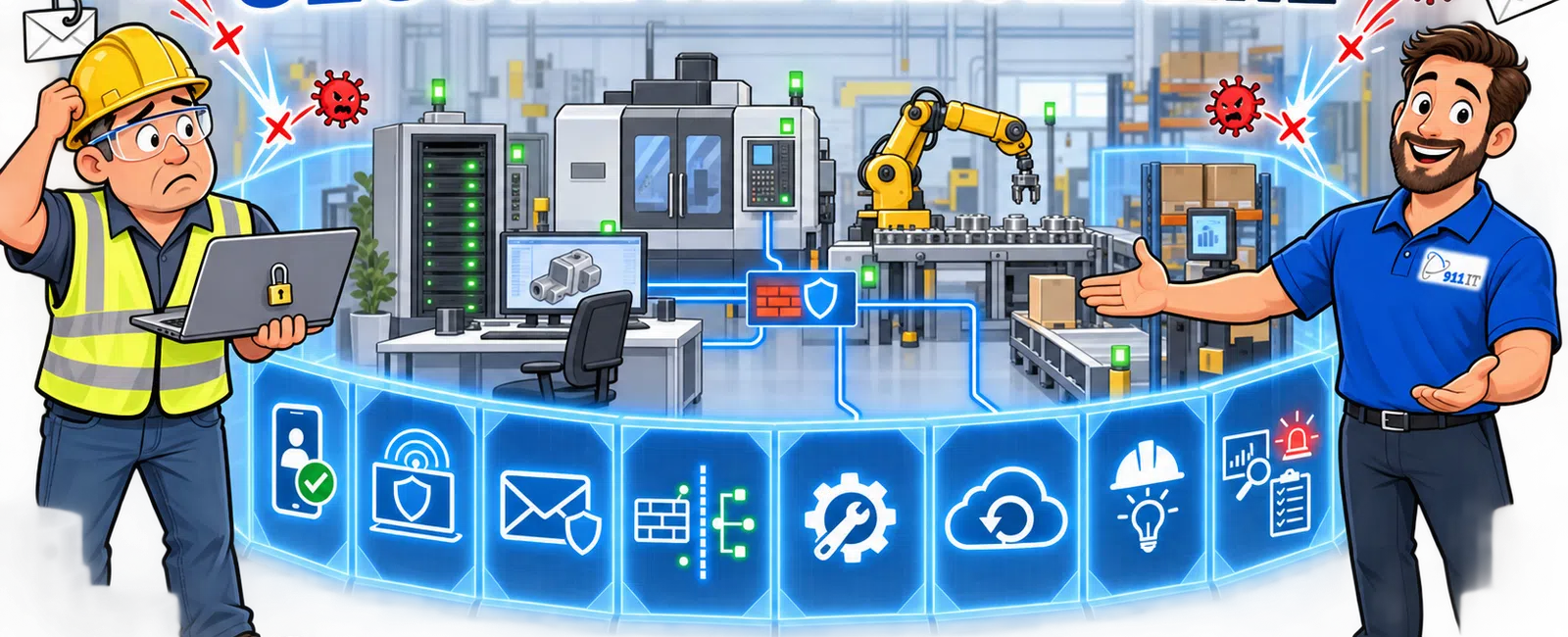
What Cybersecurity Protection Should a Small Manufacturer Have?
A manufacturing company with 25-50 employees should use at least 10 core cybersecurity safeguards: multi-factor authentication, endpoint detection and response, email security, managed security monitoring, patch management, firewall protection, secure backups, employee training, access controls and an incident-response plan.
Most manufacturers should budget approximately $40-$150 per user per month for managed cybersecurity services, depending on the security tools included, monitoring coverage, compliance obligations, number of facilities and complexity of the production environment. Advanced services such as 24/7 security operations, penetration testing, CMMC preparation and incident response may increase the total investment.
The right security program should protect both office technology and the systems surrounding production. It should also reduce downtime, protect intellectual property and help the company respond quickly when suspicious activity occurs.
This guide uses a five-layer framework to explain the cybersecurity services a 25-50 employee manufacturer should prioritize.
The Five-Layer Manufacturing Cybersecurity Framework
Layer 1: Protect Identities and User Accounts
Employee accounts are a common entry point for cyberattacks. Attackers may steal passwords through phishing emails, reused credentials, malicious websites or compromised personal devices.
Manufacturers should implement:
- Multi-factor authentication
- Unique user accounts
- Strong password requirements
- Secure password management
- Restricted administrator privileges
- Automated employee onboarding and offboarding
- Regular access reviews
- Conditional access policies where appropriate
Multi-factor authentication should be required for systems such as:
- Microsoft 365
- Remote-access platforms
- Cloud applications
- Virtual private networks
- Administrative accounts
- Financial and payroll systems
- Backup-management portals
Manufacturers should avoid shared user accounts whenever possible. Shared credentials make it difficult to determine who accessed a system, changed a setting or downloaded sensitive information.
Administrative Accounts Require Additional Protection
Employees should not use administrator accounts for routine email, web browsing or daily office work. Administrative access should be limited to authorized personnel and used only when elevated permissions are required.
A secure approach may include:
- Separate administrator and standard user accounts
- Multi-factor authentication for privileged access
- Logging of administrative activity
- Approval procedures for sensitive changes
- Immediate removal of access when roles change
Layer 2: Protect Computers, Servers and Production-Connected Devices
Traditional antivirus alone is not enough for a modern manufacturing environment. Computers and servers should use endpoint detection and response technology that can identify suspicious behavior, isolate compromised devices and support investigation.
Endpoint protection should cover:
- Office computers
- Engineering workstations
- Laptops
- Servers
- Warehouse terminals
- Shared production computers
- Remote employee devices
Protection may include:
- Endpoint detection and response
- Managed threat monitoring
- Automated isolation of compromised devices
- Application control
- Device encryption
- USB and removable-media controls
- Operating-system patching
- Software-update management
Legacy Manufacturing Systems Need Compensating Controls
Some production systems cannot run modern security software or receive current operating-system updates. Replacing them immediately may be impractical, but leaving them exposed is also risky.
Risk-reduction measures may include:
- Network segmentation
- Blocking unnecessary internet access
- Restricting user access
- Allowing connections only from approved devices
- Monitoring network activity
- Securing vendor remote access
- Maintaining system-image backups
- Documenting a replacement plan
Legacy systems should be treated as known risks with documented safeguards rather than ignored because they continue to operate.
Layer 3: Secure Email, Networks and Remote Access
Email remains one of the most common ways attackers target employees. A convincing message may impersonate an executive, supplier, customer, freight company or software vendor.
Email protection should include:
- Spam and phishing filtering
- Malicious-link protection
- Attachment scanning
- Domain impersonation protection
- External-sender warnings
- Microsoft 365 security configuration
- Phishing-reporting tools
- Ongoing employee training
Network security should include:
- Business-grade firewalls
- Secure wireless networks
- Separate guest Wi-Fi
- Network segmentation
- Managed switches
- Secure DNS filtering
- Logging and alerting
- Controlled vendor connections
- Documented firewall rules
Remote Access Should Be Explicitly Approved
Manufacturers often allow equipment vendors, software consultants and employees to connect remotely. Each remote connection creates potential risk.
A secure remote-access process should define:
- Who is authorized
- Which systems can be accessed
- When access is permitted
- Whether multi-factor authentication is required
- How activity is logged
- How access is disabled when no longer needed
Permanent vendor accounts should be avoided when temporary, approved access can accomplish the same purpose.
Layer 4: Protect Data and Prepare for Recovery
Manufacturers should assume that preventive security controls may eventually fail. The company must be able to recover data and restore operations after ransomware, equipment failure, human error or natural disaster.
A secure backup strategy should include:
- Automated backups
- Multiple backup copies
- Offsite or cloud-based storage
- Protection from unauthorized deletion
- Encryption
- Backup-failure monitoring
- Regular restoration testing
- Documented recovery procedures
A useful planning model is the 3-2-1 backup principle:
- Maintain at least three copies of important data.
- Store the copies on at least two different types of media or platforms.
- Keep at least one copy separate from the primary environment.
The company should also define:
- Recovery point objective: How much recent data the business can afford to lose.
- Recovery time objective: How long a system can remain unavailable.
An ERP system may require a faster recovery than a noncritical file archive. Recovery priorities should reflect operational impact.
Learn more about protecting critical operations through business continuity services.
Layer 5: Monitor, Train and Respond
Cybersecurity tools are most effective when qualified people monitor alerts and respond to suspicious activity. Installing software without reviewing its warnings may create a false sense of security.
Managed monitoring may include:
- Endpoint alerts
- Microsoft 365 sign-in activity
- Firewall events
- Backup failures
- Suspicious account behavior
- Malware detections
- Unexpected administrative changes
- Unusual data transfers
The provider should explain:
- Who receives alerts
- When alerts are reviewed
- Which events trigger immediate action
- Who contacts company leadership
- Whether monitoring is available 24/7
- What incident-response services are included
Employee Training Is a Core Security Control
Employees should receive security awareness training at least annually, with shorter reminders or simulated phishing exercises throughout the year.
Training should address:
- Phishing emails
- Business email compromise
- Password security
- Multi-factor authentication requests
- Suspicious attachments
- Safe use of removable media
- Reporting lost devices
- Protecting sensitive information
- Social-engineering phone calls
- Physical security
Employees should know exactly how to report a suspicious email or security concern. Fast reporting can reduce the impact of an incident.
The 10 Essential Cybersecurity Services for Manufacturers
| Security service | Primary purpose | Recommended priority |
|---|---|---|
| Multi-factor authentication | Reduces the risk of stolen passwords being used successfully | Critical |
| Endpoint detection and response | Detects and contains suspicious activity on computers and servers | Critical |
| Email security | Blocks phishing, malicious links and impersonation attempts | Critical |
| Managed security monitoring | Ensures alerts are reviewed and escalated | Critical |
| Patch management | Corrects known software and operating-system vulnerabilities | High |
| Firewall and network management | Controls traffic and separates sensitive systems | High |
| Secure backups | Supports recovery after ransomware, failure or accidental deletion | Critical |
| Security awareness training | Helps employees recognize and report attacks | High |
| Access management | Limits systems and data to authorized users | High |
| Incident-response planning | Defines actions and responsibilities during a cyberattack | Critical |
What Cybersecurity Services Are Often Missing?
Many manufacturers have antivirus software and backups but still lack the processes required to manage risk consistently.
Common gaps include:
- No one reviews security alerts after hours.
- Multi-factor authentication is not enabled for every critical system.
- Former employees retain active accounts.
- Administrative access is shared.
- Backups have never been restored during a test.
- Production networks are not separated from office networks.
- Vendor remote access remains permanently enabled.
- Employees receive no phishing training.
- Cybersecurity policies do not match actual practices.
- No incident-response exercise has been completed.
- Unsupported systems have no documented risk plan.
- Leadership receives no regular cybersecurity reporting.
A cybersecurity assessment should identify these gaps and rank them by business impact rather than presenting an unprioritized list of technical findings.
How Much Should Manufacturing Cybersecurity Cost?
A 25-50 employee manufacturer may spend approximately $40-$150 per user per month for managed cybersecurity services. The final price depends on the tools, monitoring, compliance and response services included.
| Security level | Approximate monthly range | Typical scope |
|---|---|---|
| Foundational | $40-$70 per user | Endpoint security, email filtering, multi-factor authentication guidance and patch management |
| Managed protection | $70-$110 per user | Foundational controls plus managed monitoring, training, backup oversight and security reporting |
| Advanced or compliance-focused | $110-$150+ per user | Expanded monitoring, compliance support, vulnerability management, incident-response planning and advanced controls |
At these planning ranges, estimated monthly cybersecurity costs may be:
| Employees | Estimated monthly range |
|---|---|
| 25 employees | $1,000-$3,750 |
| 35 employees | $1,400-$5,250 |
| 50 employees | $2,000-$7,500 |
These estimates may overlap with a managed IT agreement when cybersecurity tools and monitoring are already included. Ask providers to separate included services from optional upgrades so the same service is not counted twice.
Factors That Increase Cybersecurity Costs
- Multiple locations
- 24/7 operations
- Large numbers of devices relative to employee count
- Legacy production systems
- CMMC or NIST requirements
- Extensive cloud infrastructure
- 24/7 security operations
- Penetration testing
- Advanced logging and retention
- Incident-response retainers
- Network redesign or segmentation
- Unsupported hardware or software
Does a Manufacturer Need 24/7 Security Monitoring?
A manufacturer should strongly consider 24/7 monitoring when it operates multiple shifts, stores sensitive customer information, supports defense contracts or cannot tolerate extended production downtime.
Cyberattacks do not occur only during business hours. An attacker may intentionally begin encrypting systems at night, during a weekend or over a holiday when fewer employees are available.
Before purchasing 24/7 monitoring, ask:
- Is a human analyst reviewing alerts?
- Which security tools are monitored?
- What actions can the monitoring team take?
- Who is contacted during an incident?
- Can compromised devices be isolated?
- Is incident-response labor included?
- How are false alarms handled?
- What reports will leadership receive?
A service that only forwards alerts to an unattended email address does not provide the same protection as active monitoring and response.
How Should Manufacturers Secure Operational Technology?
Operational technology may include systems that monitor or control physical processes. These systems can have long life cycles, limited security features and strict uptime requirements.
A practical operational-technology security plan may include:
- Inventory the systems. Document devices, operating systems, vendors, connections and business owners.
- Map communications. Identify which office systems, cloud services and vendor networks connect to production.
- Segment the network. Separate production systems from employee and guest networks.
- Restrict access. Limit users, vendors and devices to the minimum access required.
- Monitor activity. Identify unexpected connections and unusual traffic.
- Plan recovery. Maintain configurations, system images, spare equipment and vendor contacts.
- Manage change carefully. Test updates and schedule production-impacting work during approved maintenance windows.
The IT provider should coordinate with equipment vendors and production leaders before changing settings that may affect machinery or manufacturing applications.
What Cybersecurity Framework Should a Manufacturer Use?
The correct framework depends on contracts, customers and business objectives.
| Situation | Framework or requirement to evaluate |
|---|---|
| Department of Defense contracts involving covered information | CMMC and applicable NIST SP 800-171 requirements |
| General cybersecurity risk management | NIST Cybersecurity Framework |
| Customer requests for a certifiable security program | ISO/IEC 27001 |
| Prioritized technical safeguards | CIS Controls |
| Payment-card processing | Applicable PCI DSS requirements |
Manufacturers in the defense supply chain can review CMMC compliance services. Compliance requirements should be confirmed through applicable contracts, legal counsel and qualified compliance advisors.
What Should an Incident-Response Plan Include?
An incident-response plan should define what the company will do when it suspects ransomware, account compromise, data theft or another cybersecurity event.
The plan should identify:
- Who has authority to declare an incident
- Who contacts the IT or security provider
- Who can isolate devices or networks
- How leadership will communicate if email is unavailable
- When legal counsel and insurance are contacted
- Who preserves logs and evidence
- How affected systems are restored
- Who communicates with employees, customers or regulators
- How the incident is documented
- How corrective actions are assigned
Example: Employee Reports a Stolen Password
An employee enters a password on a fraudulent Microsoft 365 login page and reports the event 10 minutes later.
A documented response may include:
- Reset the employee's password.
- Revoke active cloud sessions.
- Confirm multi-factor authentication settings.
- Review sign-in history.
- Search for suspicious inbox rules or forwarded messages.
- Review administrative or financial activity.
- Check the employee's device for malicious software.
- Determine whether additional accounts were affected.
- Document the incident and corrective actions.
The speed of the employee's report can significantly reduce the potential impact. This is why training and a clear reporting process are essential.
How Often Should Cybersecurity Be Reviewed?
Manufacturers should review security performance at least quarterly and conduct a formal risk or gap assessment at least annually. More frequent reviews may be required by contracts, insurance policies or significant business changes.
An additional assessment should be considered when the company:
- Opens a new facility
- Implements a new ERP or production platform
- Adds remote access
- Acquires another business
- Begins a government contract
- Changes managed IT providers
- Experiences a security incident
- Adds significant cloud services
- Introduces new production equipment
A 15-Question Manufacturing Cybersecurity Checklist
- Is multi-factor authentication enabled for every critical system?
- Are all computers and servers protected by managed endpoint security?
- Who reviews cybersecurity alerts after hours?
- Are former employee accounts disabled immediately?
- Are administrator accounts separate from standard accounts?
- Are operating systems and applications patched consistently?
- Are production and office networks appropriately separated?
- Is vendor remote access restricted and monitored?
- Are backups protected from ransomware?
- When was the last successful restoration test?
- Do employees receive regular phishing training?
- Does the company have a documented incident-response plan?
- Are legacy systems documented with compensating controls?
- Does leadership receive regular security reports?
- Are contractual and compliance requirements reviewed annually?
Red Flags in a Cybersecurity Proposal
The Proposal Uses "Complete Protection" Without Defining Services
No provider can eliminate all cybersecurity risk. The proposal should list specific tools, monitoring responsibilities and response procedures.
The Provider Relies Only on Antivirus
Manufacturers need layered safeguards covering identity, email, endpoints, networks, backups, employees and incident response.
Security Alerts Are Not Actively Monitored
A tool can detect suspicious activity without anyone responding. Confirm who reviews alerts and what actions the team can take.
Backups Are Included but Never Tested
A completed backup job does not prove that systems and data can be restored within the required timeframe.
The Provider Ignores Production Systems
A manufacturing security assessment should evaluate the networks, workstations and vendor connections surrounding production equipment.
The Provider Guarantees Compliance
Technology services can support compliance, but compliance also depends on contracts, policies, employee behavior, documentation and management decisions.
The Proposal Does Not Explain Incident Response
The company should know who responds, what services are included and when additional forensic or legal support may be required.
Real-World Example: From Security Findings to Corrective Action
Consider a 35-employee manufacturer with Microsoft 365, an ERP server, engineering workstations and several older production computers.
A cybersecurity assessment identifies five major issues:
- Multi-factor authentication is not enabled for all employees.
- Former vendor accounts remain active.
- Engineering workstations use outdated security software.
- The production network is not separated from guest Wi-Fi.
- Backups have not been restoration-tested in 18 months.
A 90-day remediation plan may include:
- Days 1-15: Enable multi-factor authentication and remove unnecessary accounts.
- Days 15-30: Deploy managed endpoint protection to supported systems.
- Days 30-60: Segment guest, office and production networks.
- Days 45-75: Test backup restoration and document recovery procedures.
- Days 60-90: Train employees and conduct an incident-response exercise.
The outcome should be measured through completed actions, verified configurations and retained evidence—not simply the purchase of new software.
Frequently Asked Questions About Manufacturing Cybersecurity
Is antivirus enough for a small manufacturer?
No. Antivirus is one layer. Manufacturers also need identity protection, email security, managed monitoring, patching, backups, network controls, employee training and incident-response planning.
How much should a 25-50 employee manufacturer spend on cybersecurity?
A planning range of approximately $40-$150 per user per month may be reasonable, depending on scope, tools, monitoring, compliance and production complexity. Some of these costs may already be included in a managed IT agreement.
Does every manufacturer need 24/7 cybersecurity monitoring?
Not every company has the same risk, but 24/7 operations, sensitive data, government contracts and low tolerance for downtime make continuous monitoring more valuable.
Should production systems connect to the same network as office computers?
Not automatically. Network segmentation can reduce the likelihood that a compromised office computer affects production systems. The correct design depends on required communications and equipment limitations.
Can older production equipment be secured?
Risk can often be reduced through segmentation, restricted access, monitoring, secure vendor connections and recovery planning. Unsupported equipment should also have a documented replacement strategy.
How often should employees receive security training?
Formal training should occur at least annually, with shorter reminders, simulations or targeted training throughout the year.
How often should backups be tested?
Critical backups should be tested regularly based on business risk. Many manufacturers should conduct restoration testing at least quarterly, with more frequent tests for especially important systems.
Does cyber insurance replace cybersecurity services?
No. Insurance may help manage financial consequences, but it does not prevent incidents or restore operations. Insurers may also require specific controls before providing coverage.
Can a managed IT provider handle cybersecurity?
Yes, provided the company has qualified security personnel, appropriate tools, active monitoring and documented response procedures. Ask exactly which services are included.
What is the first cybersecurity improvement a manufacturer should make?
Start with an assessment, but urgent foundational priorities commonly include multi-factor authentication, managed endpoint protection, secure backups and removal of unnecessary access.
Do small manufacturers get targeted by cybercriminals?
Yes. Attackers may target smaller businesses because they often have valuable data, operational urgency and fewer internal security resources.
What should we do after a suspected phishing incident?
Report it immediately, reset affected credentials, revoke active sessions, review account activity and have the device and cloud environment assessed for further compromise.
Why Manufacturers Use 911 IT for Cybersecurity
911 IT provides cybersecurity and manufacturing IT support for businesses across Utah, Wyoming and Arizona. The team combines preventive safeguards, managed support, business continuity and long-term security planning.
Cybersecurity capabilities include:
- Multi-factor authentication support
- Endpoint detection and response
- Email and phishing protection
- Managed security monitoring
- Firewall and network security
- Patch and vulnerability management
- Security awareness training
- Backup and recovery planning
- Incident-response preparation
- CMMC and NIST readiness assistance
- 24/7 access to technical support
- A 100% satisfaction guarantee
Manufacturers can combine these services with managed IT services or use them to supplement an existing internal technology team.
Schedule a Manufacturing Cybersecurity Assessment
Manufacturing cybersecurity should be based on your actual systems, contracts and operational risks. A structured assessment can identify the most important gaps, estimate remediation costs and create a practical improvement plan.
911 IT can evaluate your users, devices, production environment, cloud services, backups and existing security controls, then prioritize the actions that will reduce risk most effectively.
Schedule a discovery call with 911 IT or contact our team to discuss cybersecurity services for your manufacturing company.


