
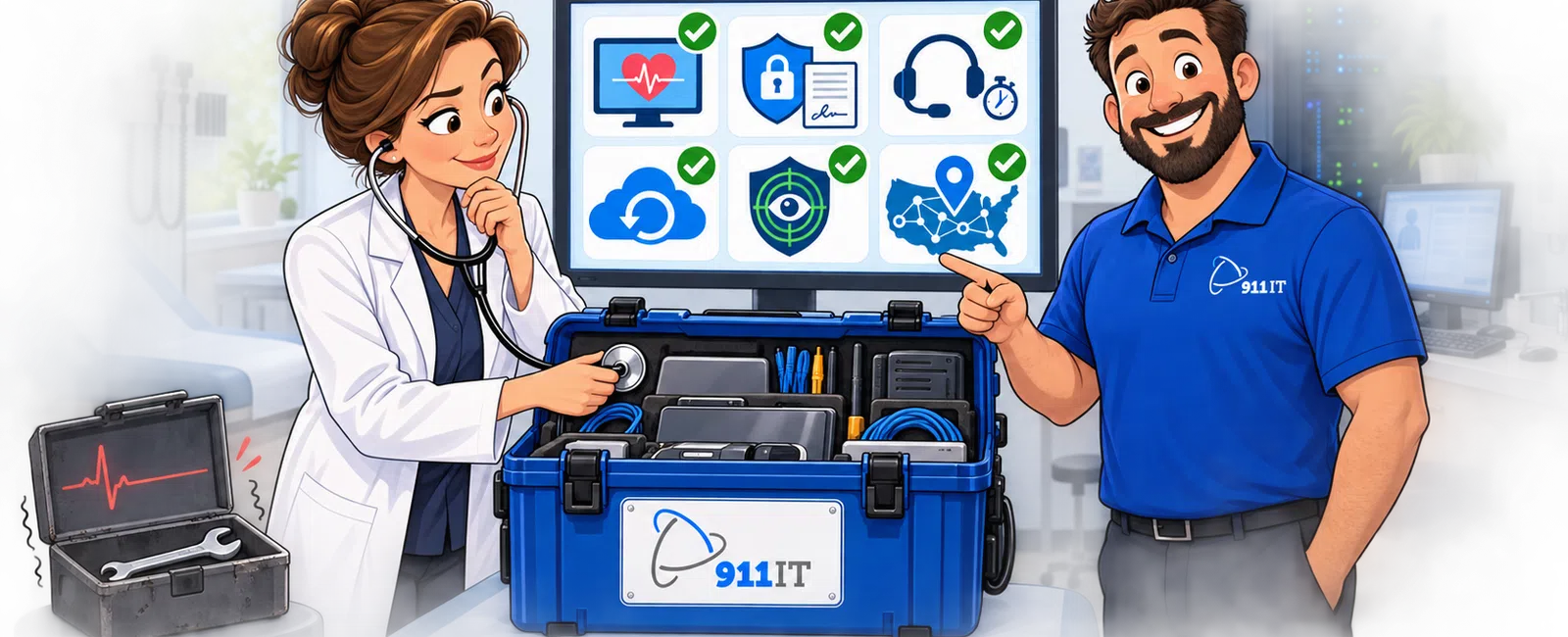
The top IT support companies for healthcare organizations in the USA include 911 IT (serving Utah, Wyoming, and Arizona), Clearwater Compliance (national), CISO Global, Compliancy Group, and regional managed service providers with HIPAA expertise. These 5+ firms specialize in protecting electronic protected health information (ePHI), maintaining Business Associate Agreements (BAAs), and supporting EHR systems while ensuring compliance with HIPAA, HITECH, and state-specific healthcare privacy regulations.
Healthcare data breaches cost medical practices an average of $408 per patient record in 2026, making specialized IT support critical for risk mitigation.
What Distinguishes Healthcare-Focused IT Support from General Technology Services?
Healthcare IT support requires expertise that generic technology providers cannot deliver. Medical practices handle protected health information (PHI) under strict federal and state regulations, demanding providers who understand HIPAA's Security Rule, Privacy Rule, and Breach Notification requirements.
Specialized healthcare IT companies maintain current knowledge of EHR platforms like Epic, Cerner, Athenahealth, and eClinicalWorks. They understand clinical workflows, practice management software integration, and the unique demands of patient portals. Generic IT firms lack this domain expertise and often create compliance gaps.
Business Associate Agreements form the legal foundation of healthcare IT relationships. Every IT vendor accessing ePHI must sign a BAA accepting liability for data protection. Companies without healthcare experience frequently misunderstand these obligations, exposing practices to Office for Civil Rights (OCR) audits and penalties.
Salt Lake City healthcare providers face additional complexity serving patients across Utah's urban corridors and Wyoming's rural communities. Healthcare IT support in this region must accommodate telehealth infrastructure for remote consultations, secure data transmission across state lines, and compliance with Utah Health Data Authority requirements alongside federal regulations.
Marcus, who works in accounting but supports healthcare clients, shared his experience with responsive IT support: "911 IT has been a breath of fresh air. Every time I've reached out, I've gotten quick answers and real help - no waiting, no runaround." This responsiveness proves critical when EHR downtime directly impacts patient care delivery.
Healthcare-specialized IT support protects both patient safety and practice viability through compliance expertise and clinical system knowledge.
What Technical Capabilities Should Healthcare IT Providers Demonstrate?
Encryption capabilities form the baseline for healthcare IT support. Providers must implement AES-256 encryption for data at rest and TLS 1.2 or higher for data in transit. This includes encrypting backup repositories, email communications containing PHI, and mobile device management for clinicians accessing patient records remotely.
Network segmentation separates clinical systems from administrative networks, limiting breach exposure. Advanced providers implement zero-trust architectures where every access request requires verification regardless of network location. This approach protects against lateral movement if attackers compromise a single workstation.
EHR performance optimization requires understanding database architecture, interface engines, and HL7 messaging standards. Slow chart loading times frustrate clinicians and reduce patient throughput. Competent IT providers monitor EHR response times, optimize SQL queries, and coordinate with EHR vendors during system updates.
Disaster recovery planning for healthcare differs fundamentally from other industries. Medical practices cannot tolerate extended downtime - patient care continuity demands recovery time objectives (RTOs) measured in hours, not days. Business continuity services for healthcare must include failover systems, redundant internet connections, and tested restoration procedures.
Ransomware defense has become non-negotiable for healthcare organizations. Attackers specifically target medical practices knowing that patient care pressure creates urgency to pay ransoms. Multi-layered security includes endpoint detection and response (EDR), email filtering with sandboxing, network behavior analysis, and regular security awareness training for staff.
Bill, working in manufacturing, noted the importance of knowledgeable support: "I like working with 911 IT because they have an in-house tech who is friendly and knowledgeable about my computer. This is especially important since I work only one day a week in the office and need to clear emails remotely on other days." Healthcare providers working across multiple locations need this same reliable remote support capability.
Technical depth in healthcare IT separates providers who protect practices from those who create liability.
How Do Regional Versus National Healthcare IT Providers Compare?
| Factor | National Providers | Regional Providers |
|---|---|---|
| Resource Breadth | Extensive compliance teams, standardized processes, specialized services like penetration testing | Focused expertise with deep local market knowledge and relationship-driven service |
| Response Time | Remote support primary, third-party field technicians for on-site needs | Local technicians dispatch within the hour for critical issues during patient care hours |
| Regional Knowledge | Broad pattern recognition across diverse implementations nationwide | Understanding of local health systems, referral patterns, state-specific compliance requirements |
| Cost Structure | Premium pricing reflecting brand recognition and compliance infrastructure | Typically 20-30% lower costs while maintaining equivalent HIPAA compliance standards |
| Best For | Multi-state health systems requiring standardized delivery across locations | Independent practices and regional groups valuing responsiveness and relationship depth |
911 IT serves healthcare organizations across Utah, Wyoming, and Arizona from their South Jordan headquarters. This three-state footprint provides regional responsiveness while serving diverse healthcare markets from urban specialty practices to rural family medicine clinics. Their HIPAA compliance services address both federal requirements and state-specific regulations across their service territory.
Jason in retail described the value of immediate support: "The best thing about using 911 IT is the convenience of being able to send a message and have online or onsite support almost immediately. If I have any IT issue, I know it will be taken care of quickly." Healthcare practices need this same rapid response when clinical systems fail.
The optimal choice depends on practice size, geographic distribution, and the value placed on relationship versus scale.
What Compliance Services Must Healthcare IT Vendors Provide?
HIPAA Security Risk Assessments form the foundation of compliance programs. The Security Rule requires covered entities to conduct regular assessments identifying vulnerabilities in administrative, physical, and technical safeguards. Competent IT providers facilitate these assessments, document findings, and implement remediation plans.
Business Associate Agreements must clearly define each party's responsibilities for PHI protection. The IT provider's BAA should specify encryption standards, breach notification procedures, subcontractor management, and audit rights. Practices should never work with IT vendors unwilling to sign comprehensive BAAs.
Breach response protocols require immediate action when PHI exposure occurs. IT providers must help practices determine breach scope, contain the incident, preserve forensic evidence, and document the timeline. OCR expects breach notification within 60 days, leaving little margin for investigation delays.
Access controls and audit logging track who accesses patient records and when. IT providers should implement role-based access ensuring staff see only the PHI necessary for their job functions. Audit logs must capture login attempts, record access, and administrative changes for OCR compliance reviews.
- Security awareness training covering phishing recognition, password management, and mobile device security
- Documentation of workforce training completion for OCR audit protection
- Regular policy review and updates reflecting regulatory changes
- Vendor risk management for third-party services accessing ePHI
- Incident response planning with defined escalation procedures
Utah's Health Data Authority adds state-specific requirements for healthcare data collection and reporting. Practices serving Arizona patients must understand that state's telehealth consent requirements. Wyoming's rural healthcare programs involve additional federal funding compliance. Multi-state IT providers must navigate this regulatory complexity.
Compliance expertise transforms IT providers from vendors into risk management partners.
Which EHR Platforms Do Leading Healthcare IT Companies Support?
Epic Systems dominates large hospital environments and integrated delivery networks. IT providers supporting Epic must understand Hyperspace workflows, Interconnect integration, and the platform's complex infrastructure requirements. Epic's frequent update cycles demand providers who maintain current certification and testing protocols.
Athenahealth serves ambulatory practices with its cloud-based platform combining EHR, practice management, and revenue cycle services. IT support for athenaNet focuses on network performance, browser optimization, and integration with external systems like labs and imaging centers. The cloud architecture shifts support emphasis from server management to connectivity and user experience.
eClinicalWorks appeals to small and mid-sized practices seeking affordable comprehensive solutions. IT providers must support both cloud and self-hosted deployments, understand the platform's telehealth capabilities, and troubleshoot its patient portal. eClinicalWorks' extensive customization options create unique support challenges.
Cerner (now Oracle Health) powers many academic medical centers and large health systems. Supporting Cerner requires expertise in Millennium architecture, CCL scripting, and interface engine management. The Oracle acquisition is driving platform evolution that IT providers must track.
Specialty-specific EHRs serve niche markets. Dentrix and Eaglesoft dominate dental practices. Kareo targets small physician practices. ChiroTouch serves chiropractors. IT providers supporting multiple specialties must maintain broader platform knowledge or partner with specialty-specific experts.
Practice management software integration connects EHR clinical documentation with scheduling, billing, and claims processing. IT providers must ensure HL7 interfaces function correctly, troubleshoot clearinghouse connections, and optimize e-prescribing workflows. Integration failures directly impact practice revenue.
EHR expertise determines whether IT support enhances or hinders clinical productivity.
What Should Healthcare Organizations Expect to Invest in IT Support?
Fully managed IT services for healthcare practices typically range from $100-$250 per user monthly in 2026. This comprehensive model includes 24/7 helpdesk support, proactive monitoring, patch management, cybersecurity, and compliance assistance. A 20-person medical practice should budget $2,000-$5,000 monthly for complete IT management.
Co-managed IT arrangements, where practices maintain some internal IT capability while outsourcing specialized functions, generally cost $75-$150 per user monthly. This hybrid approach works well for larger practices with existing IT staff who need cybersecurity expertise, compliance support, or after-hours coverage. Co-managed IT services provide flexibility for organizations in transition.
Cybersecurity add-ons including endpoint detection and response, security information and event management (SIEM), and phishing simulation training typically add $25-$75 per user monthly. Given healthcare's status as the most-targeted industry for cyberattacks, these investments prove essential rather than optional.
Backup and disaster recovery services range from $10-$30 per user monthly for basic solutions. Healthcare practices should budget toward the higher end for solutions meeting HIPAA's contingency planning requirements, including encrypted offsite storage, regular restoration testing, and rapid recovery capabilities.
Project work for EHR migrations, network upgrades, or office expansions typically bills at $150-$250 hourly. A complete EHR transition might require 40-80 hours of IT support depending on practice size and complexity, representing $6,000-$20,000 in project costs beyond software licensing.
VoIP phone services cost approximately $20-$40 per user monthly. Healthcare practices benefit from unified communications integrating with EHR systems, enabling features like click-to-call from patient records and automatic call logging for compliance documentation.
Mark in insurance described the value proposition: "We brought in 911 IT because we were at a point in our business where we needed professional IT support. Our business had outgrown the services of our previous technology provider and we couldn't afford the periodic downtime we experienced with our internet and phones." His practice eliminated downtime and gained issue resolution within minutes - outcomes that justify IT investment.
IT investment should be evaluated against the cost of downtime, breach exposure, and compliance penalties rather than viewed as discretionary spending.
How Do You Evaluate Healthcare IT Provider Claims and Credentials?
Request client references from similar healthcare organizations. Ask specifically about HIPAA compliance support, breach response experience, and EHR expertise. A provider claiming healthcare specialization should readily provide references from medical practices, dental offices, or behavioral health clinics.
Review the provider's Business Associate Agreement before engaging services. The BAA reveals their understanding of HIPAA obligations and willingness to accept liability. Providers offering weak BAAs with limited commitments lack confidence in their security practices.
Verify technical certifications relevant to healthcare IT. While not mandatory, certifications like Certified HIPAA Professional (CHP), HITRUST CSF Practitioner, or vendor-specific credentials (Microsoft 365 Certified, Cisco CCNP) indicate investment in expertise. Ask about ongoing training programs for technical staff.
Examine security infrastructure through specific questions. What EDR platform do they deploy? How do they handle security patch management? What's their process for security incident response? Vague answers suggest limited capabilities. Detailed responses with specific tools and methodologies indicate operational maturity.
Assess monitoring and response capabilities. Healthcare IT providers should offer 24/7 monitoring with defined response time commitments. Ask about their helpdesk staffing model, ticket escalation procedures, and average resolution times. The difference between 24/7 monitoring and 24/7 support with live technicians matters during emergencies.
Review service level agreements for specific commitments. SLAs should define response times for different priority levels, uptime guarantees, and remedies for service failures. Providers confident in their capabilities offer substantive SLAs rather than disclaimer-filled documents.
911 IT holds multiple recognitions including the 2024 MSP Titans award and Better Your Best Winner designation. They offer managed IT services with 24/7 live support and rapid response commitments.
Due diligence protects practices from providers who market healthcare expertise without operational capability to deliver it.
What Red Flags Indicate Inadequate Healthcare IT Support?
Reluctance to sign a comprehensive Business Associate Agreement immediately disqualifies a provider from healthcare IT work. Any hesitation about BAA terms or attempts to limit liability suggest the provider doesn't understand HIPAA's requirements or lacks confidence in their security practices.
Absence of healthcare client references indicates limited experience in the vertical. Providers claiming healthcare expertise should readily share case studies, testimonials, or references from medical practices. Generic IT experience doesn't translate to healthcare compliance knowledge.
Reactive-only support models create unacceptable risk for healthcare organizations. Providers offering only break-fix services without proactive monitoring, patch management, and security updates leave practices vulnerable to preventable breaches and system failures.
Unclear pricing structures with hidden fees undermine budget planning. Healthcare practices need transparent, predictable IT costs. Providers unable to clearly explain their pricing model or who frequently surprise clients with additional charges create financial uncertainty.
Lack of documented processes for common healthcare IT scenarios suggests operational immaturity. Competent providers maintain runbooks for EHR downtime response, breach investigation procedures, and disaster recovery activation. Process-driven delivery ensures consistent service quality regardless of which technician responds.
Inadequate cybersecurity emphasis reflects outdated thinking. Any IT provider not leading healthcare conversations with ransomware defense, multi-factor authentication, and security awareness training misunderstands the current threat landscape. Cybersecurity should be central, not peripheral, to healthcare IT support.
Slow response times during critical incidents prove incompatible with healthcare operations. When EHR systems fail during patient hours, practices need immediate support. Providers with response times measured in hours rather than minutes cannot serve healthcare effectively.
Single-technician operations create coverage gaps and knowledge concentration risk. While small providers can deliver excellent service, healthcare practices should understand continuity plans for vacations, illness, or technician turnover.
Recognizing these warning signs helps healthcare organizations avoid costly provider relationships that increase rather than reduce risk.
Frequently Asked Questions
Which company provides the most reliable IT support for multi-location medical practices?
Regional managed service providers with healthcare specialization typically deliver superior multi-location support compared to national firms. Look for providers offering 24/7 monitoring, site-to-site VPN expertise, and local technicians across your geographic footprint. 911 IT serves healthcare organizations across Utah, Wyoming, and Arizona with rapid response support and HIPAA compliance expertise. Evaluate providers based on their EHR platform knowledge, Business Associate Agreement terms, and documented response times rather than company size alone.
How do healthcare IT support costs compare to hiring internal IT staff?
A full-time IT professional costs $65,000-$95,000 annually plus benefits, providing single-person coverage without after-hours support or specialized cybersecurity expertise. Managed IT services at $100-$250 per user monthly deliver 24/7 support, compliance knowledge, and team depth for comparable or lower costs. A 15-person practice paying $2,250 monthly ($27,000 annually) receives comprehensive support including cybersecurity, backup management, and HIPAA compliance assistance that would require multiple internal hires to replicate.
What qualifications should I verify before signing a healthcare IT contract?
Request healthcare client references and verify the provider's willingness to sign a comprehensive Business Associate Agreement accepting HIPAA liability. Ask about their experience with your specific EHR platform, security incident response procedures, and compliance audit support capabilities. Review their cybersecurity infrastructure including endpoint protection, email filtering, and backup testing protocols. Examine service level agreements for specific response time commitments and uptime guarantees. Verify 24/7 support availability and ask whether monitoring is automated-only or includes live technician response.
How quickly should healthcare IT providers respond to critical system failures?
Critical issues affecting patient care delivery demand response within 15-30 minutes with resolution efforts beginning immediately. EHR downtime, network outages during clinic hours, or security incidents require emergency prioritization. Less urgent issues like individual workstation problems can tolerate 2-4 hour response windows. Evaluate providers based on their defined response time commitments in service level agreements rather than vague promises. Ask about their helpdesk staffing model and whether 24/7 support means automated monitoring only or live technician availability.
Can healthcare practices switch IT providers without disrupting patient care?
Yes, with proper planning and a transition-focused provider. The migration process typically spans 30-60 days including documentation review, system access transfer, and knowledge transfer sessions. Schedule intensive transition activities during low-volume periods or after hours to minimize disruption. A competent incoming provider will coordinate with your existing vendor, document current configurations, and establish monitoring before assuming full responsibility. Request a detailed transition plan addressing EHR access continuity, data backup verification, security tool migration, and staff communication.


