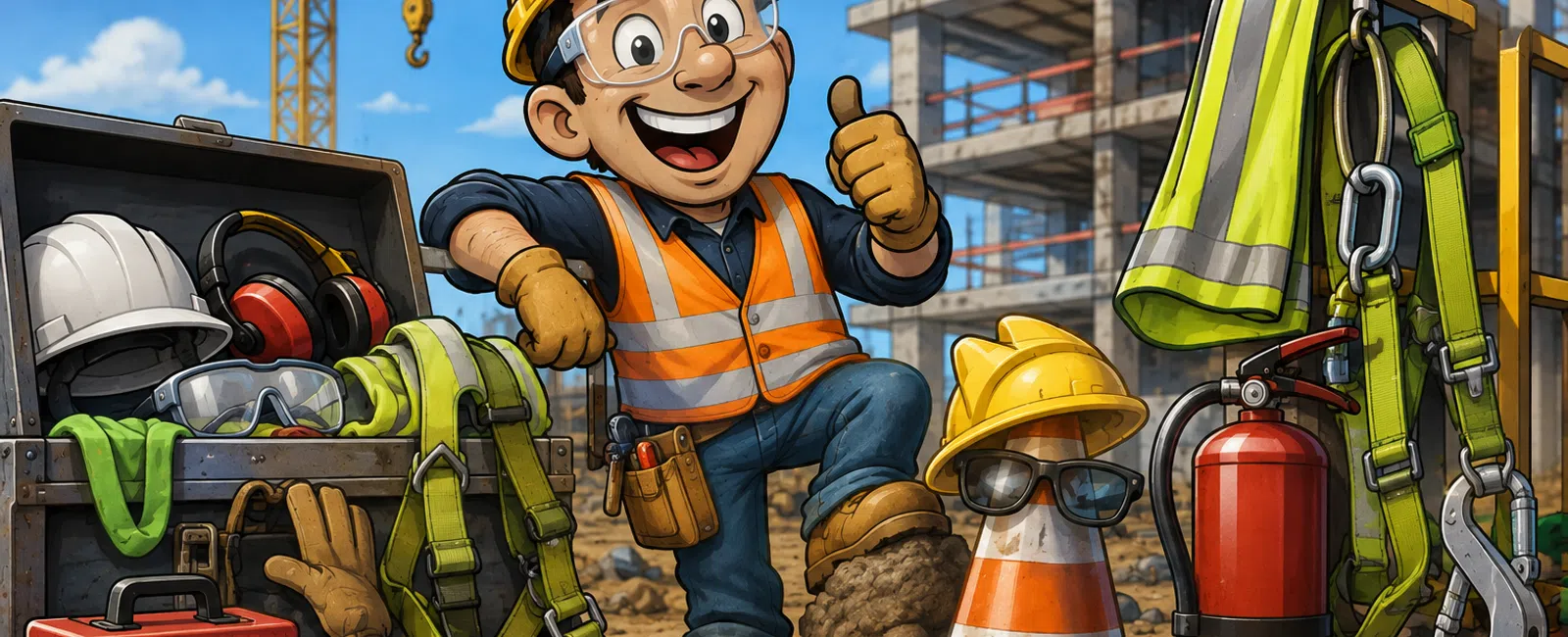
For OSHA compliance, construction sites must have personal protective equipment (hard hats, safety glasses, gloves, high-visibility vests), fall protection systems for work above 6 feet, first aid kits, fire extinguishers, hazard communication materials including Safety Data Sheets, OSHA-required posters, injury/illness logs (Form 300), and emergency action plans. Sites also need proper signage, barricades, and documented safety training records for all workers.
What Personal Protective Equipment Must Be Available on Every Construction Site?
OSHA Standard 1926.95 mandates that employers provide appropriate PPE at no cost to workers when hazards are present. Hard hats meeting ANSI Z89.1 standards protect against falling objects and head injuries, which account for a significant portion of construction fatalities.
Safety glasses or face shields guard against flying debris, dust, and chemical splashes. High-visibility clothing ensures workers remain visible to equipment operators, particularly critical on Salt Lake City sites where winter conditions reduce visibility. Steel-toed boots protect feet from crushing injuries and puncture wounds.
Hearing protection becomes mandatory when noise levels exceed 85 decibels for an 8-hour period. Respiratory protection ranges from dust masks for nuisance particulates to full respirators for environments with hazardous fumes or insufficient oxygen. Gloves must match the specific hazard - cut-resistant for sharp materials, insulated for electrical work, chemical-resistant for concrete and solvents.
Fall protection harnesses with lanyards are required for any work performed at heights of 6 feet or more. Utah's elevation-variable terrain often creates situations where standard scaffolding must be supplemented with personal fall arrest systems. Each harness requires inspection before every use and documentation of that inspection.
PPE alone doesn't satisfy OSHA requirements; you must also train workers on proper use, maintenance, and limitations of each piece of equipment.
What Safety Equipment and Systems Are Required Beyond Personal Gear?
Fall protection systems extend beyond personal harnesses to include guardrails, safety nets, and warning line systems. Guardrails must be installed on any walking or working surface with an unprotected edge 6 feet or higher. The top rail should be 42 inches above the walking surface, with a midrail positioned halfway between.
Scaffolding requires competent person inspection before each work shift and after any occurrence that could affect structural integrity. Salt Lake City's winter freeze-thaw cycles can compromise scaffold stability, making daily checks particularly important. Scaffold tags indicating inspection status and load capacity must be prominently displayed.
Ladders need inspection for cracks, bent rails, and missing rungs. Extension ladders must extend at least 3 feet above the landing surface. The 4-to-1 rule applies: for every 4 feet of height, the base should be 1 foot away from the wall.
Electrical safety equipment includes ground-fault circuit interrupters (GFCIs) on all temporary power, assured equipment grounding conductor programs, and lockout/tagout devices for equipment maintenance. Temporary wiring must be protected from damage by vehicles and weather - particularly relevant in Utah's mountainous terrain where job sites face exposure to snow, rain, and UV degradation.
OSHA requires first aid supplies within 3-4 minutes of all work areas, with at least one person trained in first aid present when no medical facility is reasonably accessible.
Fire extinguishers rated for Class A, B, and C fires must be placed within 100 feet of any work area. Monthly inspections verify pressure gauge readings and accessibility. Welding and cutting operations require additional fire watch procedures and specialized equipment.
What Documentation and Recordkeeping Must Be Maintained On-Site?
OSHA Form 300 (Log of Work-Related Injuries and Illnesses) must be maintained for sites with 11 or more employees. The log records every work-related injury requiring medical treatment beyond first aid, restricted work, or days away from work. Form 300A, the annual summary, must be posted from February 1 to April 30 each year.
Safety Data Sheets (SDS) for every hazardous chemical on-site must be readily accessible to all workers. This includes common construction materials like concrete, adhesives, solvents, and fuels. The hazard communication program requires a written plan, container labeling, and worker training documentation.
Training records prove compliance during OSHA inspections. Documentation must include the trainer's name and qualifications, training date, topics covered, and attendee signatures. Required training topics include fall protection, scaffolding, electrical safety, hazard communication, and equipment-specific certifications for forklifts, cranes, and aerial lifts.
Competent person designations require written documentation. OSHA defines a competent person as someone capable of identifying hazards and authorized to take corrective action. Excavations, scaffolding, and fall protection each require a designated competent person with documented training.
Site-specific safety plans outline hazard assessments, emergency procedures, and control measures. These living documents should be updated as site conditions change.
Emergency action plans detail evacuation routes, assembly points, and emergency contact numbers. Plans must account for all shifts and include procedures for accounting for personnel after evacuation.
How Does Technology Support OSHA Compliance on Modern Construction Sites?
Digital safety management systems replace paper logs with mobile-accessible platforms that track inspections, incidents, and training. These systems generate compliance reports automatically and send reminders for recurring inspections, reducing the administrative burden on site supervisors.
Mobile devices enable real-time incident reporting with photo documentation and GPS coordinates. Workers can submit near-miss reports immediately, allowing safety managers to address hazards before injuries occur. Cloud-based storage ensures documentation survives even if the site trailer experiences theft or weather damage - a real concern in remote Utah, Wyoming, and Arizona locations.
Project management software integrates safety compliance with scheduling and resource allocation. When a scaffold inspection comes due, the system can automatically restrict access until a competent person completes and documents the inspection. This prevents the common scenario where production pressure overrides safety protocols.
Kevin from a construction company emphasizes the importance of reliable IT support: "When I call for assistance, the response is instantaneous. I'm on the phone with a real person right away, and they're able to assist me with whatever issue I'm having." For construction firms, technology downtime directly impacts safety compliance when digital inspection systems, training platforms, or documentation tools become unavailable.
Wearable technology monitors environmental conditions and worker biometrics. Heat stress monitors alert supervisors when workers reach dangerous core temperatures - particularly valuable during Salt Lake City's summer months when temperatures exceed 95°F and workers wear multiple layers of PPE. Gas detection monitors provide early warning of hazardous atmospheres in confined spaces.
Drones conduct site inspections of hard-to-reach areas, reducing fall hazards while documenting conditions. Aerial footage provides evidence of safety compliance and site conditions for dispute resolution. Construction-specific IT support ensures these technologies remain operational across remote job sites with challenging connectivity.
Backup and disaster recovery systems protect years of safety documentation from loss. OSHA requires retention of injury logs for five years and some exposure records for 30 years. A comprehensive business continuity strategy prevents compliance gaps when servers fail or natural disasters strike.
What Signage and Communication Tools Are Legally Required?
OSHA poster "Job Safety and Health: It's the Law" (OSHA 3165) must be displayed where workers can see it. The poster informs workers of their rights, including the right to report hazards without retaliation and to receive required safety training. State-specific posters may also be required - Utah has additional workers' compensation notification requirements.
Danger signs mark immediate hazards that could cause death or serious injury. The word "DANGER" appears in white letters on a red oval inside a black rectangle. These signs indicate situations like high voltage, confined spaces requiring permits, or structural instability.
Caution signs warn of potential hazards that could cause minor to moderate injury. Yellow backgrounds with black lettering alert workers to trip hazards, low clearances, or areas requiring PPE. Warning signs use orange backgrounds for machine-specific hazards and equipment that could cause injury if improperly used.
Barricades and caution tape establish exclusion zones around hazards. Hard barricades prevent vehicle and pedestrian access to excavations, crane swing radius areas, and overhead work zones. The color coding matters: red indicates immediate danger, yellow signals caution, and orange marks construction zones.
Bilingual signage addresses Utah's growing Spanish-speaking construction workforce. OSHA requires hazard communication in languages workers understand. Sites with non-English-speaking workers must provide training and signage in their primary language.
Two-way radios or other reliable communication systems enable workers to report emergencies and coordinate activities. Cell phone coverage proves unreliable in Utah's mountainous terrain and remote Wyoming locations, making dedicated radio systems essential. VoIP phone services can extend office communication to site trailers when internet connectivity is available.
What Inspection and Maintenance Schedules Must Be Followed?
Daily inspections cover equipment and systems used that day. Scaffolds, ladders, fall protection equipment, electrical cords, and power tools all require pre-use inspection. Competent persons must document these inspections, even when no deficiencies are found.
Weekly inspections address site-wide conditions including housekeeping, access routes, fire extinguisher accessibility, and first aid kit supplies. Salt Lake City's rapid weather changes mean drainage and mud control require frequent attention to prevent slip and fall hazards.
Monthly inspections verify fire extinguisher pressure, emergency eyewash station function, and fall protection equipment that remains in place but isn't used daily. These inspections require documentation with inspector signature and date.
Quarterly reviews assess the overall safety program effectiveness. Incident trends, near-miss reports, and training completion rates reveal systemic issues. This management-level review should result in documented action items with assigned responsibilities and deadlines.
Annual certifications apply to specific equipment. Cranes require annual inspections by qualified inspectors. Powered industrial trucks (forklifts) need yearly evaluations of operator performance. Fall protection equipment manufacturers typically recommend annual recertification or replacement.
Preventive maintenance schedules extend equipment life and prevent failures that create hazards. Hydraulic systems on excavators, braking systems on vehicles, and electrical systems on generators all require scheduled maintenance. Managed IT services apply the same preventive approach to technology systems that support safety compliance, ensuring digital tools remain reliable.
Maintenance documentation proves due diligence during incident investigations and OSHA inspections.
What Essential Items Should Every Construction Site Maintain?
A comprehensive OSHA compliance checklist ensures nothing gets overlooked during site setup and daily operations. These items represent the minimum requirements for most construction sites, though specific projects may require additional equipment based on hazard assessments.
- Personal Protective Equipment: Hard hats (ANSI Z89.1), safety glasses, high-visibility vests, steel-toed boots, work gloves, hearing protection, and respiratory protection as needed
- Fall Protection: Harnesses with lanyards for work above 6 feet, guardrails, safety nets, warning line systems, and anchor points meeting 5,000-pound load requirements
- Emergency Equipment: First aid kits stocked per ANSI Z308.1, fire extinguishers (Class ABC) within 100 feet of work areas, emergency eyewash stations for chemical exposure areas
- Documentation: OSHA Form 300 injury logs, Safety Data Sheets for all chemicals, training records with signatures and dates, competent person designations, site-specific safety plans
- Required Postings: OSHA "Job Safety and Health" poster (OSHA 3165), state workers' compensation notices, emergency contact numbers, evacuation routes and assembly points
- Safety Signage: Danger signs for immediate hazards, caution signs for potential hazards, barricades and caution tape for exclusion zones, bilingual signage where needed
- Communication Systems: Two-way radios or reliable phone systems, emergency notification procedures, contact information for local emergency services
- Inspection Tools: Checklists for daily equipment inspections, tags for scaffolding and ladder status, documentation forms with date and inspector signature fields
- Electrical Safety: Ground-fault circuit interrupters (GFCIs) on all temporary power, lockout/tagout devices, electrical testing equipment, proper extension cord ratings
- Access Equipment: Ladders meeting ANSI standards, scaffolding with load capacity tags, aerial lifts with operator manuals and inspection records
This checklist serves as a starting point, not an exhaustive list. Each construction site requires a hazard assessment to identify specific equipment and procedures needed for that project's unique conditions.
Frequently Asked Questions
What are the most commonly cited OSHA violations in construction?
Fall protection (1926.501) consistently ranks as the most cited violation, followed by hazard communication (1926.1200), scaffolding (1926.451), respiratory protection (1926.103), and ladders (1926.1053). These five categories account for the majority of construction citations. Proper training, equipment availability, and documented inspections address most of these violations. Salt Lake City construction firms face additional scrutiny around fall protection due to the prevalence of multi-story projects in the growing commercial sector.
How often must construction workers receive OSHA safety training?
Initial training occurs before workers begin tasks involving specific hazards. Annual refresher training is required for many topics including fall protection, scaffolding, and powered industrial truck operation. Additional training is mandatory when new equipment is introduced, work processes change, or after incidents reveal training gaps. OSHA 10-hour and 30-hour courses provide foundational safety knowledge but don't replace task-specific training requirements. Documentation must prove workers understood the training through testing or demonstration.
Do small construction companies have different OSHA requirements?
Most OSHA construction standards apply regardless of company size. However, recordkeeping requirements differ: companies with 10 or fewer employees are exempt from maintaining OSHA Form 300 injury logs unless specifically notified by OSHA. Small employers still must report fatalities within 8 hours and hospitalizations within 24 hours. All companies must provide required PPE, training, and hazard controls. Utah's construction market includes many small firms working as subcontractors, but size doesn't reduce safety obligations.
What technology investments improve OSHA compliance most effectively?
Mobile inspection apps with photo documentation capabilities provide the highest immediate return by standardizing inspections and creating defensible records. Cloud-based training management systems ensure workers receive required training on schedule and documentation remains accessible. Project management platforms that integrate safety checklists into daily workflows prevent compliance tasks from being overlooked. Environmental monitoring equipment provides objective data about heat stress, noise exposure, and air quality. Reliable IT infrastructure supporting these tools - including backup systems and cybersecurity protection - prevents compliance gaps from technology failures.
How do remote Utah construction sites maintain OSHA compliance?
Remote sites require additional planning for emergency response since medical facilities may be hours away. First aid training becomes more critical, and communication systems must function without cell coverage. Satellite internet or dedicated radio networks enable contact with emergency services. Equipment and supply staging must account for limited access - running out of required PPE or first aid supplies creates compliance violations. Weather monitoring becomes essential as mountain sites experience rapid changes. Documentation systems must work offline and sync when connectivity is restored to prevent recordkeeping gaps.