Your AI Intern Is Working. Now You Have to Prove You're in Control
The proposal looked right.
Clear structure. Confident tone. Recommendations that sounded exactly
like what a client should hear.
Until one question exposed it.
A coverage assumption that didn't match the actual policy.
Not slightly off. Completely wrong.
That moment doesn't come from bad intent.
It comes from a missing system.
And in an insurance agency, a missing system is what turns efficiency
into liability.
The Gap Most Agencies Don't See
AI is already inside your workflows.
Your producers are using it to draft emails.
Your account managers are using it to clean up language.
Your team is saving time.
That part is working.
The part that isn't:
There is no consistent way to control how AI is used.
Which means:
- No defined tool
boundaries
- No required
validation step
- No way to prove
review happened
And the moment a carrier, regulator, or board member asks:
"Show me how AI-generated work is verified before it reaches a client."
Most agencies hesitate.
Because they can't show it.
What Good Looks Like: A Controlled AI Workflow
Control doesn't mean slowing your team down.
It means making the workflow visible, repeatable, and defensible.
Controlled Workflow Example
Tool Environment
Approved AI tools only, tied to your internal systems
Non-Negotiable Rule
No client-sensitive data enters unapproved or public platforms
Standard Flow
- Draft created
using approved AI
- Internal review
by producer or account manager
- Data validated
against AMS/CRM (Epic, AMS360)
- Approval
confirmed before anything is sent externally
This is what an external evaluator expects to see:
- A defined
process
- A clear review
step
- Evidence that
validation actually happens
Anything less creates uncertainty.
And uncertainty is where risk lives.
Why Tool Choice Is a Control Decision
Teams treat AI tools like convenience.
But in your environment, they're part of your risk surface.
Unapproved Tools
- No visibility
into how data is handled
- No alignment
with your internal controls
- No way to
demonstrate oversight
Approved Tools
- Connected to
your access systems
- Governable
within your environment
- Reviewable when
questions come up
This is not about preference.
It's about whether you can stand behind how your data is being handled.
Use This: AI Policy Starter Template
If your team doesn't have a clear policy, start here.
Copy/Paste Policy
AI-generated content must be reviewed and approved by the responsible
producer or account manager before being shared externally.
Only approved AI tools may be used for business purposes.
Client-sensitive data—including policy numbers, claims history, personal
identifiers, and financial details—must not be entered into AI systems.
The employee using AI is accountable for the accuracy and completeness of all
output.
Internal Rollout Message
Subject: AI Usage Standards — Effective Immediately
Team,
We are standardizing how AI is used across the agency.
Starting now:
- Only approved
tools may be used
- No client data
may be entered into AI systems
- All AI-assisted
work must be reviewed before sending
This ensures our work remains accurate and defensible under any review.
If something is unclear, pause and confirm.
Quick AI Risk Audit
Run this with your team this week.
Answer yes or no:
- Are unapproved
AI tools currently being used?
- Is
client-sensitive data entering AI tools?
- Is there a
required review step before external use?
- Can AI-assisted
content be identified after the fact?
- Do managers
consistently verify output?
- Is there a
defined list of approved tools?
- Is ownership of
AI usage clearly assigned?
If more than two answers are "no" or "not sure," you do not have control
yet.
Before vs After: What Actually Changes
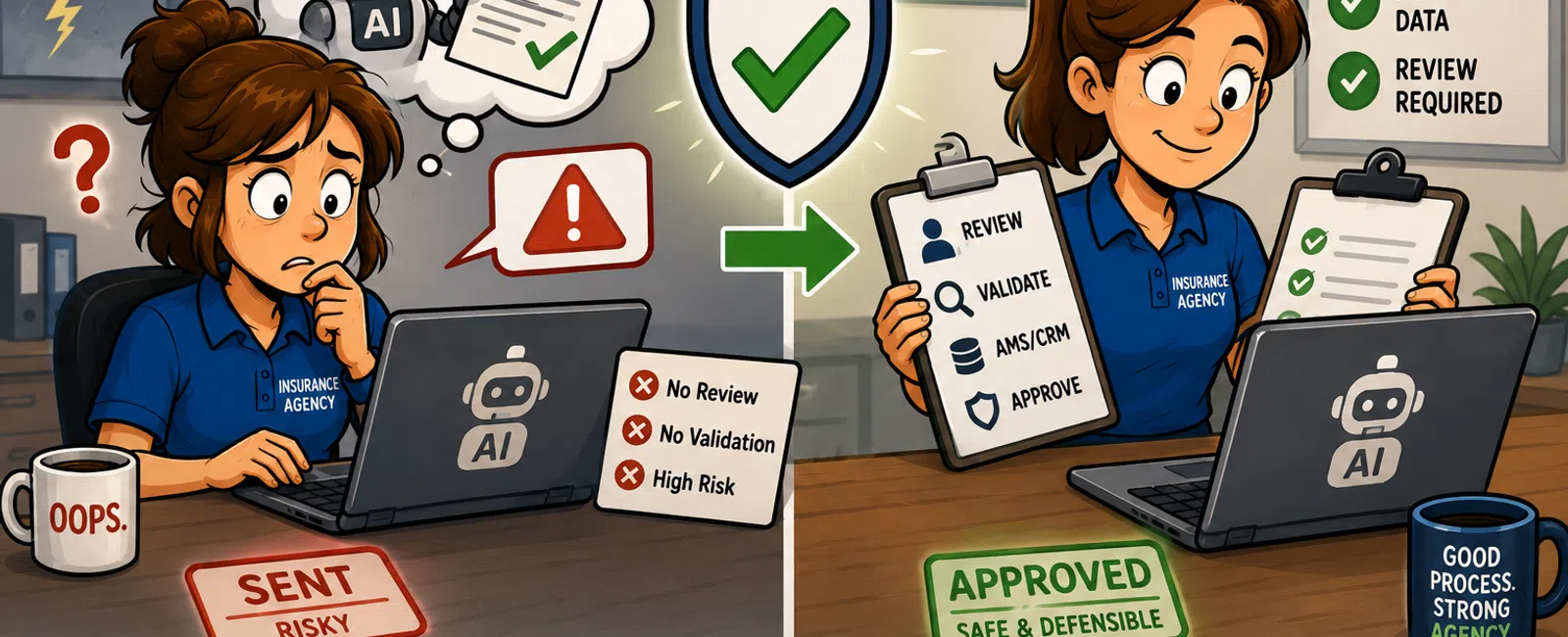
Before
A producer drafts a renewal proposal using AI.
No validation step exists.
The content looks correct.
It gets sent.
The client finds the mistake.
Now your team is explaining why something inaccurate left your office.
After
The same producer drafts using AI.
But:
- A review step
is required
- Data is checked
against AMS360
- Approval
happens before sending
The error is caught internally.
The client never sees it.
Same technology.
Different outcome.
That difference is control.
How You Know This Is Working
A policy alone doesn't mean anything.
You need proof.
Track These Three Metrics
- Percentage of
AI-assisted outputs reviewed before external use
- Number of
unapproved tools identified in internal checks
- Weekly manager
spot-check completion
Simple Enforcement Model
Each manager reviews 3-5 recent client-facing documents weekly:
- Was AI used?
- Was it
reviewed?
- Was data
validated?
That creates a record.
And when someone asks how your agency controls AI, that record becomes
your answer.
The Real Risk
Most agencies aren't misusing AI.
They're just using it without structure.
That's what makes this dangerous.
Because the risk isn't obvious during drafting.
It shows up later:
- During an audit
- During a client
challenge
- During a claim
situation
And by then, it's already visible to someone else.
What You Do Next Week
Block 30 minutes with your leadership team.
Do two things:
- Run the
7-question audit
- Agree on three
enforced rules:
- Approved tools
only
- No client data
in AI
- Mandatory
review before external use
Not a full overhaul.
Just real control.
Take the Next Step
Schedule your 10 minute discovery call.
We'll walk through your current AI usage and pinpoint exactly where control is
breaking down.
911 IT will help you confirm whether your process is defensible—or already
exposed.