While You're Out of Office, Your Control Is Being Tested
Not when something breaks.
When nothing does.
When the office is quiet, the systems are still running, and the only
thing standing between "secure" and "exposed" is whether someone actually owns
what's happening behind the scenes.
That's the moment your agency gets tested.
And if something goes wrong, the conversation won't be about technology.
It will be about accountability.
The Gap That Opens Before the Weekend Starts
This doesn't begin on Saturday.
It begins when the week starts to wind down.
Access gets shared to keep things moving.
Vendors are given permissions without defined end dates.
Projects finish, but no one circles back to remove what was granted.
None of it feels risky.
Because each decision makes sense in the moment.
But together, they create a system that keeps running… without anyone
clearly in control.
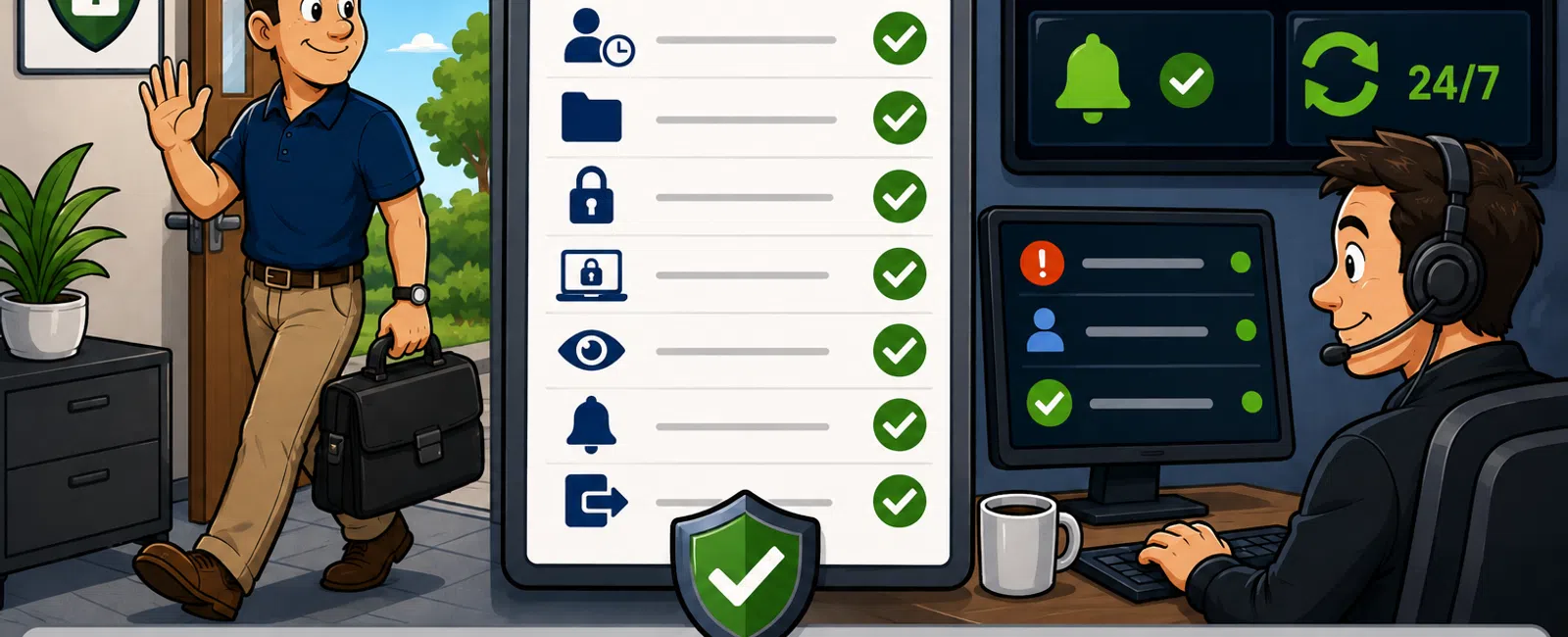
The 8-Point Pre-Weekend Control Check (Operational Version)
This is not about awareness.
This is about execution you can stand behind.
- Validate all
active access
Pull your current user list and match it to active roles today—not last week or last quarter - Remove
temporary and vendor access
Review accounts created or modified in the last 7 days and revoke anything tied to finished work - Clean up
completed project permissions
Cross-check recent tickets and confirm access was removed when work ended - Eliminate
shared credentials
Replace shared logins with named users tied to specific individuals - Enforce device
controls
Confirm endpoints are actively enforcing lock policies—not just configured once - Confirm
monitoring coverage
Verify that monitoring is active during nights and weekends—not just during business hours - Assign alert
ownership
Identify exactly who receives alerts and who is responsible for acting on them - Confirm the
response path
Define what happens if something triggers when your team is off the clock
If you can't walk through each of these clearly, the gap already exists.
Ownership Model for the 8 Checks
This is where most agencies fall apart.
Not because they don't care—but because no one is clearly assigned.
Here's how control becomes real:
- IT Provider
Owns access enforcement, monitoring tools, alert configuration, and response readiness - Operations
(You)
Owns vendor access, policy alignment, and making sure documentation reflects reality - Department
Managers
Own who should and should not have access based on actual work taking place
Without this structure, your checklist isn't a system.
It's just good intentions.
How You Prove This Was Actually Done
This is the difference between "we reviewed it" and "we can defend it."
You need proof that stands on its own:
- A record
showing access was reviewed before the weekend
- Logs confirming
users or vendors were removed
- Confirmation
that monitoring was active during off-hours
- Verification of
who receives alerts and when
Because when someone asks you to show control, they are not asking what
you remember doing.
They are asking what you can produce.
What Happens If Something Triggers on Saturday?
This is where most environments break down.
An alert fires late Saturday night.
What happens next?
Who receives it?
How fast are they expected to respond?
What counts as escalation?
Who makes the decision to act?
If those answers aren't already defined, then the alert doesn't protect
you.
It just tells you something happened after the fact.
The Most Common Misses Before a Long Weekend
Across agencies, the same patterns show up:
Shared credentials that were never cleaned up
Vendor access left active after work was done
Alerts routed to inboxes no one is actively watching
Monitoring tools running without clear ownership behind them
These aren't rare.
They're predictable.
And they're where risk quietly builds.
A Scenario That Feels Fine—Until It Isn't
A mid-sized agency heads into a three-day weekend.
Thursday:
A vendor is given access to help complete a project.
Friday:
The work wraps up. No one removes the access because it's assumed handled.
Saturday night:
A login occurs using that same account.
An alert is triggered—but routed to a shared inbox no one checks.
Monday:
Everything looks normal.
Except now you can't explain when access should have ended—or who owned
removing it.
That's where control breaks.
What You Do Next Week
Block 30 minutes on Thursday.
Run the 8-point check, but do it differently this time:
Assign ownership to each step
Identify what proof exists for completion
Call out anything that relies on assumption
Don't fix everything yet.
Just make the gaps visible.
The Right Next Step
Schedule your 10 minute discovery call.
We'll walk through your current ownership, monitoring coverage, and what
proof you can actually produce today. 911 IT will help you confirm where your
control holds—and where it quietly doesn't.