Your AI Intern Just Started on the Jobsite. Who's Supervising It?
The report looked solid.
Clean language. Confident conclusions. Exactly the kind of document that
signals a company has its act together.
Then someone checked the numbers.
The production rates didn't match anything the company had ever achieved.
The schedule assumed manpower that didn't exist. And a subcontractor scope
summary referenced terms no one had agreed to.
Nothing was hacked.
Nothing was broken.
The AI just filled in the gaps — confidently.
That report almost went out with a bid tied to a six-figure decision.
That's the risk most construction companies are running right now.
Not bad tools.
No supervision.
A Real Example
A project coordinator used AI to summarize a vendor email about updated
payment details.
Clean summary. Looked right.
The problem: the "updated" banking info came from a spoofed email thread.
No one verified it. No secondary check. No approval rule.
Two things failed:
- No verification
policy in place
- No system
enforcing who confirms payment changes
The transfer was staged before someone caught it.
Exposure was just under $180,000.
No malware. No breach.
Just a process that didn't exist.
That's where these issues break: not in the technology — in the gaps
around it.
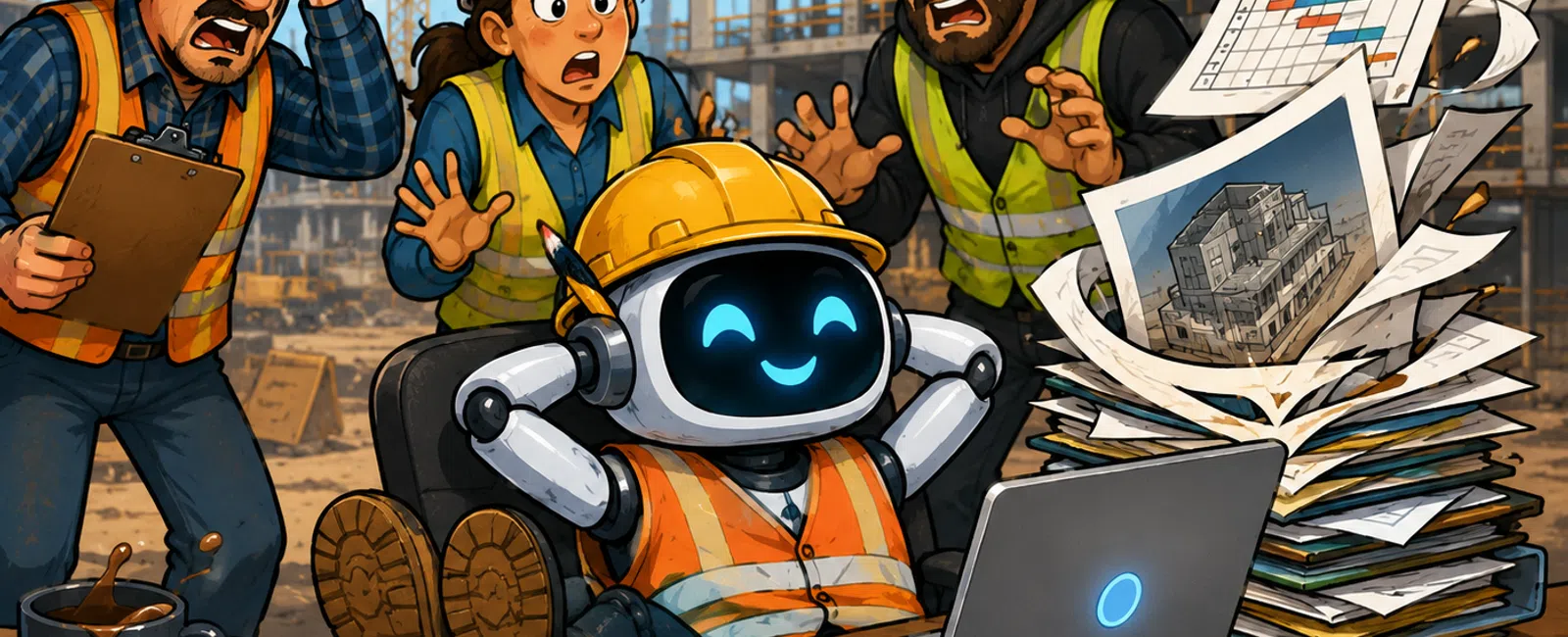
The Intern Nobody Onboarded
Right now, most companies are doing the equivalent of this:
Giving a new intern access to:
- Bid templates
- Schedules
- Financial
summaries
- Subcontractor
data
- Client
communication
And saying:
"Jump in wherever you can help."
No rules.
No boundaries.
No review.
It feels like efficiency. And it is.
But unsupervised efficiency is still risk.
Where Construction Companies Get Hit
This doesn't fail randomly. It fails in predictable places tied to how
construction actually runs.
Here's where we see it break most often:
Vendor Payment Changes
AI summarizes or rewrites email threads. A bad detail gets passed along
cleanly. Without a verification rule, it looks legitimate.
Subcontractor Onboarding Gaps
Scopes, insurance docs, and contracts get processed through AI tools. If those
tools aren't controlled, sensitive data is exposed or altered without
traceability.
Field Supervisors Using Personal Devices
Phones on job sites using personal apps or AI tools. No oversight. No logging.
No way to track what was shared or generated.
Plan Files and Shared Drives Accessed from Jobsites
Drawings and documents get moved, summarized, or distributed through AI layers
with no audit trail tied to the user.
These aren't edge cases.
This is everyday workflow in construction.
What the Unsupervised Intern Is Actually Doing
Three things happen every time AI runs without structure:
1. Sensitive Data Leaves Without Visibility
Teams paste contracts, payroll summaries, and pricing into tools they don't
control.
2. Output Gets Treated Like Fact
AI doesn't flag uncertainty. It produces clean results whether it's right or
not.
3. No One Can Track What Happened
No logs. No ownership. No accountability.
From an audit standpoint, that's exposure.
How This Gets Judged When It Goes Sideways
If a claim, dispute, or financial issue lands on a desk, no one asks:
"Was this AI?"
They ask:
- Who approved
this?
- What system
enforced the process?
- Where is the
audit trail?
- Why was this
allowed to happen?
If you don't have answers tied to controls, logs, and policy, it reads as
lack of management.
Not a technology issue.
A leadership gap.
How This Is Enforced (This Is the Missing Piece)
Guidelines are not enough. This only works if the system enforces it.
Here's what that actually looks like inside a functioning operation:
- MFA is required
across systems — and cannot be bypassed
- No shared
logins — technically restricted, not just discouraged
- Approval
workflows are system-based and tracked
- File access is
logged and tied to individual users
- AI tool access
is limited to approved platforms only
If you can't prove it happened, it didn't happen.
That's how this is evaluated in the real world.
The Minimum Acceptable AI Oversight Framework
This is your baseline. Nothing fancy. Just controlled.
Approved Tools
Only listed, reviewed AI tools are allowed.
Input Boundaries
No client data
No financials
No contracts
No employee info
If it shouldn't leave your system, it doesn't go into AI.
Review Rule
AI drafts
Humans approve
Nothing external goes out without review
Non-negotiable.
Ownership
One person accountable for AI usage.
Not everyone. Not no one.
Verification Policy (Simple and Enforced)
All financial approvals require secondary verification via phone or approved
system.
Email alone is not sufficient.
Would Your Last Hire Pass This?
Run this quick check:
- Was MFA active
before they logged in?
- Did they ever
borrow or share credentials?
- Could they
properly verify a payment request?
- Do you have a
log of what they accessed or sent?
If any of those answers are unclear, the problem isn't hypothetical.
It's already inside your operation.
What We See All the Time
This is one of the most common onboarding gaps right now.
Most first-week issues with AI or new systems come down to:
- Missing MFA
- No enforced
approval rules
- No visibility
into user activity
Not complicated failures.
Basic ones.
Your Next-Week Action
This week, sit down with one person — project manager, admin, or field
lead — and ask:
"Where are you already using AI or automation in your daily work?"
Don't correct. Just listen.
That conversation will show you your real system — not the one you think
you have.
The One Thing to Do Right Now
Schedule your 10 minute discovery call with 911 IT. We'll walk through
whether your current systems actually enforce the controls you think exist.
You'll know exactly where you're exposed and what's missing.