
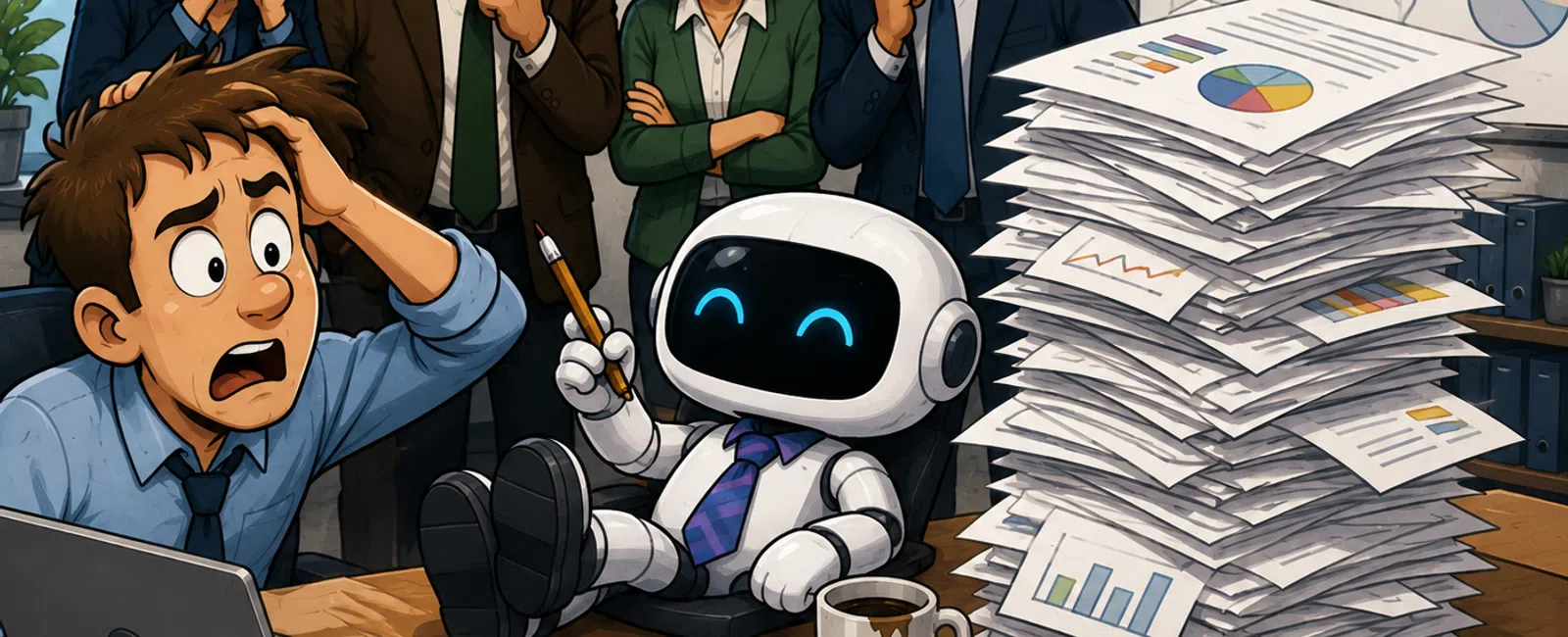
Your AI Intern Just Started. Who's Supervising It?
The proposal looked great.
Clean formatting. Strong recommendations. Confident data points that made
everything feel complete.
Then the client asked a simple question:
"Where did these numbers come from?"
No one had an answer.
Because the AI made them up.
Not vaguely. Not accidentally. Confidently and in detail.
The Real Problem Isn't AI
It's the Lack of Ownership
Right now, AI is being introduced into businesses quietly.
Someone uses it to draft a proposal.
Someone else uses it to summarize a report.
Another person uses it to clean up an email.
It works. It saves time. It feels like progress.
But no one is asking the question that actually matters:
Who is responsible for what it produces?
The False Assumption
"It's Just Helping"
That's how it feels.
Like a faster way to write.
A shortcut to organize thoughts.
A tool that fills in gaps.
But AI doesn't just assist. It creates.
It produces finished work.
It fills missing information.
It completes ideas that were never fully formed.
And it does it with confidence — whether it's right or wrong.
What Goes Wrong Without Structure
When AI is used without clear boundaries, the same problems show up again
and again.
Information Leaves Without Notice
People paste content into AI tools to move faster:
- Client details
- Financial
summaries
- Internal
documents
It feels efficient.
But now that information has left your controlled environment.
Tools Multiply Without Visibility
Different employees use different platforms.
No approval.
No consistency.
No awareness.
Now your business has tools connected to sensitive work that no one is
tracking.
Output Gets Trusted Too Fast
This is where things break.
The content looks polished.
The tone sounds right.
The structure feels complete.
So it moves forward.
That's how incorrect information ends up in front of clients.
A Situation That Happens Under Pressure
A team member is building a proposal on a tight deadline.
They use AI to generate market insights to strengthen their
recommendation.
The output includes specific statistics that make the proposal more
convincing.
They assume it's based on real data.
No one verifies it.
The proposal goes out.
Now the issue isn't accuracy.
It's credibility.
What "Supervised AI" Actually Looks Like
You don't need a complicated policy.
You need a system that assumes people will use AI — and protects the
business when they do.
The Minimum AI Control Checklist
Start here:
- Approved tools
are clearly defined
- AI is used for
drafting, not final output
- Every
deliverable is reviewed before being shared
- Clear rules
exist for what data is never entered
- One person owns
AI usage and oversight
If any of these are missing, you're relying on assumptions instead of
structure.
The External Lens Most Teams Miss
Imagine someone evaluating your business from the outside.
They wouldn't ask if AI is saving time.
They would ask:
- Do you know
which tools your team is using?
- Is sensitive
data being controlled?
- Is all output
reviewed before it reaches a client?
- Is someone
accountable for what AI produces?
Those answers determine whether AI is helping your business — or quietly
exposing it.
Why This Gets Overlooked
No one is ignoring this intentionally.
It usually sounds like:
- "We'll
formalize it later"
- "Everyone's
just experimenting"
- "It's working,
so we'll deal with it later"
But AI doesn't wait for structure.
It scales whatever is already happening.
If your process is unclear, it accelerates the problem.
What To Do Next Week
Pick one workflow where AI is already being used.
Review four things:
- What tool is
being used
- What data is
being entered
- What output is
being created
- Whether anyone
is reviewing it
Fix one gap before it becomes normal.
You don't need a full policy yet.
You need one controlled process.
The Bottom Line
AI doesn't create risk on its own.
It exposes gaps that already exist.
And when something that capable shows up without ownership, it doesn't
slow down and wait.
It moves forward anyway.
Your Next Step
Schedule your 10 minute discovery call with 911 IT to review how AI is
currently being used across your business.


