
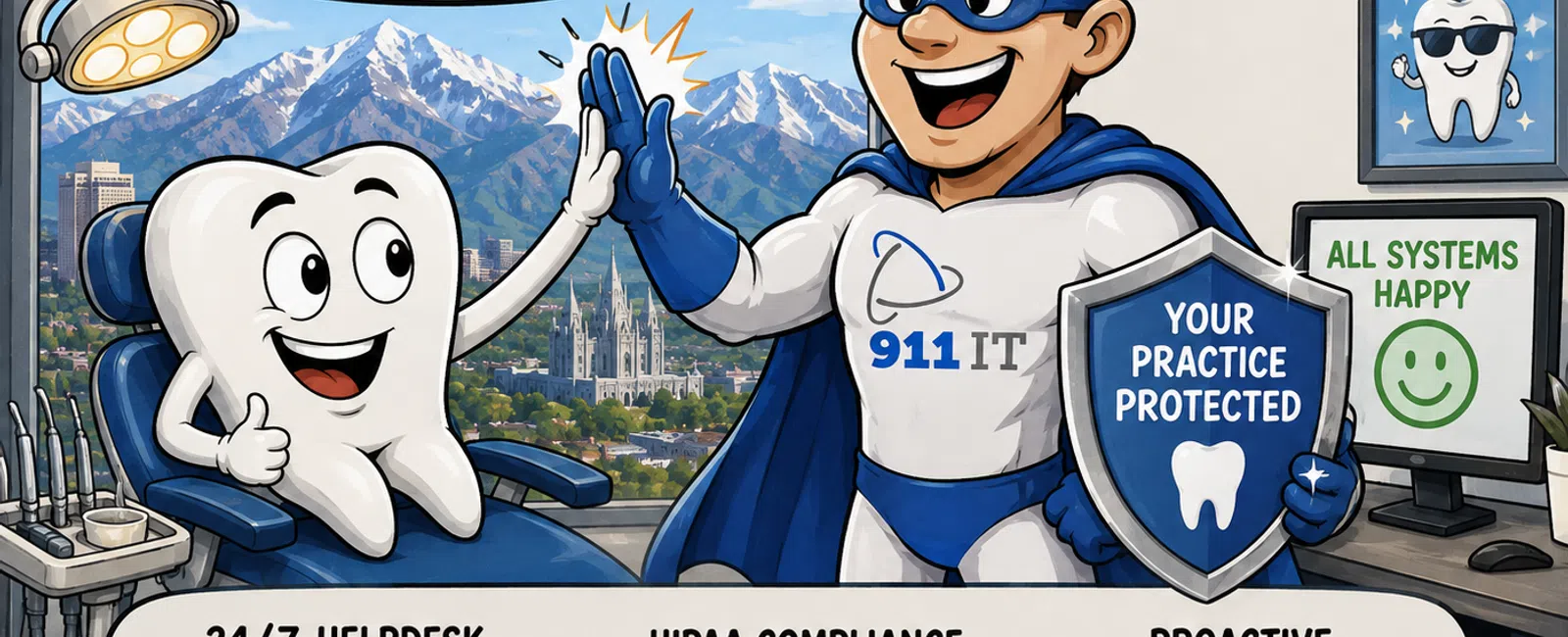
911 IT delivers comprehensive managed IT services specifically designed for Salt Lake City dental practices, offering 24/7 helpdesk support, HIPAA compliance expertise, and proactive monitoring of practice management systems. With a local South Jordan office at 1124 South Jordan Pkwy and a 100% Satisfaction Guarantee, 911 IT provides rapid on-site response for chair-side technology failures. Their flat-rate transparent pricing eliminates surprise bills while supporting dental-specific software including Dentrix, Eaglesoft, and digital imaging systems.
Why Do Salt Lake City Dental Practices Need Specialized IT Support?
Dental practices operate fundamentally different technology ecosystems than typical businesses. Your practice management software, digital radiography systems, intraoral cameras, and CAD/CAM equipment must function flawlessly during patient hours - there's no "try again tomorrow" when a patient is in the chair.
Salt Lake City's competitive dental market demands modern patient experiences. Utah residents expect online scheduling, patient portals, digital treatment plans, and secure communication channels. When your technology fails, you're not just losing productivity - you're losing patient trust and revenue.
HIPAA compliance adds another layer of complexity. Protected Health Information (PHI) flows through your practice management system, email, patient portals, and backup systems. A single compliance gap can result in OCR audits and penalties ranging from thousands to millions of dollars.
Generic IT providers rarely understand the nuances of dental technology. They don't know how periodontal charting integrates with your EHR, why your PACS system requires specific network configurations, or how to troubleshoot chair-side tablet connectivity without disrupting patient care.
Garry from an engineering firm experienced this specialized support firsthand: "911 IT has been a local, personable partner that truly listens and works with us on detailed requests and advanced security compliance needs specific to our niche. Their team is humble, well-trained, and incredibly responsive especially when critical support issues arise."
No major outages while maintaining advanced security compliance requirements.
Local presence matters in Salt Lake City. When your digital X-ray system fails or your server crashes, you need someone who can arrive on-site within hours, not days. Remote-only providers can't physically troubleshoot hardware failures or network infrastructure issues that require hands-on intervention.
Specialized dental IT support protects your practice's operational continuity and compliance posture simultaneously.
What Should Dental Practices Look for in a Managed IT Provider?
HIPAA compliance expertise is non-negotiable. Your IT provider must understand Business Associate Agreements (BAAs), Security Risk Assessments (SRAs), encryption requirements, and breach notification procedures. They should conduct regular compliance audits and maintain documentation that satisfies OCR requirements.
Look for providers with proven experience supporting dental-specific software. Your practice management system - whether Dentrix, Eaglesoft, Open Dental, or Curve - is your operational backbone. The IT team must understand database management, backup procedures, claim processing workflows, and integration points with imaging systems.
24/7 support availability is critical. Dental emergencies don't follow business hours, and neither do technology failures. You need a provider offering round-the-clock helpdesk access with technicians who understand dental practice workflows.
Proactive monitoring prevents disasters. The best providers don't just respond to problems - they identify and resolve issues before they impact patient care. Server health monitoring, backup verification, security patch management, and network performance tracking should happen continuously.
Christian from a legal firm discovered the value of consolidated services: "We love that 911 IT provides IT, phone, and hosting services. I didn't realize how interconnected those services were and what a pain it was to try and work with three different providers before we started working with 911 IT."
Transparent pricing models eliminate budget surprises. Flat-rate monthly pricing allows you to predict IT costs accurately, unlike break-fix models where every support call generates an invoice. Industry-standard managed IT services for dental practices typically range from $100 - $250 per user per month, depending on service scope and practice size.
Local presence in the Salt Lake City area enables faster emergency response. When chair-side technology fails during patient hours, you can't wait for a technician to fly in from another state. Providers with South Jordan or Salt Lake offices can reach your practice quickly.
Choose providers who treat your practice as a partnership, not just another account.
How Does 911 IT Support Dental Practice Technology?
911 IT provides comprehensive HIPAA compliance services tailored specifically for dental practices. This includes conducting Security Risk Assessments, implementing required safeguards, maintaining Business Associate Agreements, and documenting compliance activities that satisfy OCR audit requirements.
Their team supports all major dental practice management systems and EHR platforms. Whether you're running Dentrix, Eaglesoft, Open Dental, Curve, or another system, 911 IT's technicians understand the software architecture, backup requirements, and integration points with digital imaging and patient communication tools.
24/7 helpdesk support means your practice never faces technology problems alone. When your appointment scheduling system freezes during morning check-in or your digital radiography system fails mid-appointment, you can reach a live technician immediately - not an answering service or ticket system.
Proactive monitoring identifies problems before they disrupt patient care. 911 IT continuously monitors server health, backup completion, security threats, and network performance. When issues emerge, they're often resolved before your staff even notices.
Remote support capabilities minimize downtime. Most technical issues can be diagnosed and resolved remotely, eliminating wait times for on-site visits. When physical intervention is required, 911 IT's Salt Lake City location enables rapid response.
Data backup and disaster recovery services protect your practice's most valuable asset - patient records. 911 IT implements redundant backup systems with regular testing to ensure your practice can recover quickly from hardware failures, ransomware attacks, or natural disasters.
VoIP phone services integrate seamlessly with your practice management system, enabling features like automatic patient record pop-ups when calls arrive, call recording for quality assurance, and reliable communication infrastructure that supports telehealth consultations.
Cybersecurity services protect your practice from increasingly sophisticated threats. Ransomware attacks specifically target healthcare providers because patient care urgency creates pressure to pay ransoms. 911 IT implements multi-layered security including endpoint protection, email filtering, security awareness training, and network monitoring.
Adam from an accounting firm experienced this reliability: "This company is the go-to for IT services. They always have someone who is willing to help if not immediately, within the next 24 hours. They know how to fix everything, and their services are wonderful."
The 100% Satisfaction Guarantee demonstrates 911 IT's commitment to dental practice success.
What Are the Costs for Dental Practice IT Services in Salt Lake City?
Managed IT services pricing for dental practices typically follows a per-user model, with industry averages ranging from $100 - $250 per user per month for comprehensive coverage. This includes 24/7 helpdesk support, proactive monitoring, security management, backup services, and compliance assistance.
Practice size significantly impacts total monthly costs. A solo practitioner with three staff members faces different pricing than a multi-doctor practice with 15 team members. However, per-user pricing scales predictably, making budget planning straightforward.
HIPAA compliance services add specialized value for dental practices. Industry-standard compliance services range from $50 - $200 per user per month depending on the framework complexity and required documentation. This investment protects against penalties that can reach hundreds of thousands of dollars for violations.
Cybersecurity enhancements beyond basic protection typically cost $25 - $75 per user per month. Advanced endpoint detection and response (EDR), managed detection and response (MDR), security information and event management (SIEM), and regular security awareness training fall into this category.
VoIP phone services for dental practices generally range from $20 - $40 per user per month. This includes the phone system, features like call recording and patient record integration, and ongoing support.
Backup and disaster recovery services cost approximately $10 - $30 per user per month. For dental practices, this investment is critical - losing patient records, treatment histories, and billing information can devastate operations.
One-time project costs apply for practice transitions, server migrations, or new location buildouts. IT project work typically ranges from $150 - $250 per hour, though many providers offer fixed-price quotes for defined projects.
911 IT's flat-rate transparent pricing model eliminates surprise invoices. You know exactly what you'll pay each month, allowing accurate budget forecasting without worrying about hourly charges accumulating during support calls.
Break-fix models may seem cheaper initially but often cost more over time. When you're paying $150 - $300 per hour for reactive support, a single server failure can generate thousands in emergency service fees. Proactive managed services prevent these expensive crises.
Transparent pricing protects your practice's financial predictability.
How Quickly Can Dental IT Issues Be Resolved in Salt Lake City?
Response time expectations vary by issue severity and provider capabilities. For practice-critical failures - systems that prevent patient care - you need immediate response, not next-business-day callbacks.
911 IT's 24/7 live support means you reach a real technician immediately, not an answering service. When your practice management system crashes during patient hours or your digital radiography system fails mid-appointment, every minute counts.
Remote support resolves most issues within minutes to hours. Password resets, software troubleshooting, network connectivity problems, and many other common issues can be diagnosed and fixed remotely without waiting for on-site visits.
On-site response times depend on provider location and staffing. 911 IT's South Jordan office at 1124 South Jordan Pkwy enables rapid physical response to Salt Lake City dental practices when hands-on intervention is required for hardware failures or infrastructure problems.
Proactive monitoring prevents many emergencies entirely. When 911 IT's systems detect failing hard drives, backup failures, security threats, or performance degradation, they address issues before they disrupt patient care.
Christian's experience illustrates this efficiency: "I really appreciate that 911 IT can diagnose and fix problems remotely. With their remote service, our downtime is minimal, which saves us time."
After-hours support is particularly valuable for dental practices. When you're catching up on charting after patient hours or your team is preparing for the next day, having immediate IT support available prevents delays that would otherwise carry into patient care time.
Disaster recovery speed depends on preparation quality. Practices with properly configured backup systems and tested recovery procedures can restore operations within hours after catastrophic failures. Without these preparations, recovery can take days or weeks.
Communication during outages matters as much as technical resolution. Your IT provider should keep you informed about problem diagnosis, resolution steps, and estimated timelines so you can manage patient scheduling and staff expectations.
Fast response times protect both patient care quality and practice revenue.
What Compliance Requirements Must Salt Lake City Dental Practices Meet?
HIPAA compliance is the primary federal requirement for dental practices handling electronic Protected Health Information (PHI). The Security Rule mandates administrative, physical, and technical safeguards to protect patient data confidentiality, integrity, and availability.
Security Risk Assessments (SRAs) must be conducted regularly to identify vulnerabilities in your practice's technology infrastructure. These assessments examine access controls, encryption implementation, backup procedures, and potential security gaps.
Business Associate Agreements (BAAs) are legally required with any vendor who handles PHI on your behalf. Your IT provider, practice management software vendor, email hosting service, backup provider, and other technology partners must sign BAAs accepting HIPAA obligations.
Encryption requirements apply to PHI both at rest (stored data) and in transit (data moving across networks). Your patient records, email communications, backup files, and any portable devices containing PHI must use appropriate encryption standards.
Access controls ensure only authorized staff members can view patient information. Role-based permissions, unique user credentials, automatic logoff timers, and audit logging help satisfy this requirement.
Breach notification procedures must be established before incidents occur. If PHI is compromised, you have specific timeframes to notify affected patients, the Department of Health and Human Services, and potentially the media depending on breach scope.
Utah follows federal HIPAA regulations without additional state-specific healthcare IT mandates, simplifying compliance compared to states with supplementary requirements. However, this doesn't reduce the importance of thorough HIPAA adherence.
Regular security awareness training for all staff members is required. Your team must understand PHI handling procedures, recognize phishing attempts, follow password policies, and know how to report potential security incidents.
Documentation of all compliance activities is critical for OCR audits. You must maintain records of risk assessments, policy updates, training completion, incident responses, and remediation actions.
PCI compliance applies if your practice accepts credit card payments. While less complex than HIPAA for most dental practices, PCI compliance still requires specific security controls around payment processing systems.
- Conduct Security Risk Assessments at least annually
- Maintain Business Associate Agreements with all vendors handling PHI
- Implement encryption for data at rest and in transit
- Establish role-based access controls with unique user credentials
- Document all compliance activities for OCR audits
- Provide regular security awareness training for staff
- Create breach notification procedures before incidents occur
Non-compliance penalties are substantial. HIPAA violations can result in fines from $100 to $50,000 per violation, with annual maximums reaching $1.5 million per violation category. OCR increasingly targets healthcare providers with compliance audits.
Comprehensive compliance requires specialized IT expertise beyond general business technology support.
Frequently Asked Questions
How do you ensure our dental practice stays HIPAA compliant with all the changing regulations?
911 IT conducts regular Security Risk Assessments, maintains current Business Associate Agreements, implements required technical safeguards including encryption and access controls, provides ongoing security awareness training for your staff, and documents all compliance activities. Their team stays current with HIPAA updates and proactively adjusts your security posture to meet evolving requirements, protecting your practice from costly violations and OCR audits.
What happens if our practice management software goes down during patient hours?
911 IT's 24/7 helpdesk provides immediate support when practice-critical systems fail. Their technicians can diagnose and resolve most issues remotely within minutes to hours. For hardware failures requiring physical intervention, their South Jordan location enables rapid on-site response to Salt Lake City practices. Proactive monitoring often identifies potential failures before they occur, and robust backup systems ensure quick recovery from catastrophic events.
Can you support our specific dental software like Dentrix or Eaglesoft?
Yes, 911 IT supports all major dental practice management systems including Dentrix, Eaglesoft, Open Dental, Curve, and others. Their technicians understand dental software architecture, database management, backup requirements, and integration with digital imaging systems. This specialized knowledge ensures your EHR and practice management software receives expert support rather than generic troubleshooting from providers unfamiliar with dental technology ecosystems.
How quickly can you respond to emergency IT issues in Salt Lake City?
911 IT provides 24/7 live helpdesk support with immediate technician access - not answering services or ticket systems. Most issues are resolved remotely within minutes to hours. For problems requiring physical intervention, their South Jordan office at 1124 South Jordan Pkwy enables rapid on-site response to Salt Lake City dental practices. Proactive monitoring prevents many emergencies by identifying and resolving issues before they disrupt patient care.
What does managed IT service cost for a dental practice?
Industry-standard managed IT services for dental practices typically range from $100 - $250 per user per month, depending on service scope and practice size. 911 IT offers flat-rate transparent pricing that includes 24/7 helpdesk support, proactive monitoring, security management, backup services, and compliance assistance. This predictable monthly cost eliminates surprise invoices and allows accurate budget forecasting, unlike break-fix models where emergency support generates expensive hourly charges.
Do you provide on-site support or only remote assistance?
911 IT provides both remote and on-site support. Most technical issues can be diagnosed and resolved remotely, minimizing downtime and eliminating wait times for technician visits. When hardware failures, network infrastructure problems, or other issues require physical intervention, their South Jordan location enables rapid on-site response to Salt Lake City dental practices. This hybrid approach delivers the fastest possible resolution regardless of problem type.


