
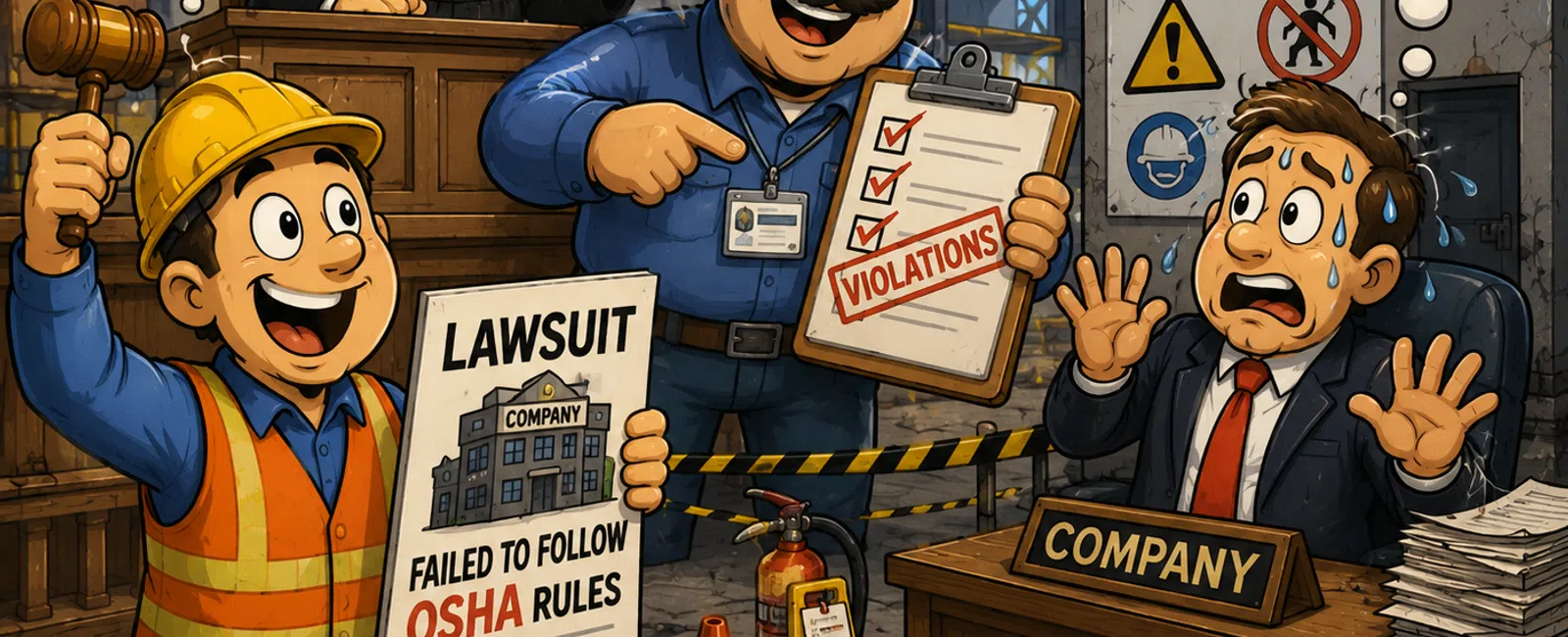
You cannot sue a company directly for OSHA violations because OSHA is enforced by federal and state agencies, not through private lawsuits. However, if an OSHA violation causes injury, you may sue for negligence, personal injury, or third-party liability. OSHA citations can result in fines up to $156,259 per willful violation as of 2026.
Who Actually Enforces OSHA Regulations?
OSHA enforcement falls to the U.S. Department of Labor's Occupational Safety and Health Administration at the federal level, with some states operating their own OSHA-approved programs. Utah operates under federal OSHA jurisdiction, while Arizona and Wyoming have state-specific plans that must meet or exceed federal standards.
When OSHA receives a complaint or conducts an inspection, the agency issues citations directly to employers. These citations carry financial penalties but do not create a private right of action for employees or third parties to sue.
Construction sites face particular scrutiny. OSHA's Focus Four hazards - falls, struck-by objects, electrocutions, and caught-in/between accidents - account for more than half of construction fatalities. Inspectors prioritize these risks during site visits.
For construction firms in Salt Lake City and across Utah, maintaining OSHA compliance isn't just about avoiding fines. It's about protecting workers and preserving your ability to bid on projects that require safety certifications.
OSHA conducted 33,393 federal inspections in fiscal year 2025, with construction representing the largest industry sector inspected.
When Can You Sue for Workplace Injuries Related to OSHA Violations?
While you can't sue solely for an OSHA violation, you can pursue legal action if that violation causes harm. Workers' compensation typically covers employee injuries, but several exceptions allow additional lawsuits.
Third-party liability claims arise when someone other than your employer causes your injury. On construction sites, this might include equipment manufacturers, subcontractors, or property owners. If a defective scaffold collapses due to an OSHA-violating design flaw, you could sue the manufacturer.
Intentional tort claims apply when an employer deliberately causes harm or knowingly maintains dangerous conditions. These cases are rare but bypass workers' compensation exclusivity. Proving intent requires showing the employer knew about the hazard and consciously disregarded worker safety.
Gross negligence claims in some states allow employees to sue when employer conduct goes beyond ordinary negligence. This threshold is high - typically requiring reckless disregard for safety that's substantially certain to cause injury.
OSHA violations serve as powerful evidence in these lawsuits. A citation for lacking fall protection strengthens your negligence case if you're injured in a fall. Courts often admit OSHA standards as proof of the expected duty of care.
Legal action for OSHA-related injuries requires proving the violation directly caused your harm and that the employer owed you a duty of care.
How Do Construction Companies Protect Themselves from OSHA Liability?
Construction firms reduce OSHA liability through systematic safety programs, comprehensive documentation, and technology infrastructure that supports compliance tracking.
Written safety programs form the foundation. OSHA requires specific written plans for hazard communication, fall protection, personal protective equipment, and emergency action. These documents must be accessible to all employees and regularly updated.
Regular training ensures workers understand hazards and proper procedures. OSHA mandates training for specific tasks like scaffolding, confined spaces, and excavation work. Documentation of training completion protects companies during inspections.
Daily job site inspections catch hazards before they cause injuries. Competent persons - workers with OSHA-defined authority and knowledge - must inspect sites for fall hazards, electrical risks, and other dangers. Digital inspection checklists stored in cloud systems create timestamped records.
Incident investigation procedures document what happened, why, and what corrective actions were taken. This demonstrates good faith efforts to maintain safety even when accidents occur.
Technology plays an increasingly vital role. Construction management software tracks safety training expiration dates, stores inspection reports, and manages equipment maintenance schedules. But these systems only work when your IT infrastructure is reliable.
Rhonda from a construction company explained how 911 IT eliminated her panic over technology issues: "They are always available and can take care of any need we have right away. I never panic anymore when something isn't working right, I just call anyone on the team, and they pleasantly take over, and the problem is gone."
When your safety documentation system goes down during an OSHA inspection, you can't prove compliance. When project management software crashes, you lose visibility into which workers completed required training. Business continuity services ensure your compliance systems remain accessible even during outages.
Remote job sites across Utah, Wyoming, and Arizona present unique challenges. Trailer offices need secure network connections to access safety databases and submit incident reports. Construction IT support that understands job site connectivity ensures your compliance systems work everywhere your crews do.
Proactive safety management combined with reliable technology infrastructure creates defensible documentation that protects your company.
What Happens When OSHA Finds Violations at Your Construction Site?
OSHA inspections follow a structured process that begins with an opening conference, continues through a walkaround inspection, and concludes with a closing conference where inspectors discuss findings.
Citations arrive by certified mail within six months of the inspection. They describe each violation, specify the standard violated, propose penalties, and set an abatement date by which you must correct the hazard.
Violation categories determine penalty amounts:
- Other-than-serious violations: Up to $16,131 per violation for hazards unlikely to cause death or serious harm
- Serious violations: Up to $16,131 per violation when substantial probability of death or serious physical harm exists
- Willful violations: Up to $156,259 per violation when the employer knowingly violated standards
- Repeat violations: Up to $156,259 per violation for the same standard within five years
- Failure-to-abate penalties: $16,131 per day until violations are corrected
You have 15 working days to contest citations. During this period, you can negotiate with OSHA through an informal conference. Many cases settle with reduced penalties in exchange for rapid abatement and enhanced safety programs.
Uncontested citations become final orders. They appear in OSHA's public database, visible to potential clients, insurance companies, and competitors. General contractors increasingly check subcontractor OSHA records before awarding bids.
Serious or willful violations can trigger follow-up inspections. OSHA returns to verify abatement and may expand the inspection scope if they find additional hazards.
The financial impact extends beyond fines. Workers' compensation premiums increase after OSHA citations. Project delays during abatement cost money. Reputational damage affects your ability to win bids, especially for public projects or clients with strict safety requirements.
Salt Lake City's growing construction market means more competition and more scrutiny. Companies with clean OSHA records gain competitive advantages.
How Does Digital Documentation Strengthen Your OSHA Defense?
Digital safety management systems create timestamped, tamper-evident records that prove compliance efforts. Unlike paper logs that can be lost or questioned, cloud-based systems provide audit trails showing exactly when inspections occurred and who completed them.
Mobile access allows field supervisors to complete safety checklists on tablets or smartphones at the actual job site. Photos attach directly to inspection records, documenting conditions at specific times. GPS metadata proves the inspector was physically present.
Automated reminders prevent training lapses. When a worker's fall protection certification approaches expiration, the system alerts supervisors. This proactive approach prevents violations before they occur.
Centralized storage makes information instantly accessible during OSHA inspections. When an inspector asks for your hazard communication program or training records for a specific employee, you can produce them in minutes rather than hours.
Integration between systems eliminates data silos. Your project management software, safety tracking platform, and HR system should share information. When a new worker joins a project, their training requirements automatically appear in the safety system.
But digital systems create new vulnerabilities. Ransomware attacks can encrypt your entire safety database. Hardware failures can delete months of inspection records. Network outages at remote sites prevent real-time documentation.
Cybersecurity services protect your compliance data from attacks that could leave you unable to prove safety efforts. Regular backups ensure you can restore records after any incident. Managed IT services keep your systems running so documentation never stops.
Kevin, who works in construction, praised 911 IT's team for their "incredible skill and knowledge while helping me with my tech needs" and their ability to "handle even the most challenging issue with ease." That preventative approach matters for construction companies. When your safety management system fails during a critical project phase, you're not just losing productivity - you're creating compliance gaps that could surface during an inspection.
Digital documentation strengthens your defense only when the underlying technology infrastructure is reliable, secure, and properly maintained.
What Role Does Workers' Compensation Play in OSHA Violation Cases?
Workers' compensation provides the primary remedy for most workplace injuries, including those resulting from OSHA violations. This no-fault system pays medical expenses and lost wages regardless of who caused the accident.
The workers' compensation bargain trades limited benefits for employer immunity. Employees receive guaranteed compensation without proving negligence, while employers gain protection from most lawsuits. This arrangement prevents employees from suing for OSHA violations.
Exceptions to exclusivity allow additional lawsuits in specific circumstances. Intentional torts, third-party liability, and gross negligence claims can proceed alongside workers' compensation in some states.
Utah follows the exclusive remedy doctrine strictly. Workers' compensation is typically the sole remedy for workplace injuries unless you can prove intentional harm. Arizona and Wyoming have similar approaches with slight variations in their gross negligence thresholds.
OSHA violations don't automatically overcome workers' compensation exclusivity. Even if your employer violated multiple OSHA standards, you'll likely receive only workers' compensation benefits unless you can prove one of the narrow exceptions.
However, OSHA violations significantly impact workers' compensation proceedings. They can increase benefit awards, affect employer premium rates, and influence settlement negotiations. Insurance carriers scrutinize OSHA citations when setting rates.
For construction companies, this means OSHA compliance directly affects insurance costs. A serious citation can increase workers' compensation premiums by 10-30% or more, depending on severity and frequency.
Subcontractor agreements often include indemnification clauses for OSHA violations. General contractors may require subcontractors to cover costs arising from safety violations. These contractual obligations create additional financial exposure beyond direct OSHA penalties.
Understanding how workers' compensation interacts with OSHA enforcement helps construction companies assess their true liability exposure.
Frequently Asked Questions
Can I sue my employer directly for an OSHA violation?
No, you generally cannot sue your employer directly for an OSHA violation. OSHA is enforced by government agencies, not through private lawsuits. Workers' compensation typically provides the exclusive remedy for workplace injuries. However, you may sue if the violation caused injury and you can prove intentional harm, third-party liability, or gross negligence in states that allow such exceptions.
What are the penalties for OSHA violations in construction?
OSHA penalties for construction violations range from $16,131 per other-than-serious or serious violation to $156,259 per willful or repeat violation as of 2026. Failure-to-abate penalties of $16,131 per day accumulate until violations are corrected. These fines increase annually for inflation. Beyond direct penalties, violations increase workers' compensation premiums and can disqualify companies from bidding on certain projects.
How long does OSHA have to issue citations after an inspection?
OSHA has six months from the inspection date to issue citations. Citations arrive by certified mail and include descriptions of violations, proposed penalties, and abatement deadlines. Employers have 15 working days to contest citations or request an informal conference. Uncontested citations become final orders and appear in OSHA's public database, visible to clients and competitors.
Do OSHA violations appear on public records?
Yes, OSHA violations appear in the agency's public database once citations become final. This searchable database includes company names, violation descriptions, penalty amounts, and abatement status. General contractors, insurance companies, and potential clients frequently check OSHA records before awarding contracts. Serious or willful violations remain visible for years and can significantly impact a construction company's reputation and bidding opportunities.
Can subcontractors be held liable for OSHA violations on a construction site?
Yes, subcontractors can be cited for OSHA violations in areas they control. OSHA holds each employer responsible for protecting its own employees and may cite multiple companies at a single site. General contractors face additional liability for site-wide hazards under the multi-employer citation policy. Contractual indemnification clauses often require subcontractors to cover costs from their violations, creating financial exposure beyond direct OSHA penalties.


