
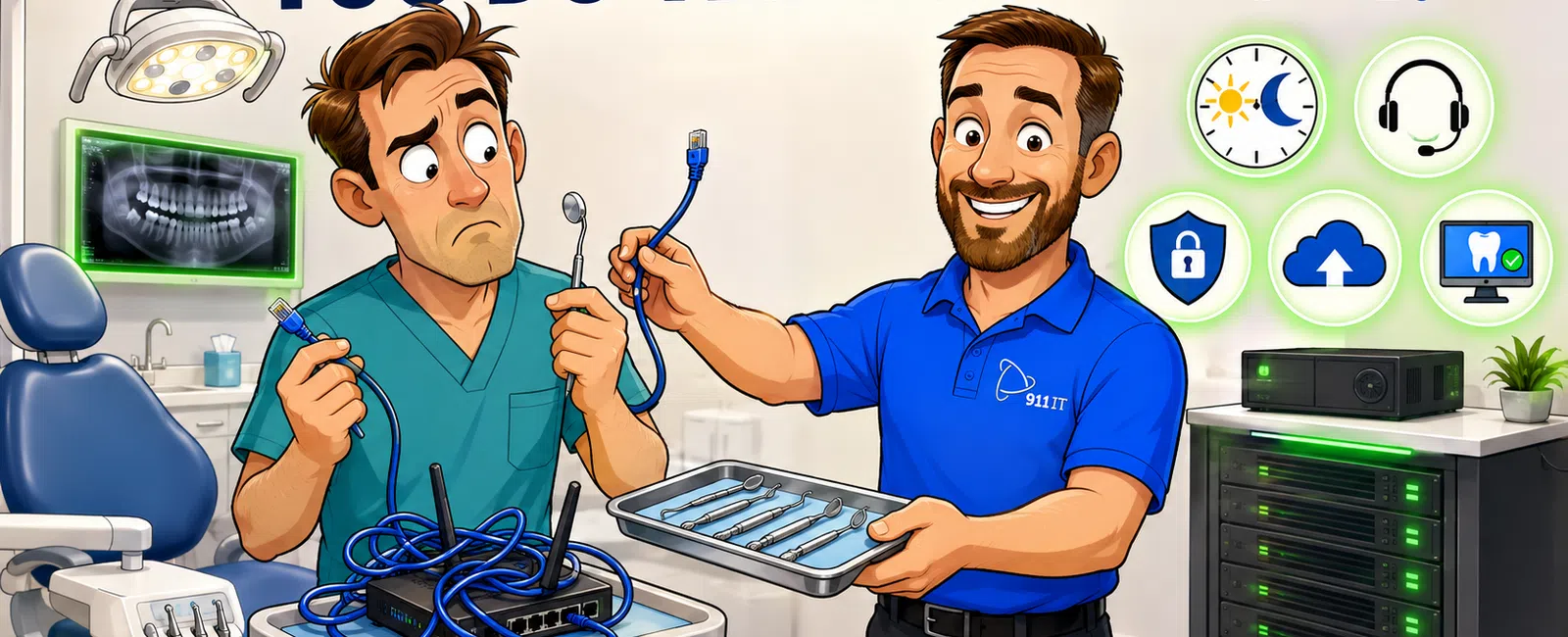
Managed IT services typically cost dental practices $100 - $250 per user monthly, while a full-time in-house IT professional averages $65,000 - $85,000 annually plus benefits - making managed services more cost-effective for practices under 15 staff members. Managed providers deliver 24/7 monitoring, HIPAA compliance expertise, and redundant coverage that single IT employees cannot match, especially critical when practice management systems control patient scheduling and billing.
Why Do Dental Practices Need Specialized IT Support?
Dental practices depend on technology for every patient interaction. Your practice management system schedules appointments, processes insurance claims, and manages billing. Digital radiography systems capture and store diagnostic images. Intraoral cameras and CAD/CAM systems require network connectivity to treatment planning software.
When any component fails during patient hours, your operatories sit idle. A downed server means no access to patient charts, treatment histories, or insurance verification. Chair-side technology failures force you to reschedule procedures, damaging patient trust and practice revenue.
HIPAA regulations add another layer of complexity. Your IT infrastructure must encrypt patient data at rest and in transit, maintain audit logs, implement access controls, and document security risk assessments. The Office for Civil Rights levies substantial fines for violations - even unintentional breaches caused by misconfigured systems.
Salt Lake City dental practices face additional pressure from tech-savvy patients who expect online scheduling, patient portals, and digital communication. Your IT infrastructure must support these patient-facing technologies while maintaining security and compliance.
Specialized dental software like Dentrix, Eaglesoft, and Open Dental requires expertise beyond general IT knowledge. These systems integrate with imaging hardware, payment processors, and clearinghouses for claim submission. Configuration errors can disrupt your entire revenue cycle.
What Are the Hidden Costs of Hiring In-House IT for Dental Offices?
Salary represents just the starting point. A qualified IT professional with healthcare experience commands $65,000 - $85,000 annually in the Salt Lake City market. Add health insurance, retirement contributions, paid time off, and payroll taxes, and your true cost reaches $85,000 - $110,000.
Training expenses accumulate quickly. HIPAA regulations evolve, dental software releases updates quarterly, and cybersecurity threats change daily. Sending your IT staff to conferences, certification courses, and vendor training sessions costs $3,000 - $8,000 annually.
Single points of failure create risk. When your IT person takes vacation, gets sick, or leaves for another job, your practice has zero IT coverage. Emergency situations during their absence require expensive after-hours support from outside contractors at $150 - $300 per hour.
Tool and software licensing add up. Your IT staff needs remote monitoring software, security tools, backup systems, and diagnostic utilities. These subscriptions cost $5,000 - $12,000 annually for a single-location practice.
Knowledge gaps are inevitable. One person cannot master every technology your practice uses - from network infrastructure to dental imaging systems to VoIP phones to cybersecurity. When complex problems arise outside their expertise, you still need outside specialists.
A 10-person dental practice spending $95,000 annually on in-house IT could access comprehensive managed services for $12,000 - $30,000 yearly.
Recruitment and turnover create additional costs. Finding qualified candidates takes months, during which you pay premium rates for temporary coverage. When employees leave, you repeat the cycle while institutional knowledge walks out the door.
How Do Managed IT Providers Support Dental Practice Operations?
Managed service providers monitor your entire infrastructure 24/7. Automated systems detect server issues, network slowdowns, backup failures, and security threats before they impact patient care. When your practice management system shows warning signs at 2 AM, technicians address it before your morning appointments.
Helpdesk support provides immediate assistance during patient hours. When a hygienist cannot access digital radiography images or a front desk computer freezes during check-in, your team calls a dedicated support line. Most issues resolve remotely within minutes, minimizing disruption to patient flow.
Sarah, working in healthcare, experienced this firsthand: "911 IT was phenomenal to work with! After calling tech after tech to come out to find out the issues with our phone lines, Adam came out within a few hours and FIXED our phones immediately! He took the time to LOOK what was wrong instead of just glancing at the issues and bidding us out at thousands of dollars."
Proactive maintenance prevents emergencies. Managed providers apply software patches, update antivirus definitions, test backups, and replace failing hardware before complete failure. This approach reduces unexpected downtime that forces appointment cancellations.
Compliance management becomes systematic. Providers document security risk assessments, implement required safeguards, maintain Business Associate Agreements, and generate audit reports. HIPAA compliance services ensure your practice meets regulatory requirements without hiring a dedicated compliance officer.
Dental software expertise matters. Quality managed providers understand how Dentrix integrates with imaging systems, how Eaglesoft connects to clearinghouses, and how Open Dental synchronizes with patient portals. They troubleshoot software-specific issues that general IT staff struggle with.
Scalability supports practice growth. Adding a new operatory, opening a second location, or acquiring another practice requires network expansion, additional workstations, and software licensing. Managed providers scale resources up or down based on your needs without hiring additional staff.
Disaster recovery planning protects your practice. Providers implement redundant backups, test restoration procedures, and document recovery processes. When ransomware strikes or hardware fails catastrophically, you have a clear path to resume operations quickly.
Which IT Model Handles Dental-Specific Technology Challenges Better?
Practice management system integration requires specialized knowledge. Your PMS connects to digital imaging systems, intraoral cameras, payment processors, insurance clearinghouses, and patient communication platforms. Managed providers supporting multiple dental practices encounter and solve integration issues regularly.
In-house IT staff learn through trial and error on your single practice. Each integration problem becomes a learning experience that costs your practice time and money. Managed providers apply solutions they have already developed for similar practices.
Digital imaging systems demand specific expertise. PACS configuration, sensor calibration, and image quality troubleshooting require understanding dental radiography workflows. Managed providers with dental clients maintain relationships with imaging vendors and access their technical support channels.
Chair-side technology failures need immediate resolution. When a CAD/CAM system stops communicating with your milling unit during a crown preparation, you cannot wait hours for diagnosis. Managed providers maintain documentation of your specific equipment configurations and troubleshoot faster.
Insurance claim processing depends on reliable connectivity. Your practice management system submits claims electronically to clearinghouses. Network issues, software misconfigurations, or security certificate problems can halt your revenue cycle. Managed providers monitor these connections continuously.
Patient portal functionality affects patient satisfaction. When patients cannot access treatment plans, make payments, or schedule appointments online, they contact your front desk. Managed providers ensure portal integrations remain functional and troubleshoot authentication issues quickly.
Cybersecurity threats target healthcare practices specifically. Ransomware attacks encrypt patient records and demand payment for decryption keys. Phishing emails impersonate dental suppliers or insurance companies. Cybersecurity services implement layered defenses that single IT employees cannot maintain alone.
Managed providers deliver better outcomes for dental-specific technology because they accumulate expertise across multiple practices and maintain vendor relationships that individual practices cannot access.
How Does Each Model Impact Patient Care and Practice Revenue?
Downtime directly reduces revenue. Each operatory generates $500 - $1,200 per day in production. When technology failures prevent treatment, you lose that production permanently. You cannot reschedule every patient, and some seek care elsewhere.
In-house IT staff work business hours. A server failure at 7 PM means no access to patient records until your IT person arrives the next morning. Your evening hygiene appointments cannot proceed, costing $1,000 - $2,000 in lost production.
Managed providers offer 24/7 monitoring and support. Issues detected overnight get resolved before morning appointments. Emergency support during evenings and weekends keeps your practice operational during extended hours that many dental offices now offer.
Patient experience suffers from technology problems. Waiting while staff troubleshoot computer issues, rescheduling because imaging systems are down, or repeating information because records are inaccessible creates frustration. Patients remember these experiences when choosing providers.
Preventive maintenance reduces interruptions. Managed providers replace aging equipment before failure, apply updates during off-hours, and test systems regularly. In-house IT staff juggling daily support requests often defer maintenance until problems force action.
Insurance claim processing delays affect cash flow. When claim submission systems malfunction, your accounts receivable ages. Managed providers monitor clearinghouse connections and resolve transmission errors quickly, maintaining steady revenue flow.
Treatment planning efficiency depends on reliable technology. Dentists present treatment plans using digital imaging, intraoral photos, and planning software. Technical glitches during case presentations undermine patient confidence and reduce case acceptance rates.
Multi-location practices face coordination challenges. In-house IT staff at each location work independently, implementing different solutions and creating inconsistent patient experiences. Managed providers standardize technology across locations, enabling centralized management and reporting.
Practice growth requires technology investment. Opening new operatories, implementing new services like clear aligner therapy, or adding cone beam CT scanning demands IT infrastructure expansion. Managed providers include planning and implementation expertise without additional hiring.
What Should Salt Lake City Dental Practices Evaluate Before Deciding?
Practice size determines cost-effectiveness. Practices with fewer than 15 staff members typically find managed services more economical than full-time IT employees. Larger practices or dental service organizations might justify in-house staff supplemented by co-managed IT services for specialized expertise.
Current technology complexity matters. Practices using basic practice management systems with minimal integration can manage with less IT support. Practices with digital imaging, CAD/CAM systems, patient portals, and multiple locations need more sophisticated support.
Growth plans affect your decision. If you plan to open additional locations, acquire other practices, or significantly expand services, managed providers scale more easily than hiring additional IT staff for each location.
Compliance requirements create ongoing work. HIPAA mandates security risk assessments, policy documentation, staff training, and incident response procedures. Managed providers with HIPAA compliance expertise handle these requirements systematically.
Risk tolerance varies by practice. Some dentists accept the single-point-of-failure risk of in-house IT staff. Others prioritize redundant coverage and 24/7 availability that managed providers deliver. Consider how technology downtime affects your specific practice and patient base.
Local presence enables rapid response. Salt Lake City practices benefit from providers with local technicians who can arrive on-site quickly when remote resolution is impossible. Salt Lake City IT support with nearby offices responds faster than remote-only providers.
Vendor relationships provide value. Established managed providers maintain relationships with dental software vendors, imaging equipment manufacturers, and clearinghouses. These relationships expedite technical support and problem resolution.
Financial predictability helps budgeting. Managed services provide flat-rate monthly costs that simplify financial planning. In-house IT involves variable expenses for training, tools, turnover, and emergency contractors that complicate budgeting.
Evaluate providers carefully using these criteria:
- Request references from other dental practices using similar practice management systems
- Verify experience with your specific dental software (Dentrix, Eaglesoft, Open Dental, etc.)
- Confirm HIPAA compliance expertise and Business Associate Agreement terms
- Understand response time commitments for both remote and on-site support
- Review service level agreements for uptime guarantees and escalation procedures
- Assess their relationships with dental technology vendors and equipment manufacturers
Consider hybrid approaches. Some practices maintain in-house IT staff for daily support while contracting managed providers for after-hours monitoring, backup management, cybersecurity, and specialized projects. This model provides on-site presence with expert backup.
For most Salt Lake City dental practices, managed services deliver better outcomes at lower total cost than in-house IT staff, especially when you account for coverage gaps, expertise limitations, and hidden employment costs.
Frequently Asked Questions
How quickly can managed IT providers respond to emergencies in dental practices?
Quality managed service providers offer 24/7 helpdesk support with remote resolution for most issues within 15-30 minutes. For problems requiring on-site presence, local providers like those serving Salt Lake City can typically arrive within 2-4 hours during business hours. Emergency response times should be documented in your service level agreement before signing any contract.
Can managed IT services support our specific dental software like Dentrix or Eaglesoft?
Reputable managed service providers supporting dental practices maintain expertise in major practice management systems including Dentrix, Eaglesoft, Open Dental, Curve, and others. They understand integration with imaging systems, clearinghouses, and patient portals. Always verify a provider's experience with your specific software before engagement, and request references from practices using the same system.
What happens to our patient data if we switch from in-house IT to managed services?
Managed service providers migrate your existing data without disruption to patient care. They document your current systems, plan migration timing around your schedule, and test thoroughly before cutover. Your patient records, images, and practice data remain yours - providers simply manage the infrastructure. HIPAA-compliant Business Associate Agreements protect your data legally throughout the relationship.
Do managed IT services cost more than hiring one IT person for a small dental practice?
For practices under 15 staff members, managed services typically cost less than in-house IT when you account for salary, benefits, training, tools, and coverage gaps. A 10-person practice might pay $12,000 - $30,000 annually for comprehensive managed services versus $85,000 - $110,000 for a full-time employee with benefits. Managed services also eliminate single-point-of-failure risks and provide broader expertise.
How do managed service providers ensure HIPAA compliance for dental practices?
Managed providers conduct security risk assessments, implement required technical safeguards, maintain audit logs, encrypt data at rest and in transit, manage access controls, and document policies and procedures. They execute Business Associate Agreements accepting liability for their role in handling protected health information. Compliance services typically cost $50 - $200 per user monthly depending on practice complexity and existing security posture.


