
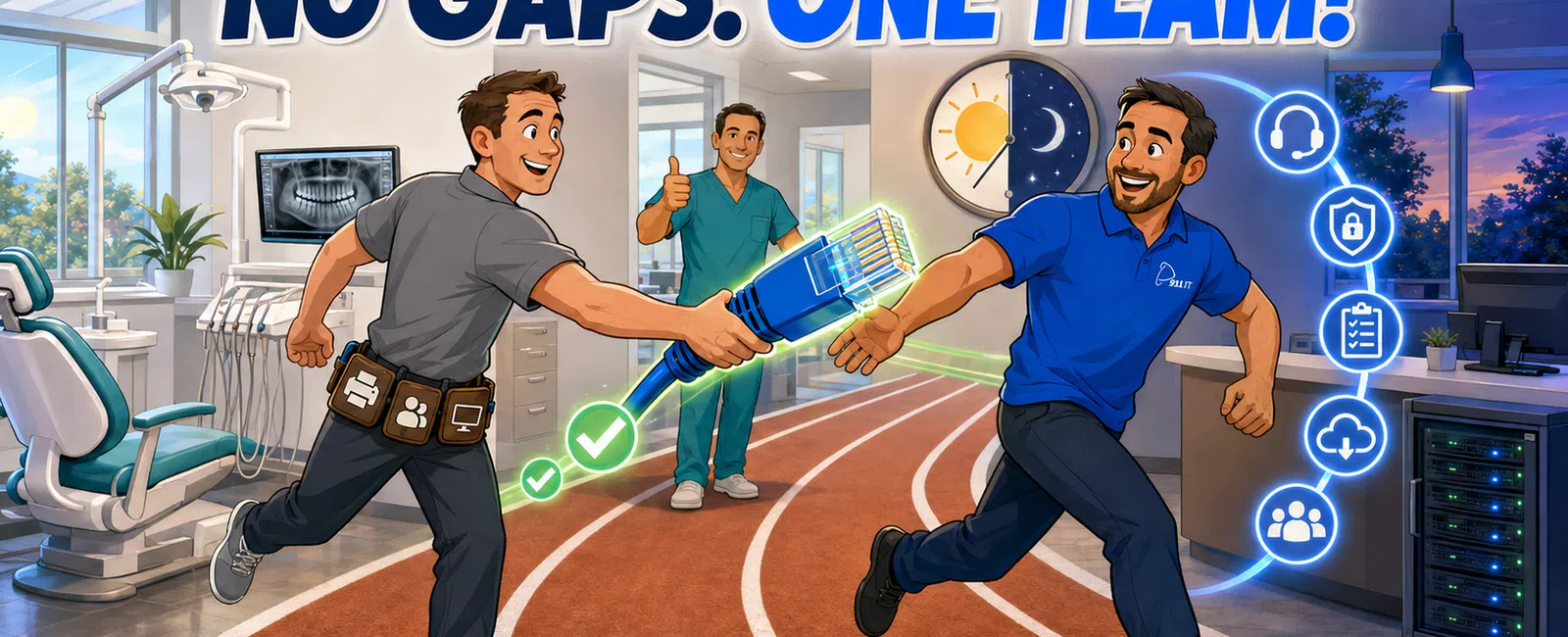
Co-managed IT for dental practices combines your existing in-house IT person or tech-savvy staff member with an external managed service provider (MSP) who handles specialized tasks like 24-7 monitoring, HIPAA compliance, cybersecurity, and escalation support. Industry pricing typically ranges from $75 - $150 per user per month, with the MSP providing backup expertise while your internal person maintains day-to-day control and patient-facing technology relationships.
What responsibilities does the MSP handle versus your in-house person?
The division of labor in co-managed IT follows a clear pattern: your in-house person owns the visible, practice-specific tasks while the MSP provides the invisible infrastructure and specialized expertise. Your staff member continues password resets, printer troubleshooting, new employee onboarding, and chair-side technology support - the tasks that require immediate physical presence and practice knowledge.
The MSP takes on continuous network monitoring, patch management, security threat detection, backup verification, and compliance documentation. These are the tasks that require specialized tools, certifications, and round-the-clock attention that a single in-house person cannot realistically provide alone.
For dental-specific systems like Dentrix, Eaglesoft, or Open Dental, the arrangement works particularly well. Your in-house person handles user training and workflow questions while the MSP ensures the database remains backed up, the server stays patched, and the network infrastructure supporting the practice management system runs optimally.
Jessie from a restoration business captures the experience: "Every time I call, they know exactly who I am and have my file pulled up in front of them ready to help. They are always in a good mood when helping me - even when my needs are super difficult - and they always get the issue solved very quickly."
This partnership eliminates the isolation many solo IT staff feel when facing complex problems beyond their expertise.
How does co-managed IT protect patient data and ensure HIPAA compliance?
HIPAA compliance requires continuous vigilance across multiple technical controls - encryption, access logs, security risk assessments, business associate agreements, and breach notification procedures. A single in-house person rarely has time to maintain all required documentation while also handling daily support tickets.
Co-managed arrangements split compliance responsibilities strategically. The MSP provides the Business Associate Agreement your practice legally requires, conducts annual Security Risk Assessments, implements encryption at rest and in transit, monitors for unauthorized access attempts, and maintains audit logs that satisfy OCR requirements during investigations.
Your in-house person focuses on the human side: training staff on PHI handling, managing user permissions as employees join or leave, ensuring workstations lock after inactivity, and maintaining the practice's policies and procedures manual.
Utah dental practices must document HIPAA compliance even without state-specific healthcare IT mandates beyond federal requirements.
The MSP typically provides 24-7 security monitoring that detects ransomware, phishing attempts, and unauthorized access in real-time - coverage impossible for a single person working business hours. When the Office for Civil Rights investigates a breach, having an MSP's documentation and monitoring logs demonstrates due diligence that can reduce penalties significantly.
911 IT's HIPAA compliance services include continuous monitoring and documentation specifically designed for healthcare practices.
What happens when your practice management system crashes during patient appointments?
The nightmare scenario for any dental practice: Dentrix freezes mid-morning with a waiting room full of patients, and your part-time IT person is unreachable or lacks the expertise to diagnose database corruption. Co-managed IT provides escalation paths that solo IT staff cannot offer.
When your in-house person encounters a problem beyond their skill level, they immediately escalate to the MSP's helpdesk. The MSP's team includes specialists who have seen hundreds of practice management system failures across dozens of dental offices - pattern recognition your single IT person will never develop.
For critical failures during patient hours, the MSP can remote in within minutes while your in-house person stays visible to staff, communicating status and managing expectations. This dual response prevents the chaos of staff standing around helplessly while patients wait.
Scott from an engineering firm describes similar partnership benefits: "911 IT's services allows us to focus on our core business by effectively and safely managing our security for our cloud-based services. As end users, we are consistently impressed by the professionalism, courtesy, and expertise of 911 IT staff."
The MSP also maintains offsite backups of your practice management database, enabling rapid restoration if local backups fail or ransomware encrypts your server. Your in-house person coordinates with staff while the MSP handles the technical recovery.
Co-managed IT transforms single points of failure into redundant support systems.
How does pricing work when you already have someone on staff?
Co-managed IT costs less than fully managed services because you're not paying for basic helpdesk coverage your in-house person already provides. Industry pricing typically ranges from $75 - $150 per user per month, compared to $100 - $250 per user for fully managed services.
The calculation depends on which services you need from the MSP. A basic co-managed package might include:
- 24-7 network monitoring and alerting
- Automated patch management for servers and workstations
- Backup verification and testing
- Escalation support for complex technical issues
- Security threat detection and response
More comprehensive packages add cybersecurity monitoring, compliance documentation, strategic planning, and unlimited helpdesk access for both your IT person and end users.
For a 10-person dental practice with one in-house IT person, co-managed IT might cost $750 - $1,500 monthly. That investment buys your IT person a safety net, professional development through MSP interaction, and the ability to take vacation without leaving the practice unprotected.
Additional services layer on top: HIPAA compliance documentation might add $50 - $200 per user monthly, cybersecurity monitoring adds $25 - $75 per user monthly, and VoIP phone services run $20 - $40 per user monthly. The modular approach lets you pay only for capabilities your in-house person cannot provide.
Most MSPs offer flat-rate pricing that makes budgeting predictable. You know exactly what IT will cost each month, eliminating surprise bills when problems arise.
Which Salt Lake City providers offer co-managed IT for dental practices?
Salt Lake City dental practices have several local options for co-managed IT, each with different strengths and ideal client profiles. The market includes both regional MSPs and smaller specialists.
911 IT provides co-managed services specifically designed for healthcare practices, with co-managed IT support that includes 24-7 monitoring, HIPAA compliance expertise, and rapid response for practice-critical systems. Their South Jordan location at 1124 South Jordan Parkway enables fast on-site response when chair-side technology fails. The company has earned recognition as a 2024 MSP Titans award winner and maintains a 100% satisfaction guarantee.
Executech serves Utah businesses across multiple industries with enterprise-grade infrastructure. Wasatch I.T. focuses on small to mid-sized businesses throughout the Salt Lake valley. Nexus IT Consultants provides IT consulting and managed services with emphasis on strategic planning.
INTELITECHS offers managed services and cybersecurity for Utah companies. ProLink IT specializes in healthcare and financial services IT support. Qual IT provides technology solutions for businesses seeking compliance-focused partnerships.
Large national MSPs operate in Salt Lake City but often treat small dental practices as one account among thousands. Your support tickets enter queues handled by rotating junior technicians who lack dental-specific system knowledge. Escalation to senior staff takes hours or days rather than minutes.
The sweet spot for most dental practices: a regional MSP large enough to provide 24-7 coverage and specialized expertise, small enough that your practice manager knows the support team by name and your calls receive priority attention.
How do you transition to co-managed IT without disrupting patient care?
The transition to co-managed IT should be invisible to patients and minimally disruptive to staff. The process typically unfolds over 2-4 weeks with careful planning that respects your practice schedule.
The MSP begins with a network assessment conducted after hours or during lunch when patient volume is low. They document your current infrastructure, identify security gaps, catalog software versions, and map data flows. Your in-house IT person participates throughout, transferring institutional knowledge about practice-specific configurations and past problems.
Next comes access provisioning: the MSP installs monitoring agents on servers and workstations, configures remote management tools, and establishes secure VPN access. These changes happen in the background without affecting daily operations. Staff notice nothing different at their workstations.
The MSP and your IT person establish communication protocols - who handles what, how escalations work, what constitutes an emergency, and how to coordinate during incidents. Clear boundaries prevent confusion when problems arise.
Training follows: the MSP walks your IT person through their ticketing system, monitoring dashboard, and escalation procedures. Your IT person learns how to leverage MSP resources effectively, transforming from solo practitioner to team leader with backup.
The entire transition maintains your in-house person's authority and relationships while adding safety nets behind the scenes.
What makes co-managed IT better than hiring a second IT person?
A second full-time IT employee costs $50,000 - $75,000 annually in salary plus benefits - $4,200 - $6,250 monthly for a single additional person with limited expertise. Co-managed IT delivers an entire team of specialists for a fraction of that cost.
Two in-house IT staff still cannot provide 24-7 coverage without burning out. They still face knowledge gaps in specialized areas like HIPAA compliance, advanced cybersecurity, or cloud architecture. They still create single points of failure when both are sick or on vacation simultaneously.
Co-managed IT provides depth and breadth impossible with additional headcount. You gain access to security analysts, compliance specialists, network engineers, and helpdesk technicians - expertise that would require a team of six or more employees to replicate internally.
The MSP also maintains enterprise-grade tools that cost thousands monthly to license: security information and event management (SIEM) platforms, endpoint detection and response (EDR) systems, patch management automation, and backup verification tools. These tools would consume your entire IT budget if purchased separately.
Your in-house person benefits professionally from MSP partnership. They learn from specialists, avoid burnout from being the only technical resource, and develop skills through exposure to problems beyond their current expertise.
Debbie from a legal office experienced this partnership approach: "No matter the issue(s) that we encountered with our computers your entire staff was always very helpful and outstanding reflections of your Company. I worked with various computer representatives and everyone wanted to make sure we were satisfied customers."
Co-managed IT scales expertise without scaling payroll.
Frequently asked questions
Can co-managed IT support our specific dental software like Dentrix or Eaglesoft?
Yes, experienced MSPs support all major dental practice management systems including Dentrix, Eaglesoft, Open Dental, Curve, and Denticon. The MSP handles the underlying infrastructure - servers, databases, backups, network connectivity - while your in-house person manages user training and workflow questions. This division ensures both technical stability and practice-specific customization work together effectively.
What happens if our in-house IT person leaves the practice?
Co-managed IT provides continuity when your in-house person departs. The MSP already knows your network, has documentation of your systems, and can immediately expand coverage to full managed services while you recruit a replacement. This prevents the knowledge loss and support gaps that devastate practices when solo IT staff leave unexpectedly. You can also choose to transition permanently to fully managed services.
How quickly can the MSP respond to emergencies during patient hours?
Most co-managed IT agreements include defined response times for critical issues - typically 15-30 minutes for practice-down emergencies like server failures or network outages during patient hours. The MSP can remote in immediately while dispatching on-site technicians if needed. Salt Lake City practices benefit from local MSP presence enabling faster physical response than remote-only national providers can offer.
Does co-managed IT include cybersecurity monitoring and ransomware protection?
Co-managed IT packages typically include basic security monitoring, but comprehensive cybersecurity requires additional services. Expect to add $25 - $75 per user monthly for advanced threat detection, endpoint protection, security awareness training, and ransomware prevention. Dental practices storing patient records and payment card data need this enhanced protection to prevent breaches that trigger HIPAA penalties and damage reputation.
Will the MSP work with our existing vendors like our dental software company?
Yes, professional MSPs coordinate with your existing vendors including dental software companies, imaging system providers, and equipment manufacturers. The MSP handles the IT infrastructure side while your software vendor addresses application-specific issues. This partnership prevents finger-pointing when problems arise and ensures coordinated troubleshooting. Your in-house person orchestrates these relationships while the MSP provides technical expertise.


