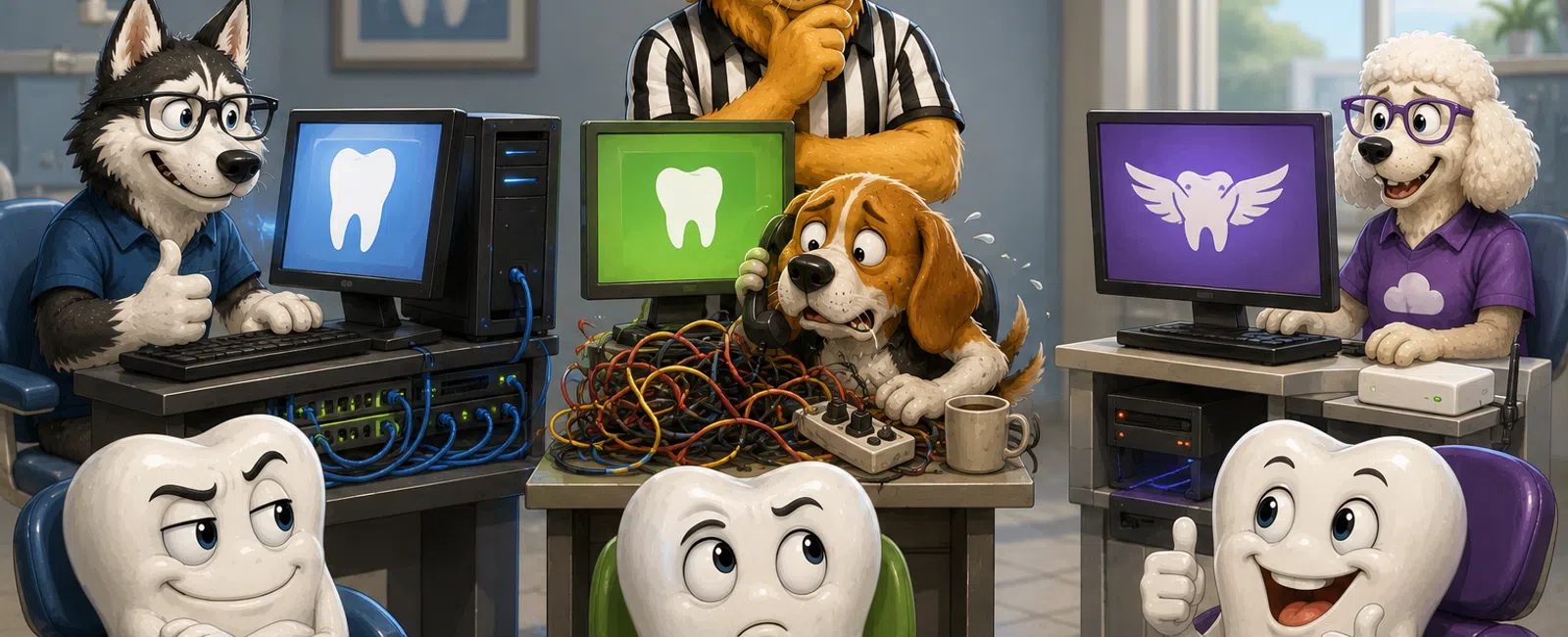
How Do Dentrix, Eaglesoft and Open Dental Compare From an IT Perspective?
Dentrix, Eaglesoft and Open Dental can all support a successful dental practice, but each platform creates different requirements for servers, workstations, integrations, backups and technical support. The best choice is not simply the system with the longest feature list. It is the platform that fits your practice’s workflow, growth plans, existing equipment and ability to manage the supporting technology.
For most practices, the IT decision comes down to five factors: infrastructure, compatibility, vendor coordination, cybersecurity and long-term cost. A practice should also consider whether it has one location or several, how many employees need access, which imaging systems it uses and how much downtime it can tolerate.
This guide compares the three platforms from an IT-support perspective. Product features, licensing and technical requirements can change, so practices should verify final specifications directly with each software vendor before purchasing or upgrading.
The Five-Part Dental Software IT Comparison Framework
Use this framework to compare Dentrix, Eaglesoft and Open Dental without getting distracted by features that may not affect your daily operations.
- Infrastructure: What servers, cloud services, workstations and network resources will the platform require?
- Compatibility: Will it work reliably with your imaging, accounting, payment and patient-communication systems?
- Support ownership: Who handles software issues, and who handles the network, computer or server underneath it?
- Security and recovery: How will the practice protect accounts, patient information and backups?
- Total cost: What will implementation, licensing, hardware, support, upgrades and downtime cost over three to five years?
Quick Comparison of Dentrix, Eaglesoft and Open Dental
| IT Consideration | Dentrix | Eaglesoft | Open Dental |
|---|---|---|---|
| Best evaluation question | Does our environment meet the current Dentrix requirements and support our planned integrations? | Can our hardware, imaging environment and vendor ecosystem support Eaglesoft reliably? | Do we have the technical resources and support model needed to configure and maintain the platform? |
| Server and hosting planning | Confirm the supported deployment model, server specifications and upgrade path | Confirm the supported deployment model, database requirements and imaging dependencies | Confirm whether the selected deployment model fits internal support capabilities and growth plans |
| Integration planning | Review imaging, communications, payments, accounting and specialty applications | Review Patterson-related and third-party integrations, imaging and connected equipment | Review each required integration individually and confirm vendor support responsibilities |
| IT support priority | Maintain a supported and documented environment around the application | Coordinate closely among software, imaging, hardware and network vendors | Define who owns configuration, customization, upgrades and troubleshooting |
| Common risk | Running the software on aging or unsupported infrastructure | Complex troubleshooting when several vendors and systems interact | Assuming flexibility removes the need for structured IT management |
This table is not intended to declare one platform universally better. The correct choice depends on the practice’s clinical workflow, technical environment and support resources.
What IT Infrastructure Does Dental Practice Software Need?
Practice-management software does not operate in isolation. Even a well-designed application can perform poorly when the server, network, workstations or security controls are unreliable.
Before selecting or upgrading a system, document the following:
- Number of dentists, hygienists and administrative users
- Number of locations
- Number and age of workstations
- Server specifications and operating system
- Network switches, firewalls and wireless equipment
- Internet speed and redundancy
- Imaging systems and file-storage requirements
- Microsoft 365 and email environment
- Remote-access requirements
- Backup and disaster-recovery systems
- Third-party software integrations
Ask each software vendor for its current technical requirements. Your IT provider should then compare those requirements with the actual environment rather than assuming that a computer capable of opening the application is properly supported.
A practice planning to use the same software for the next five years should avoid purchasing hardware that only meets today’s minimum specification. Hardware should provide enough capacity for database growth, imaging, operating-system updates and additional users.
Dentrix IT Support Requirements
Dentrix is widely used in dental environments and may connect with imaging, patient communications, payments and other business systems. From an IT perspective, the practice needs a documented and supported foundation around the application.
What Should Be Reviewed Before a Dentrix Installation or Upgrade?
- Current Dentrix system requirements
- Server operating system and available resources
- Workstation operating systems
- Database size and projected growth
- Imaging storage
- Network performance
- Backup compatibility
- Required integrations
- Antivirus and endpoint-security exclusions approved by the vendor
- Upgrade sequencing and rollback planning
The practice should not schedule a major upgrade based only on vendor availability. The IT provider should first verify backups, available storage, operating-system compatibility and the readiness of every critical integration.
What Can Cause Dentrix Performance Problems?
When Dentrix appears slow, the application may not be the only possible cause. Troubleshooting should also examine:
- Server performance
- Database health
- Network congestion
- Workstation age
- Disk performance
- Security software configuration
- Imaging file locations
- Failed updates
- Unstable connections between locations
A qualified IT provider should isolate each layer systematically instead of repeatedly restarting computers or immediately blaming the software vendor.
What Is the Main Dentrix Support Risk?
The biggest risk is allowing the supporting environment to age without a replacement plan. The software may continue opening every morning while the underlying server, operating system or backup process becomes increasingly fragile.
Establish a three-to-five-year technology roadmap that identifies expected software upgrades, server decisions, workstation replacements and imaging storage needs.
Eaglesoft IT Support Requirements
Eaglesoft environments may involve practice management, imaging, connected equipment and several vendor relationships. The greatest IT challenge is often not one individual component but the interaction among all of them.
What Should Be Reviewed Before an Eaglesoft Installation or Upgrade?
- Current Eaglesoft technical requirements
- Server and workstation compatibility
- Database and imaging-storage requirements
- Connected imaging systems
- Peripheral equipment
- Third-party integrations
- Network capacity
- Backup coverage
- Security-software compatibility
- Vendor support responsibilities
Document the full workflow before changing the environment. An upgrade that succeeds technically may still disrupt operations if an imaging device, payment integration or other connected system is not ready.
Why Is Vendor Coordination Important With Eaglesoft?
When several systems interact, a problem can cross technical boundaries. The software vendor may need to examine the application while the IT provider checks the server, network, permissions and workstation.
The dental practice should not have to act as the messenger between multiple technical teams. Its IT provider should open cases, share relevant diagnostics and coordinate troubleshooting until ownership is clear.
What Is the Main Eaglesoft Support Risk?
The greatest risk is unclear ownership. If no one maintains a current list of integrations, devices, support contacts and dependencies, troubleshooting can take longer than necessary.
Create a technology map showing:
- Which systems connect to Eaglesoft
- Who supports each system
- Where relevant data is stored
- How each component is backed up
- What happens when one component becomes unavailable
Open Dental IT Support Requirements
Open Dental can appeal to practices that value flexibility and want greater control over how their environment is configured. That flexibility should be paired with clear technical ownership and disciplined change management.
What Should Be Reviewed Before an Open Dental Installation or Migration?
- Current vendor-supported specifications
- Selected hosting or deployment model
- Database requirements
- User and location count
- Imaging and document-storage needs
- Required bridges and integrations
- Backup and recovery design
- Remote-access requirements
- Security controls
- Responsibility for configuration and ongoing maintenance
A practice should not interpret flexibility as permission to make undocumented changes. Every customization, bridge and integration should have an owner, purpose and testing process.
What IT Skills May an Open Dental Practice Need?
The required skills depend on the deployment and the amount of customization involved. The support team may need to understand:
- Database performance and recovery
- Server or cloud infrastructure
- Network security
- User permissions
- Imaging integrations
- Upgrade testing
- Backup verification
- Vendor coordination
Before implementation, decide which responsibilities belong to the software vendor, the managed IT provider and the practice’s internal team.
What Is the Main Open Dental Support Risk?
The primary risk is creating a highly customized environment that no one has documented. Flexibility is valuable, but every additional integration or workflow can become a troubleshooting dependency.
Maintain records of configuration decisions, integrations, credentials, support contacts and change history. Documentation reduces reliance on one employee or technician.
Which Dental Software Is Easiest for an IT Provider to Support?
No platform is automatically easy or difficult to support. A well-maintained Dentrix, Eaglesoft or Open Dental environment can be reliable. A poorly documented environment running unsupported equipment can create recurring problems regardless of the software brand.
The easiest environment to support usually has:
- Current and supported software
- Standardized workstations
- A right-sized server or cloud environment
- A stable network
- Documented integrations
- Individual user accounts
- Managed cybersecurity
- Monitored and tested backups
- Clear vendor responsibilities
- A scheduled technology roadmap
Practices should therefore compare not only the applications but also the quality of the implementation and ongoing management.
How Should a Dental Practice Compare Software Compatibility?
Create a compatibility worksheet before signing a contract. List every system the practice currently uses or plans to use during the next three years.
| System Category | Questions to Confirm |
|---|---|
| Digital imaging | Does the imaging platform integrate directly, use a bridge or require a separate workflow? |
| CBCT and scanners | What workstation, network and storage resources are required? |
| Patient communications | How are appointments, reminders and patient records synchronized? |
| Payments | Which processors and terminals are supported, and who handles troubleshooting? |
| Insurance and claims | How are claims submitted, tracked and updated? |
| Accounting | Does the practice need an export, integration or separate reconciliation process? |
| Microsoft 365 | Will the workflow use email, shared mailboxes, calendars, files or identity services? |
| Reporting | Can the practice produce the operational and financial reports leadership needs? |
| Multi-location access | How will users connect securely, and what happens during an internet failure? |
| Backup and recovery | Which databases, images and documents must be protected and restored together? |
Request written confirmation for business-critical integrations. A demonstration showing two systems working together is useful, but the practice should also know who supports the connection after implementation.
How Do Backup Requirements Compare?
All three platforms require a backup strategy that protects more than a single folder. The practice must identify the application database, images, documents, configuration files and other information required for a usable recovery.
A complete dental backup plan should define:
- Backup scope: Every database, image repository, document location and related server needed for recovery.
- Backup frequency: How much recent work the practice can afford to lose.
- Storage separation: At least one protected copy that is not directly exposed to the primary environment.
- Monitoring: A person or service responsible for investigating failures.
- Recovery testing: Scheduled tests proving that data and systems can be restored.
One of the most dangerous assumptions is that the software vendor automatically protects all practice data. Hosting, support and backup are separate responsibilities unless the agreement explicitly combines them.
Learn how business continuity services can help protect critical systems and reduce recovery time.
How Do Cybersecurity Requirements Compare?
The cybersecurity fundamentals are similar regardless of which dental platform a practice uses. Patient information should be protected across the application, email, computers, network, backups and vendor connections.
Evaluate the following controls:
- Unique user accounts
- Role-based permissions
- Multi-factor authentication where supported
- Endpoint detection and response
- Operating-system and application patching
- Disk encryption
- Email security
- Secure remote access
- Backup isolation
- Security awareness training
- Account offboarding
- Incident response
The application’s permissions should match each employee’s responsibilities. Front-desk, clinical, billing and administrative users should not automatically receive the same access.
At least quarterly, export or review active practice-management-system users, identify former employees and remove access that is no longer necessary. 911 IT’s practice access review guide provides a step-by-step cleanup process.
For broader protection, explore managed cybersecurity services and HIPAA compliance services.
What Happens When the Dental Software Goes Down?
When the schedule, charts or images become unavailable, the support team should use a structured process instead of immediately reinstalling software or restarting the server.
Step 1: Define the Scope
Determine whether the issue affects one user, one workstation, one location or the entire practice.
Step 2: Check the Supporting Infrastructure
Review server health, network connectivity, available storage, database services, security alerts and recent changes.
Step 3: Protect the Data
Before making significant changes, confirm the status of backups and preserve relevant logs or diagnostic information.
Step 4: Engage the Correct Vendor
If the issue is within the application, open a case with the software vendor. The IT provider should remain involved when the vendor needs access to the server, network or workstation.
Step 5: Restore Operations and Document the Cause
After service resumes, record the cause, corrective action and any prevention steps. Recurring failures should result in a permanent improvement plan rather than another temporary fix.
A capable managed IT provider should own this coordination. The office manager should not spend hours relaying conflicting messages between software, imaging, internet and hardware companies.
What Should a Migration Plan Include?
Moving from one dental practice-management system to another is both a software project and an operational change. A successful migration should be planned in stages.
1. Discovery
- Inventory existing systems and integrations
- Identify data that must be converted
- Document clinical and administrative workflows
- Confirm legal and retention requirements
- Assign project owners
2. Technical Readiness
- Validate servers, cloud resources and workstations
- Confirm network capacity
- Review imaging requirements
- Prepare cybersecurity controls
- Verify backups
3. Data Conversion
- Define which records will migrate
- Perform a test conversion
- Validate patient, schedule, financial and clinical data
- Document information that will remain in the legacy system
4. Workflow Testing
- Test scheduling
- Test charting
- Test imaging
- Test claims and payments
- Test reports
- Test connected devices and integrations
5. Cutover and Support
- Schedule the final conversion
- Establish a downtime procedure
- Provide employee training
- Arrange vendor and IT coverage
- Monitor performance after launch
Avoid placing the final cutover immediately before a holiday, major staffing change or unusually busy clinical period. Leave enough time to resolve unexpected issues without putting patient appointments at unnecessary risk.
How Much Does Dental Software IT Support Cost?
Dental software is usually one part of a broader managed IT environment. Using the planning range established for this content series, managed IT may cost approximately $100 to $275 per user per month.
For a practice with 30 employees, that produces an estimated monthly range of $3,000 to $8,250. The actual cost depends on locations, devices, servers, security requirements, support hours and project scope.
Software licensing, data conversion, new hardware, imaging upgrades and major implementation work may be charged separately. Before choosing a platform, create a three-to-five-year cost model that includes:
- Application licensing
- Implementation and training
- Data conversion
- Server or cloud infrastructure
- Workstation replacements
- Imaging storage
- Third-party integrations
- Managed IT support
- Cybersecurity
- Backups and disaster recovery
- Future upgrades
For a detailed breakdown, read what healthcare IT support costs and which services are included.
Which Platform Is Best for a Single-Location Practice?
A single-location practice should focus on workflow fit, ease of administration, integration compatibility and the quality of available support. The platform should not require unnecessary complexity, but it should still provide room for reasonable growth.
Ask:
- Can the existing computers and server support it reliably?
- Will it work with the current imaging equipment?
- How much training will employees need?
- Who will manage upgrades and backups?
- What happens if the main server or internet connection fails?
- Can the practice obtain qualified vendor and local IT support?
The least expensive initial option is not always the lowest-cost choice over five years. Include implementation effort, employee productivity and downtime in the decision.
Which Platform Is Best for a Multi-Location Dental Group?
A multi-location group should place greater emphasis on centralized access, identity management, standardization, performance between locations and business continuity.
Evaluate:
- How users access records across locations
- Whether data is centralized or distributed
- How performance is maintained
- How permissions are managed
- How new locations are added
- How outages at one location affect the others
- How databases and images are protected
- Whether leadership can produce consolidated reporting
Standardize equipment, configurations and support procedures across every office. A collection of differently configured locations increases troubleshooting time and makes cybersecurity harder to manage.
Fifteen Questions to Ask Before Choosing Dental Software
- What are the current server and workstation requirements?
- Which deployment models are supported?
- Which imaging systems integrate with the platform?
- Which patient-communication and payment systems are supported?
- How is data backed up?
- How is a full recovery performed?
- What is included in vendor support?
- Which issues remain the responsibility of the local IT provider?
- How are upgrades tested and scheduled?
- What happens to unsupported operating systems or equipment?
- How are users and permissions managed?
- Which security controls are available?
- How does the system support multiple locations?
- How can data be exported if the practice changes platforms later?
- What is the estimated three-to-five-year total cost?
A Realistic Dental Software Decision Scenario
Consider a 30-employee dental practice with one location, 22 workstations, digital imaging, Microsoft 365 and an aging server. The practice wants to change management software because employees are frustrated with the current workflow.
Choosing a replacement based only on the sales demonstration could overlook several major costs. Before moving forward, the practice should:
- Evaluate whether the existing server should be upgraded, replaced or eliminated
- Confirm compatibility with every imaging device
- Test the data conversion
- Estimate training time for 30 employees
- Review backup and recovery procedures
- Plan for the temporary productivity decline that often follows a major workflow change
- Schedule both the software vendor and IT provider during the launch
This approach turns the purchase into a controlled business project instead of an emergency technical change.
Why Support Quality Matters as Much as Software Choice
The best application cannot compensate for slow support, unclear ownership or an unreliable network. When patients are waiting, dental staff need a support team that answers, understands the environment and coordinates the next steps.
911 IT clients consistently describe the team as responsive, knowledgeable and committed to resolving issues completely. Clients also value the ability to receive remote assistance quickly while still having access to local onsite support when necessary.
“They are experienced and take time to know our setup. This allows them to resolve our issues fast.”
— Business owner and 911 IT client
That principle is especially important in a dental practice. Technicians who understand the environment do not need to rediscover the network, server and vendor relationships every time an issue occurs.
How 911 IT Supports Dentrix, Eaglesoft and Open Dental Environments
911 IT helps dental practices manage the infrastructure around their practice-management and imaging systems. The goal is to keep the software’s supporting environment secure, documented and reliable while coordinating with application vendors when necessary.
Support may include:
- 24/7 live help desk access
- Workstation and server management
- Network monitoring
- Software-vendor coordination
- Microsoft 365 administration
- Cybersecurity management
- HIPAA-focused technical safeguards
- Backup and recovery planning
- Local onsite support
- Hardware lifecycle planning
- New-location technology planning
- Strategic technology reviews
Explore healthcare IT support, managed IT services and IT support in Salt Lake City.
Frequently Asked Questions About Dentrix, Eaglesoft and Open Dental
Does an IT provider replace Dentrix, Eaglesoft or Open Dental support?
No. The software vendor remains responsible for application-specific support. The IT provider manages the supporting computers, servers, networks, security and backups, and should coordinate directly with the vendor when an issue crosses both environments.
Can the same IT provider support all three platforms?
Potentially, provided the team understands dental environments and follows each vendor’s supported technical requirements. Ask for specific experience with your platform, imaging systems and integrations.
Which platform requires the least expensive hardware?
The answer depends on the current vendor requirements, deployment model, user count, database size and integrations. Compare a complete three-to-five-year cost model rather than a minimum hardware specification.
Can a dental practice move its software to the cloud?
Cloud and hosted options may be available depending on the platform and selected vendor arrangement. Confirm application support, performance, internet dependency, data ownership, security, backup and recovery before migrating.
Should the dental software and images be backed up together?
The recovery plan should account for every system needed to resume operations. Databases, images and documents may be stored separately, but the practice must understand how they relate and how each component will be restored.
How often should user access be reviewed?
Review access at least periodically and whenever employees join, change roles or leave. A quarterly review is a practical operating schedule for identifying inactive accounts and unnecessary permissions.
Should a practice replace its server when changing dental software?
Not automatically. Compare the server’s age, warranty, operating system, performance and capacity with the new platform’s requirements and the practice’s long-term plan.
How long should a dental software migration take?
The timeline depends on data volume, integrations, training, hardware readiness and conversion complexity. A practice should allow time for discovery, testing, employee training and a controlled cutover rather than treating the migration as a one-day installation.
What should happen before a dental software upgrade?
Verify system compatibility, confirm a current backup, review connected integrations, establish a rollback plan, notify employees and arrange both vendor and IT support.
Get Help Evaluating Your Dental Software Environment
The right dental platform is the one your practice can operate securely, support reliably and use efficiently. Before selecting Dentrix, Eaglesoft, Open Dental or another system, evaluate the complete environment: users, workstations, servers, imaging, integrations, security, backup and vendor responsibilities.
911 IT can review your current environment, identify infrastructure risks and help your practice prepare for an upgrade, migration or new location.
To discuss your dental technology plan, schedule a discovery call or contact 911 IT.