
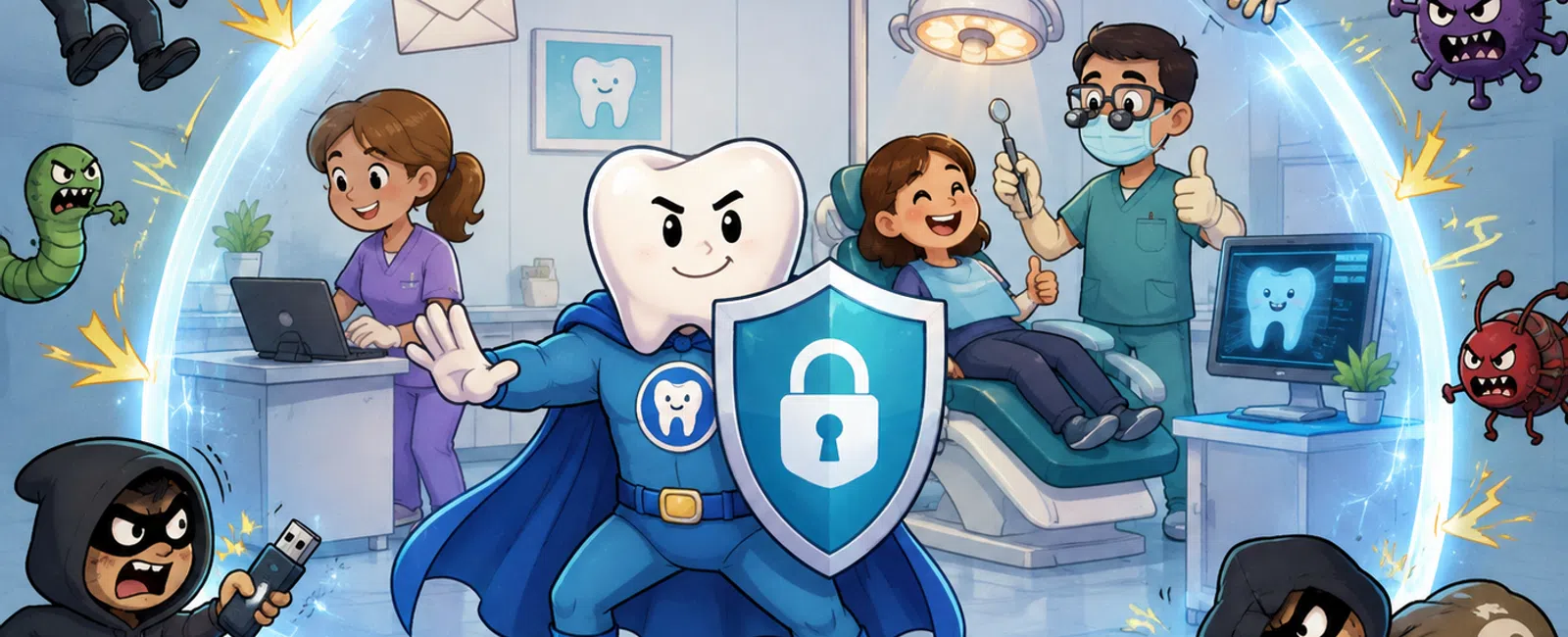
Cybersecurity for healthcare and dental businesses works through layered defenses that protect electronic Protected Health Information (ePHI) from unauthorized access, ransomware, and breaches. These defenses include firewalls, encrypted communications, endpoint detection and response (EDR) systems, multi-factor authentication, regular security assessments, and 24/7 monitoring - all designed to meet HIPAA compliance requirements while maintaining patient trust and avoiding penalties that average $50,000 per violation.
Why Do Healthcare Practices Face Unique Cybersecurity Threats?
Healthcare organizations store some of the most valuable data on the black market. A single medical record sells for $250 or more, compared to $5 for a credit card number, because PHI contains complete identity profiles including Social Security numbers, insurance details, and medical histories that criminals use for insurance fraud and identity theft.
Salt Lake City healthcare providers face additional pressure from Utah's Health Data Authority requirements alongside federal HIPAA and HITECH mandates. The region's growing telehealth adoption - particularly for rural Wyoming and Arizona patients - expands the attack surface as patient data moves across state lines and through home networks.
Dental and medical practices typically operate with lean IT budgets and small staff, making them attractive targets for ransomware gangs who know a locked EHR system means canceled appointments and lost revenue. Attackers exploit this urgency to demand quick payments.
The shift to cloud-based practice management software and patient portals creates multiple entry points. Every connected device, from digital X-ray systems to billing workstations, represents a potential vulnerability if not properly secured and monitored.
Healthcare cybersecurity must balance strict access controls with clinical workflow efficiency - doctors and nurses need immediate access to patient records during emergencies, which complicates traditional security models.
What Are the Core Layers of Healthcare Cybersecurity?
The perimeter defense starts with next-generation firewalls that inspect incoming and outgoing traffic for malicious patterns. These firewalls create a secure boundary between your practice network and the internet, blocking known threat sources and suspicious connection attempts before they reach internal systems.
Endpoint protection deploys EDR software on every workstation, laptop, and server. This software continuously monitors for ransomware behaviors, unauthorized file encryption, and malware execution, stopping threats in real-time before they spread through your network or encrypt patient records.
Email security filtering catches 99% of phishing attempts before they reach staff inboxes. Since healthcare employees receive targeted emails impersonating insurance companies, pharmaceutical vendors, and patient inquiries, advanced filtering with link scanning and attachment sandboxing prevents credential theft and malware delivery.
Multi-factor authentication (MFA) requires staff to verify their identity through a second factor - typically a phone app or text code - beyond just a password. This single control blocks most unauthorized access attempts, even when passwords are compromised through phishing or data breaches.
Encryption protects data both in transit and at rest. Patient information moving between your EHR and clearinghouses travels through encrypted tunnels, while stored backups use encryption keys to render stolen data unreadable without proper credentials.
Network segmentation isolates critical systems. Your EHR servers operate on a separate network segment from the guest WiFi patients use in the waiting room, preventing a compromised visitor device from accessing clinical systems.
Layered defenses reduce breach risk by 95% compared to single-point security solutions.
How Does 24/7 Monitoring Detect and Stop Healthcare Cyber Threats?
Security Information and Event Management (SIEM) systems aggregate logs from every device, application, and security tool in your practice. These systems analyze millions of events daily, identifying patterns that indicate compromise - like a user account accessing files at 3 AM or downloading unusually large amounts of patient data.
Behavioral analytics establish baseline activity for each user and device. When a dental hygienist's account suddenly attempts to access financial records they've never touched before, the system flags this anomaly for immediate investigation, potentially catching an attacker using stolen credentials.
Managed detection and response (MDR) services combine automated monitoring with human security analysts who investigate alerts around the clock. When automated systems detect suspicious activity, analysts determine whether it's a genuine threat or false positive, then initiate response procedures.
Kris from a healthcare practice noted: "I was pleasantly surprised by 911 IT's initiative to identify and fix issues beyond what I initially asked for. They kept me informed about what they were doing and why, which I gladly approved. This proactive approach and clear communication made all the difference."
Threat intelligence feeds update your defenses with the latest attack signatures and indicators of compromise. When a new ransomware variant targets healthcare organizations nationwide, your security systems receive updated detection rules within hours, blocking the threat before it reaches your network.
Automated response capabilities isolate compromised devices immediately. If a workstation shows signs of ransomware execution, the system can disconnect it from the network within seconds, preventing the malware from spreading to your EHR server or backup systems.
Continuous monitoring catches threats that bypass initial defenses and identifies configuration drift that creates vulnerabilities over time.
What HIPAA Compliance Requirements Must Your Cybersecurity Address?
The HIPAA Security Rule requires administrative safeguards including documented security policies, workforce training, and a designated security officer responsible for compliance. Your cybersecurity program must include written procedures for incident response, access management, and risk assessment that staff actually follow.
Technical safeguards mandate access controls that ensure only authorized personnel view PHI based on their role. A front desk scheduler shouldn't access clinical notes, while billing staff need different permissions than providers. Role-based access control (RBAC) enforces these boundaries automatically.
Audit controls track who accessed which patient records, when, and what actions they performed. These logs prove compliance during OCR investigations and help detect insider threats or unauthorized snooping in celebrity or employee medical records.
Transmission security requires encryption for ePHI moving outside your practice network. Patient portal communications, emails containing health information, and EHR data syncing to cloud backups must use TLS encryption or VPN tunnels to prevent interception.
The HITECH Act's Breach Notification Rule requires reporting breaches affecting 500 or more individuals to OCR within 60 days, with potential media notification. Smaller breaches still require patient notification within 60 days and annual OCR reporting. Strong cybersecurity prevents the reputational damage and notification costs of breaches.
Business Associate Agreements (BAAs) extend HIPAA obligations to your IT provider, EHR vendor, billing service, and any other entity handling PHI on your behalf. Your cybersecurity partner must sign a BAA accepting liability for safeguarding patient data and reporting breaches.
Utah healthcare providers must also comply with the Utah Health Data Authority's requirements for electronic health information exchange, adding state-level obligations to federal HIPAA mandates.
Compliance requires ongoing risk assessments, updated policies as threats evolve, and documented evidence of continuous security improvement.
How Do You Protect EHR Systems and Practice Management Software?
EHR security starts with vendor selection - choosing platforms with strong security track records, regular security audits, and clear data ownership policies. Cloud-based EHRs like Dentrix Ascend or athenahealth shift some security responsibilities to the vendor, but you remain liable for access controls and user authentication.
Application-level access controls within your EHR enforce the principle of least privilege. Configure user roles so staff can only perform functions necessary for their job - hygienists enter clinical notes but can't delete patient records, while front desk staff schedule appointments but can't view detailed medical histories.
Regular software updates and patch management close security vulnerabilities. EHR vendors release patches when they discover flaws that attackers could exploit. Delaying updates leaves known backdoors open, but patches must be tested in a staging environment before production deployment to avoid disrupting clinical workflows.
Session timeouts automatically log users out after periods of inactivity, preventing unauthorized access when a provider steps away from a workstation without logging out. Set timeouts to balance security with workflow efficiency - typically 10-15 minutes for clinical areas.
Integration security matters when your EHR connects to imaging systems, patient portals, e-prescribing platforms, and billing clearinghouses. Each integration point requires secure APIs, encrypted data exchange, and authentication to prevent attackers from exploiting connected systems as entry points.
Database security protects the underlying data store where all patient records reside. Database activity monitoring tracks queries and exports, alerting when someone attempts to dump large amounts of patient data or access the database directly rather than through the EHR application.
Backup and disaster recovery specifically for EHR data ensures you can restore patient records if ransomware encrypts your production system. Business continuity services maintain separate, immutable backups that attackers can't encrypt or delete, with tested restoration procedures that minimize downtime.
What Security Training Do Healthcare Staff Need?
Phishing recognition training teaches staff to identify suspicious emails that impersonate insurance companies, pharmaceutical vendors, or even internal IT requests. Interactive simulations send fake phishing emails to test awareness, with immediate feedback when someone clicks a malicious link or enters credentials on a fake login page.
Password hygiene training emphasizes unique, complex passwords for each system and explains why password reuse across personal and work accounts creates risk. Staff learn to use password managers that generate and store strong passwords, eliminating the temptation to write passwords on sticky notes.
Physical security awareness covers workstation privacy - positioning monitors away from patient view, locking computers when leaving the room, and never sharing login credentials with colleagues. These practices prevent shoulder surfing and unauthorized access in busy clinical environments.
Social engineering defense training prepares staff for phone calls or in-person requests that attempt to manipulate them into revealing information or granting access. Attackers pose as IT support, vendors, or even patients' family members to trick staff into bypassing security controls.
Incident reporting procedures ensure staff know how to report suspected security incidents immediately. A clear, non-punitive reporting process encourages staff to speak up when they click a suspicious link or notice unusual system behavior, enabling faster response before small incidents become major breaches.
HIPAA-specific training covers minimum necessary access principles, proper PHI disposal, and breach notification obligations. Annual training satisfies compliance requirements while reinforcing that security is everyone's responsibility.
Role-specific training addresses unique risks - billing staff learn about invoice fraud and W-2 phishing, while providers receive training on secure telehealth practices and mobile device security when accessing patient records remotely.
Regular training creates a security-aware culture where staff become your first line of defense against social engineering and human-targeted attacks.
How Much Does Healthcare Cybersecurity Cost?
Managed cybersecurity for healthcare practices typically costs between $25 - $75 per user per month for core services including EDR, email filtering, security monitoring, and staff training. This represents an add-on to base managed IT services, which generally run $100 - $250 per user per month for comprehensive support.
HIPAA compliance services that include risk assessments, policy documentation, BAA management, and compliance monitoring typically range from $50 - $200 per user per month, varying based on practice size and complexity. Smaller practices often pay toward the higher end on a per-user basis due to fixed compliance overhead.
Advanced security services like MDR with 24/7 analyst response, penetration testing, and vulnerability scanning add incremental costs but provide deeper protection for practices handling sensitive specialties or facing elevated threat levels.
The cost of not investing in cybersecurity far exceeds these preventive expenses. Healthcare data breaches cost an average of $408 per record according to industry studies, with total breach costs including notification, legal fees, regulatory fines, and reputation damage easily reaching six figures for small practices.
Amy from a healthcare practice shared: "We started using 911 IT when we tired of waiting for our issues to get resolved. Having a dedicated IT team, not a tech person that does it 'on the side' has saved me time and money. Their experienced team helps me price check and make decisions when it comes to equipment and software. Since outsourcing our IT to 911, the 911 team has setup our new location and everything was running great before we opened our doors."
Flat-rate pricing models provide budget predictability, eliminating surprise bills when security incidents require intensive response efforts. This pricing structure aligns with healthcare practices' need for consistent monthly expenses.
Consider cybersecurity an operational necessity like malpractice insurance - the question isn't whether you can afford it, but whether you can afford the consequences of going without it.
What Steps Should You Take to Implement Healthcare Cybersecurity?
- Conduct a comprehensive risk assessment to identify vulnerabilities in your current infrastructure, including network architecture, devices, applications, and data flows. Document where ePHI resides and how it moves through your systems.
- Establish baseline security controls by deploying EDR on all endpoints, implementing MFA for all user accounts, and configuring next-generation firewalls with healthcare-specific threat intelligence feeds.
- Segment your network to isolate EHR systems, financial data, and administrative functions from guest WiFi and less-secure areas. Create separate VLANs for different security zones.
- Deploy email security filtering with advanced threat protection, link scanning, and attachment sandboxing to block phishing attempts before they reach staff inboxes.
- Implement encryption for data at rest and in transit, including full-disk encryption on laptops, encrypted backups, and TLS for all external communications containing PHI.
- Configure SIEM and monitoring to aggregate security logs, establish behavioral baselines, and alert on suspicious activities that indicate potential compromise or insider threats.
- Document policies and procedures covering incident response, access management, password requirements, acceptable use, and breach notification to satisfy HIPAA administrative safeguards.
- Train all staff on security awareness, phishing recognition, HIPAA requirements, and incident reporting procedures. Schedule annual refresher training and quarterly phishing simulations.
- Test your defenses through vulnerability scanning, penetration testing, and tabletop exercises that simulate ransomware attacks or data breaches to validate response procedures.
- Establish backup and recovery procedures with immutable, off-site backups tested quarterly to ensure you can restore operations within your recovery time objectives if systems are compromised.
Implementation should follow a phased approach that addresses the highest-risk vulnerabilities first while minimizing disruption to clinical operations.
Frequently Asked Questions
What happens if my practice experiences a data breach despite having cybersecurity?
Your cybersecurity provider activates incident response procedures including containment to stop the breach, forensic investigation to determine scope, notification assistance for HIPAA breach reporting requirements, and recovery services to restore systems from clean backups. Strong cybersecurity reduces breach likelihood by 95% and minimizes damage when incidents occur through faster detection and response.
Do I need a separate IT provider for HIPAA compliance?
No, comprehensive HIPAA compliance services integrate with managed IT and cybersecurity under one provider who signs your Business Associate Agreement. This unified approach ensures security controls, compliance documentation, and technical support align rather than creating gaps between separate vendors. Look for providers with healthcare-specific experience who understand both technical requirements and regulatory obligations.
How does cybersecurity affect my staff's daily workflow?
Modern healthcare cybersecurity operates transparently in the background with minimal workflow disruption. Multi-factor authentication adds 10-15 seconds to login, while endpoint protection runs silently without slowing workstations. Security measures like role-based access actually improve workflows by presenting staff with only the systems and data relevant to their role, reducing clutter and confusion.
Can cybersecurity protect multiple office locations?
Yes, centralized security management protects multiple locations through unified policies, monitoring, and controls. Cloud-based security platforms secure branch offices, satellite clinics, and even providers' home offices for telehealth with the same protection as your main location. Managed IT services coordinate security across Utah, Wyoming, and Arizona locations while addressing state-specific compliance requirements.
What's the difference between cybersecurity and HIPAA compliance?
Cybersecurity encompasses all technical defenses protecting your systems and data from threats, while HIPAA compliance refers to meeting specific regulatory requirements for safeguarding PHI. HIPAA compliance includes cybersecurity controls but also requires administrative safeguards like policies, training, and documentation. You need both - strong cybersecurity to actually protect patient data, and compliance documentation to prove you're meeting legal obligations.
How quickly can cybersecurity be implemented for my practice?
Basic cybersecurity controls like EDR, email filtering, and MFA can be deployed within 1-2 weeks for most practices. Comprehensive implementation including network segmentation, SIEM deployment, policy documentation, and staff training typically takes 4-8 weeks depending on practice size and existing infrastructure. Phased rollouts minimize disruption while quickly addressing the highest-risk vulnerabilities first.


