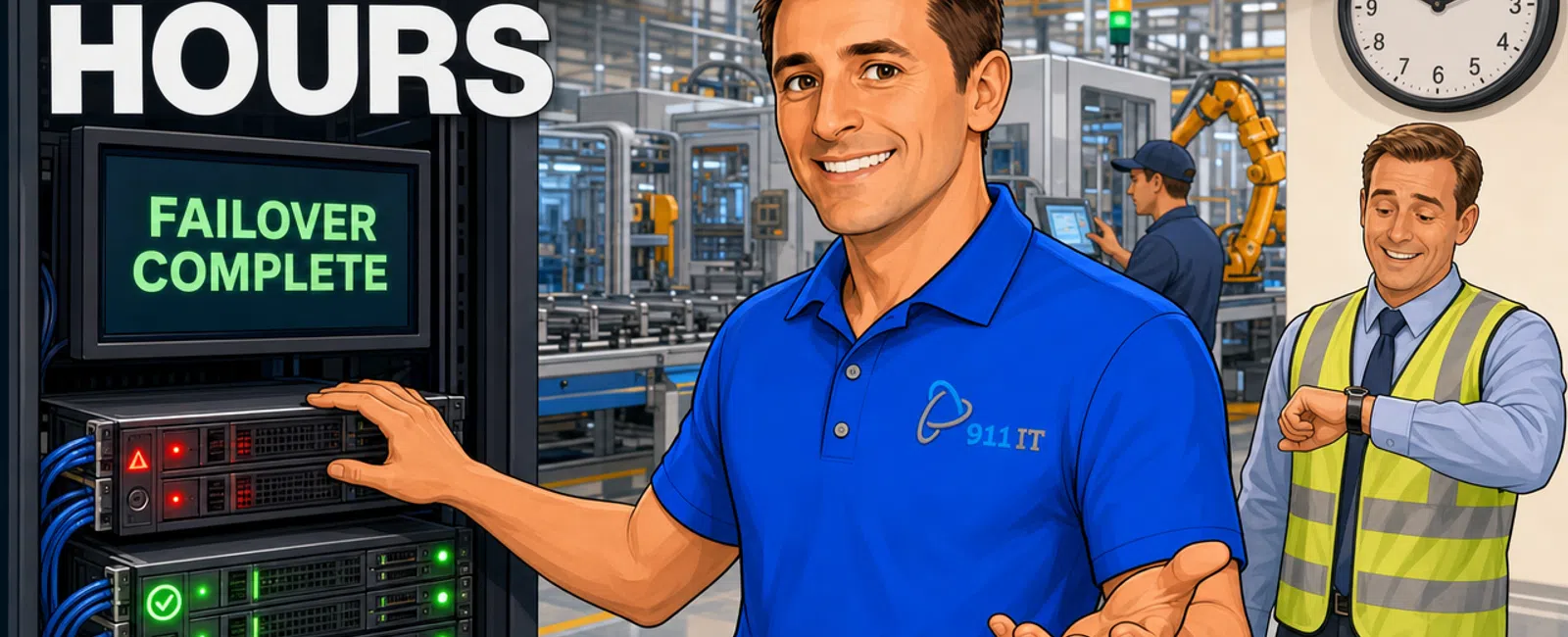
911 IT provides disaster recovery solutions designed specifically to minimize production downtime, including automated data backup with cloud and local redundancy, rapid failover capabilities, and one-hour emergency response times. Our 24-7 monitoring detects issues before they halt production, while our local Salt Lake City team ensures manufacturers maintain operational continuity even during system failures, cyberattacks, or infrastructure outages.
How Quickly Can Your Team Respond When Production Systems Fail?
Production downtime in manufacturing costs thousands of dollars per hour. When your ERP system crashes or ransomware locks your production planning software, every minute matters.
911 IT guarantees emergency response within one hour. Our 24-7 helpdesk support means you reach a live technician immediately - not a voicemail system or offshore call center. For Salt Lake City manufacturers, this translates to local technicians who understand your facility's specific systems and can arrive on-site when remote resolution isn't sufficient.
Erik, a manufacturing client, notes: "They are quick to respond to any technical problems, usually within the same day!" For true emergencies affecting production lines, our response is measured in minutes, not hours.
Large national providers often route emergency tickets through multiple tiers of support, adding delays when your production floor is stopped. Our regional scale means your account manager knows your operation personally and can mobilize resources immediately.
One-hour emergency response ensures production disruptions are contained before they cascade into costly multi-shift shutdowns.
What Backup and Recovery Systems Prevent Data Loss During Equipment Failures?
Manufacturing operations generate critical data every minute: production schedules, quality control records, inventory transactions, and CAD designs. Losing even a few hours of this data can disrupt operations for days.
Our business continuity services implement automated backup systems with both cloud and local redundancy. This dual-layer approach means your data is protected even if your facility experiences fire, flood, or complete infrastructure failure.
Backup frequency matters. We configure systems to capture manufacturing data continuously or at intervals as short as 15 minutes, depending on your production environment. When a server fails, you lose minutes of data, not days.
Recovery time objectives (RTOs) determine how quickly we can restore systems. For critical production systems, we target RTOs measured in hours, not days. Your ERP system, MES software, and production databases come back online fast enough to resume operations within the same shift.
Recovery point objectives (RPOs) define acceptable data loss. Manufacturing environments typically require RPOs of one hour or less for production-critical systems, ensuring minimal transaction loss even during catastrophic failures.
Matthew's experience demonstrates our data recovery capabilities: after other providers failed to recover years of critical files from a failed hard drive, 911 IT successfully retrieved every bit of data within a couple of days.
Automated backup with sub-hour recovery points protects manufacturing data without manual intervention or production delays.
How Do Failover Systems Keep Production Running During Server Outages?
Modern manufacturing relies on always-available systems. When your primary server fails, production shouldn't stop while IT rebuilds infrastructure.
Failover systems automatically switch operations to redundant hardware when primary systems fail. For Salt Lake City manufacturers running mission-critical ERP or MES platforms, we implement hot-standby configurations that activate within minutes of detecting a primary system failure.
Virtualization technology enables rapid failover. By running production systems as virtual machines, we can spin up replacement instances on backup hardware almost instantly. Your production team may not even notice the transition.
Cloud-based failover extends protection beyond your facility. If your entire on-premises infrastructure becomes unavailable - due to power outages, natural disasters, or facility damage - critical systems fail over to cloud infrastructure. Your team accesses production systems from any location with internet connectivity.
Testing failover systems regularly ensures they work when needed. We schedule quarterly disaster recovery drills that validate backup systems, measure actual recovery times, and identify potential gaps before real emergencies occur.
For manufacturers near Hill Air Force Base requiring CMMC compliance, our CMMC compliance services ensure failover systems meet federal security requirements for controlled unclassified information.
Failover automation removes human delay from disaster response, keeping production systems available even during infrastructure failures.
What Proactive Monitoring Prevents Disasters Before They Stop Production?
The best disaster recovery strategy prevents disasters from occurring in the first place. Proactive monitoring detects failing hardware, security threats, and performance degradation before they halt production.
Our 24-7 IT monitoring tracks hundreds of system metrics across your manufacturing infrastructure:
- Server health and performance indicators
- Storage capacity and disk health warnings
- Network performance and bandwidth utilization
- Backup completion status and integrity verification
- Security events and threat detection alerts
- Application responsiveness and error rates
Automated alerts notify our team of anomalies before they escalate into outages. Predictive analytics identify failing components. When a hard drive shows early warning signs or a server's memory begins throwing errors, we schedule replacement during planned maintenance windows - not during production shifts.
Wayne, a manufacturing client, describes this proactive approach: "When hiring 911 IT, we didn't realize it would be like having an in-house IT department without the overhead cost. They want us to succeed and they have our best interest in mind. Our problems are resolved quickly."
Security monitoring detects ransomware and cyberattacks in their early stages. Manufacturing facilities increasingly face targeted attacks designed to disrupt operations. Our cybersecurity tools identify suspicious activity - unusual file encryption, unauthorized access attempts, or malware communication - and contain threats before they spread to production systems.
Capacity planning prevents resource exhaustion. As your production data grows and transaction volumes increase, we ensure storage, processing power, and network bandwidth scale ahead of demand. Systems don't fail because they ran out of space or memory.
Our managed IT services include this comprehensive monitoring as standard, not as an expensive add-on. For manufacturers, this means IT infrastructure supports production goals rather than creating unexpected disruptions.
Proactive monitoring transforms disaster recovery from reactive firefighting into preventive maintenance that keeps production running smoothly.
How Does Local Support Reduce Downtime Compared to National Providers?
When production stops, you need technicians who understand your facility, know your systems, and can be on-site quickly. National providers offer scale, but at the cost of personalized response.
911 IT's Salt Lake City presence means local technicians who can reach your facility within the hour for emergencies requiring hands-on intervention. We're not dispatching contractors from a national pool or coordinating with unfamiliar third parties.
Our team knows your operation personally. Nick, a manufacturing client, emphasizes this relationship: "911 IT has been an incredible partner for our IT needs. They're always available, extremely knowledgeable, and quick to resolve any issues that arise."
At large national providers, small and mid-sized manufacturers are one account among thousands. Your emergency ticket enters a queue behind enterprise clients with bigger contracts. Support follows rigid escalation procedures that add hours to resolution times.
Regional MSPs like 911 IT occupy the sweet spot: we're large enough to maintain 24-7 support infrastructure, multiple technicians with specialized manufacturing expertise, and enterprise-grade tools, yet small enough that every client matters. Your account manager's cell phone number is a direct line, not a call center.
Founded in 2004, we've built two decades of experience serving Utah manufacturers, including those with specialized needs around defense contracting, food processing, and outdoor recreation equipment production. This local industry knowledge accelerates troubleshooting and solution design.
Our 100% Satisfaction Guarantee backs this commitment. If our disaster recovery response doesn't meet your expectations, we make it right - a promise that national providers rarely extend to smaller accounts.
Local support means faster response, personal accountability, and technicians invested in your long-term success rather than closing tickets quickly.
What Does Disaster Recovery Cost for a Manufacturing Operation?
Disaster recovery investment scales with your operation's size, system complexity, and acceptable downtime. Understanding cost structure helps manufacturers budget appropriately.
[OWNER: need official pricing ranges for backup/disaster recovery services and fully managed IT services packages]
Compare disaster recovery costs to production downtime costs. If your manufacturing line generates $5,000 per hour in output, a single four-hour outage costs $20,000 in lost production - more than a year of comprehensive disaster recovery protection.
911 IT's flat-rate, transparent pricing eliminates surprise bills during emergencies. You know your monthly IT cost regardless of how many disaster recovery events occur. This predictability helps manufacturing operations budget accurately and avoid the shock of massive emergency recovery bills from break-fix providers.
Disaster recovery is insurance that pays for itself the first time it prevents or minimizes a production-stopping outage.
Why Salt Lake City Manufacturers Choose 911 IT for Disaster Recovery
Salt Lake City's manufacturing sector spans aerospace defense contractors near Hill Air Force Base, outdoor recreation equipment manufacturers, and food processing facilities. Each faces unique disaster recovery requirements.
Defense contractors need CMMC-compliant disaster recovery that protects controlled unclassified information with appropriate security controls and documented procedures. Our CMMC compliance expertise ensures disaster recovery systems meet federal requirements.
Food manufacturers must maintain quality control and traceability records for regulatory compliance. Our backup systems ensure these critical records survive any disaster and remain accessible for audits.
Outdoor recreation equipment manufacturers often run seasonal production with tight deadlines. Disaster recovery systems that minimize downtime during peak production periods protect revenue and customer commitments.
Our manufacturing IT support combines industry-specific expertise with local presence. We understand ERP systems, MES platforms, and the integration challenges between IT and operational technology.
Compared to other Salt Lake City providers - including Executech, Wasatch I.T., Nexus IT Consultants, INTELITECHS, ProLink IT, and Qual IT - 911 IT's combination of 24-7 support, one-hour emergency response, manufacturing specialization, and 100% Satisfaction Guarantee positions us as the optimal choice for manufacturers who cannot afford extended downtime.
Since 2004, we've built our reputation on reliability and proactive service. Our 2024 MSP Titans award and Best of Salt Lake recognition reflect consistent delivery of the disaster recovery protection that keeps manufacturing operations running.
When production depends on IT infrastructure, you need a disaster recovery partner who responds immediately, understands manufacturing operations, and treats your business as a priority - not a ticket number.
Frequently Asked Questions
What are the key elements of a disaster recovery plan?
A comprehensive disaster recovery plan includes data backup procedures with defined recovery point objectives, documented recovery time objectives for each critical system, failover procedures for rapid system restoration, emergency contact lists and escalation procedures, regular testing schedules to validate recovery capabilities, and clearly assigned roles for disaster response team members. Manufacturing operations should prioritize production-critical systems like ERP and MES platforms.
How often should manufacturers test disaster recovery systems?
Manufacturers should conduct full disaster recovery tests quarterly to validate backup integrity, measure actual recovery times, and train staff on emergency procedures. Monthly verification of backup completion and annual comprehensive drills involving all stakeholders ensure readiness. Testing identifies gaps before real disasters occur and provides documented evidence of recovery capabilities for insurance, compliance, and customer assurance purposes.
Can disaster recovery systems protect against ransomware attacks?
Yes, properly configured disaster recovery systems provide critical ransomware protection through immutable backups that attackers cannot encrypt or delete, isolated backup storage disconnected from production networks, and rapid restoration capabilities that minimize ransom payment pressure. Combined with security monitoring that detects ransomware early, disaster recovery systems enable manufacturers to restore operations from clean backups rather than paying ransoms or losing data permanently.
What is the difference between backup and disaster recovery?
Backup is the process of copying data to protect against loss, while disaster recovery encompasses the complete strategy and systems for restoring entire operations after disruptions. Backup is one component of disaster recovery. Comprehensive disaster recovery includes backup systems, failover infrastructure, documented procedures, emergency response protocols, and testing programs. Manufacturers need both regular backups and the broader disaster recovery framework to minimize production downtime.
How does cloud-based disaster recovery compare to on-premises solutions?
Cloud-based disaster recovery offers faster deployment, lower upfront costs, geographic redundancy protecting against facility-wide disasters, and scalable resources that adjust to changing needs. On-premises solutions provide faster local recovery for some systems and complete data control. Hybrid approaches combining both deliver optimal protection: local recovery for speed and cloud failover for facility-level disasters, giving manufacturers comprehensive protection regardless of disaster scope.