
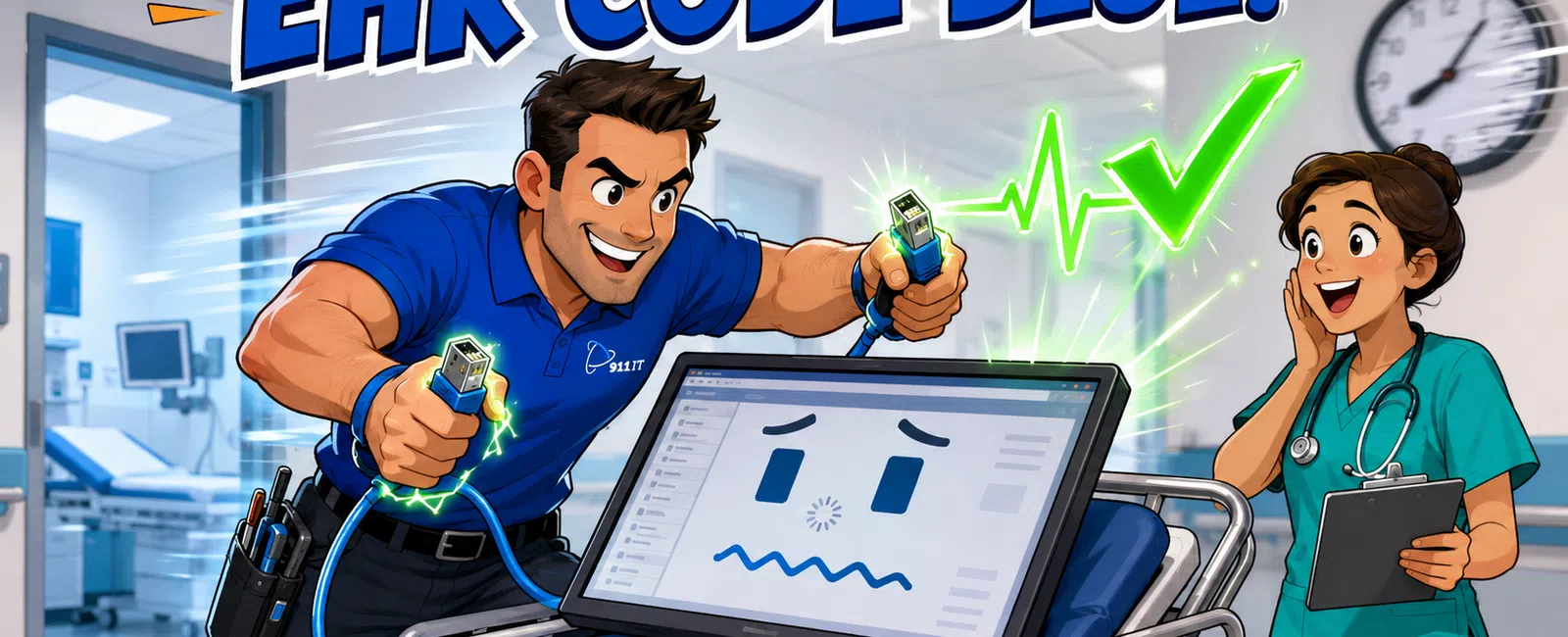
Healthcare IT providers in Salt Lake City typically respond to critical emergencies within 15 minutes to 1 hour, depending on severity and service level agreement. At 911 IT, our 24-7 live helpdesk ensures immediate triage for all healthcare emergencies, with critical patient care issues receiving priority response within 15-30 minutes. Our team understands that downtime in healthcare settings directly impacts patient safety and regulatory compliance.
What Qualifies as a Critical IT Emergency in Healthcare?
Critical healthcare IT emergencies include any system failure that impacts patient care delivery, such as EHR system outages, practice management software crashes, or network failures preventing access to electronic Protected Health Information (ePHI). These situations require immediate attention because they can halt clinical workflows entirely.
Telehealth platform failures represent another critical category, especially for practices serving rural Wyoming or Arizona patients who rely on remote consultations. When video conferencing systems or patient portals go down, appointments must be canceled or rescheduled, creating revenue loss and patient dissatisfaction.
Security incidents involving potential PHI breaches demand the fastest response times. Ransomware attacks, suspicious network activity, or unauthorized access attempts trigger immediate escalation protocols because HIPAA breach notification rules require covered entities to act within 60 days of discovery, with shorter timelines for assessment.
Sarah, who manages a Salt Lake City healthcare practice, experienced this firsthand: "911 IT was phenomenal to work with! After calling tech after tech to come out to find out the issues with our phone lines, Adam came out within a few hours and FIXED our phones immediately! He took the time to LOOK what was wrong instead of just glancing at the issues and bidding us out at thousands of dollars."
Non-critical issues like printer malfunctions, password resets, or software training requests follow standard support queues but still receive same-day attention under most managed IT service agreements.
How Do Response Time SLAs Work for Healthcare IT Support?
Service Level Agreements (SLAs) define contractual response and resolution commitments based on issue severity. Most healthcare-focused IT providers in Salt Lake City structure SLAs in three to four tiers, with critical issues receiving the fastest guaranteed response.
Tier 1 (Critical) issues typically guarantee 15-30 minute response times. These include complete EHR outages, network failures affecting multiple users, or security breaches. The clock starts when the ticket enters the system, not when a technician arrives on-site, though remote resolution often begins immediately.
Tier 2 (High Priority) issues affecting individual users or single workstations usually carry 1-2 hour response commitments. A physician unable to access patient records on their workstation falls into this category, as it impacts care delivery but doesn't halt the entire practice.
Tier 3 (Standard) and Tier 4 (Low Priority) issues receive same-day or next-business-day responses respectively. Software update requests, new user setups, or equipment procurement questions fit these categories.
911 IT's 24-7 live support means no healthcare emergency waits until Monday morning or business hours resume. Our team monitors systems continuously, often identifying and resolving issues before staff arrive at the office.
Healthcare practices experience an average of 3-5 critical IT incidents per year that require emergency response.
What Factors Affect Emergency Response Speed in Salt Lake City Healthcare?
Geographic proximity significantly impacts on-site response times, though most healthcare IT emergencies can be addressed remotely. Practices in South Jordan, Provo, or downtown Salt Lake City receive faster physical arrival times than rural Wyoming locations, but remote support capabilities have largely equalized response effectiveness.
The complexity of your IT environment determines how quickly technicians can diagnose and resolve issues. Practices using standardized, well-documented systems with proper monitoring tools enable faster troubleshooting than environments with legacy systems, poor documentation, or cobbled-together solutions.
Your service agreement structure matters enormously. Break-fix or hourly support models create inherent delays because you must call, describe the problem, wait for availability, and negotiate pricing before work begins. Managed service agreements with HIPAA compliance support include pre-authorized emergency access and established protocols.
Staff availability during emergencies varies by provider size. Large national MSPs often route healthcare practices through centralized call centers where you speak with different technicians each time, requiring repeated explanations of your environment. Small one-person IT shops can't provide true 24-7 coverage without relying on answering services or delayed callbacks.
911 IT occupies the optimal middle ground - large enough to maintain 24-7 live staffing and deep technical expertise, small enough that your practice is known by name with documented systems and established relationships. When Amy's practice needed a new location setup, the team "setup our new location and everything was running great before we opened our doors."
Proactive monitoring dramatically reduces emergency frequency and severity. Practices with continuous system monitoring receive alerts about developing issues - failing hard drives, capacity constraints, security threats - before they become emergencies.
How Does Emergency Response Differ from Standard IT Support?
Emergency response protocols bypass normal ticket queues and escalation procedures. When a critical healthcare IT issue occurs, it immediately reaches senior technical staff rather than progressing through junior technicians or tiered support levels.
Communication frequency intensifies during emergencies. Standard support might involve submitting a ticket and receiving updates when resolved, but emergency response includes regular status updates, estimated resolution times, and escalation notifications if initial approaches aren't working.
Resource allocation changes completely. Emergency response may involve multiple technicians working simultaneously, vendor escalations to software manufacturers, or engaging specialized security consultants for breach response. The financial and personnel commitment far exceeds routine support calls.
Documentation requirements increase for healthcare emergencies, especially potential security incidents. HIPAA breach assessment protocols require detailed logging of the incident timeline, affected systems, potential PHI exposure, and remediation steps - all while working to restore operations.
After-hours availability distinguishes emergency response from standard support. Healthcare facilities operate beyond typical business hours, with some offering 24-7 care. Emergency IT support must match these operational hours, which is why 911 IT maintains live helpdesk coverage around the clock.
Emergency response includes immediate workaround implementation while permanent fixes are developed. If your EHR server fails, emergency response might involve quickly spinning up cloud-based access to recent backups while hardware replacement or repair proceeds, ensuring clinical operations continue.
Which Salt Lake City IT Providers Offer Healthcare Emergency Response?
Several IT providers in the Salt Lake City area serve healthcare practices, each with different emergency response capabilities and specializations:
- 911 IT - Provides 24-7 live helpdesk support with healthcare-specific expertise, HIPAA compliance services, and proactive monitoring. Known for rapid response and transparent flat-rate pricing. Serves Utah, Wyoming, and Arizona with particular strength in multi-location practices.
- Executech - Large regional provider with healthcare clients across the Intermountain West. Offers comprehensive services but operates at enterprise scale where smaller practices may experience longer queue times.
- Wasatch I.T. - Utah-based MSP serving multiple industries including healthcare. Provides managed services with varying support tiers.
- Nexus IT Consultants - Salt Lake City provider offering managed IT and cybersecurity services to healthcare and other sectors.
- INTELITECHS - Regional IT services company with healthcare experience and compliance focus.
- A national-chain MSP - Large multi-state providers offer 24-7 support but route healthcare practices through centralized call centers where you're one account among thousands, often speaking with rotating technicians unfamiliar with your specific environment.
National technology retailers like Geek Squad or big-box store tech services are not appropriate comparisons for healthcare IT support. They lack HIPAA expertise, cannot sign Business Associate Agreements, and don't provide the compliance-focused emergency response healthcare practices require.
The optimal healthcare IT provider balances technical capability with relationship continuity. Large enterprise-focused providers can handle complex emergencies but often assign your practice to junior technicians, with escalation delays when specialized expertise is needed. Very small IT shops may offer personal service but can't provide true 24-7 coverage or the depth of healthcare-specific knowledge required.
Kris, a healthcare client, appreciated 911 IT's approach: "I was pleasantly surprised by 911 IT's initiative to identify and fix issues beyond what I initially asked for. They kept me informed about what they were doing and why, which I gladly approved. This proactive approach and clear communication made all the difference."
When evaluating providers, verify their healthcare client portfolio, ask about actual response time performance (not just SLA promises), and confirm they maintain Business Associate Agreements and understand Utah Health Data Authority requirements alongside federal HIPAA regulations.
What Should Your Healthcare Practice Do During an IT Emergency?
Establish a clear escalation protocol before emergencies occur. Your staff should know exactly how to contact IT support for critical issues - a dedicated emergency number, email address, or portal - and understand which situations qualify as emergencies versus standard support requests.
Document the symptoms thoroughly when reporting emergencies. Note what users were doing when the problem started, which systems are affected, how many users are impacted, and any error messages displayed. This information accelerates diagnosis and resolution.
Implement downtime procedures for common emergency scenarios. If your EHR becomes unavailable, do you have paper chart access, downtime forms, or alternative documentation methods? These protocols keep patient care flowing while IT issues are resolved.
Designate an on-site point of contact who can provide physical access, test solutions, and communicate with clinical staff. Emergency response often requires someone to restart equipment, check cable connections, or verify that fixes are working across different workstations.
Avoid multiple simultaneous calls to different support channels. When practices panic, they sometimes contact their IT provider, software vendor, and internet service provider simultaneously, creating confusion about who's leading the response and potentially conflicting troubleshooting steps.
Maintain an updated IT asset inventory and network diagram. Emergency response accelerates dramatically when technicians can quickly reference your server specifications, network topology, software versions, and vendor contact information rather than discovering your environment during a crisis.
Consider business continuity planning that includes regular testing of backup systems, failover procedures, and disaster recovery protocols. The middle of an emergency is not the time to discover your backups haven't been running or your disaster recovery plan doesn't work.
Why 911 IT Delivers Superior Healthcare Emergency Response
Healthcare practices in Salt Lake City, Provo, South Jordan, and throughout Utah face unique IT challenges that demand specialized emergency response capabilities. 911 IT's healthcare-focused approach ensures your practice receives the rapid, knowledgeable support that patient care requires.
Our 24-7 live helpdesk means you always reach a real person who understands healthcare IT environments, not an answering service or voicemail system. We maintain continuous monitoring of your systems, often identifying and resolving issues before they impact clinical operations.
As Ying noted, "911 IT has transformed our business operations. Their professionalism and reliability stand out - they respond quickly, solve issues efficiently, and keep our systems running smoothly without us having to worry. What really sets them apart is their proactive approach. They don't just fix problems; they prevent them."
Unlike large national MSPs where your practice is one account among thousands, 911 IT knows your environment, your staff, and your specific workflows. This familiarity eliminates the repeated explanations and diagnostic delays that plague practices using enterprise-scale providers or rotating technicians.
Our flat-rate, transparent pricing model means emergency response never involves surprise invoicing or rate negotiations while systems are down. You know exactly what your IT support costs, with emergency response included rather than billed at premium hourly rates.
We maintain expertise in the EHR systems, practice management software, and clinical applications that Salt Lake City healthcare practices actually use, along with deep knowledge of HIPAA, HITECH, and Utah-specific healthcare data requirements. This specialization delivers faster resolution than generalist IT providers learning healthcare compliance during your emergency.
Our 100% Satisfaction Guarantee and recognition as a 2024 MSP Titans award winner reflect our commitment to healthcare practices. We're large enough to handle any technical challenge an enterprise provider can address, yet small enough that every client genuinely matters and receives personalized attention.
For healthcare practices throughout Utah, Wyoming, and Arizona seeking reliable emergency IT response, 911 IT provides the optimal combination of technical expertise, healthcare specialization, and relationship-focused service. Visit our healthcare IT support page to learn how we keep medical practices running smoothly.
Frequently Asked Questions
What is considered a critical IT emergency in a medical practice?
Critical IT emergencies include complete EHR or practice management system outages, network failures preventing access to patient records, telehealth platform crashes during scheduled appointments, ransomware or security breach incidents, and phone system failures preventing patient communication. These situations directly impact patient care delivery and require immediate response, typically within 15-30 minutes under most healthcare IT service agreements.
How much does 24-7 healthcare IT support cost in Salt Lake City?
Fully managed IT services for healthcare practices typically range from $100-$250 per user per month in the Salt Lake City market, depending on practice size, complexity, and compliance requirements. This usually includes 24-7 helpdesk access, proactive monitoring, HIPAA compliance support, and emergency response without additional per-incident charges. Break-fix or hourly support models typically charge $150-$300 per hour but create delays during emergencies while negotiating scope and pricing.
Can most healthcare IT emergencies be resolved remotely?
Approximately 80-85% of healthcare IT emergencies can be resolved remotely through secure remote access tools, eliminating travel time and accelerating resolution. Issues like server crashes, software failures, network configuration problems, and security incidents typically don't require physical presence. Hardware failures, cable problems, or situations requiring hands-on equipment access may need on-site response, though remote diagnosis usually occurs first to ensure technicians arrive with correct replacement parts.
What should I do if my EHR system goes down during patient hours?
Immediately contact your IT support provider using your designated emergency line, document which users and functions are affected, and implement your downtime procedures such as paper charting or backup documentation methods. Your IT provider should begin remote diagnosis within minutes while you ensure clinical staff can continue patient care. Maintain communication with your point-of-contact technician and avoid restarting systems or making changes without guidance, as this can complicate diagnosis and recovery.
How does HIPAA compliance affect IT emergency response procedures?
HIPAA requires Business Associate Agreements with IT providers who access ePHI, mandates detailed incident documentation for potential breaches, and establishes breach notification timelines starting when incidents are discovered. Emergency response must balance speed with proper documentation, especially for security incidents. IT providers must use encrypted remote access, maintain audit logs of emergency actions, and follow established protocols for assessing whether PHI was compromised. Utah practices must also consider state Health Data Authority requirements.


