IT Support Response Times Architecture Firms Should Expect
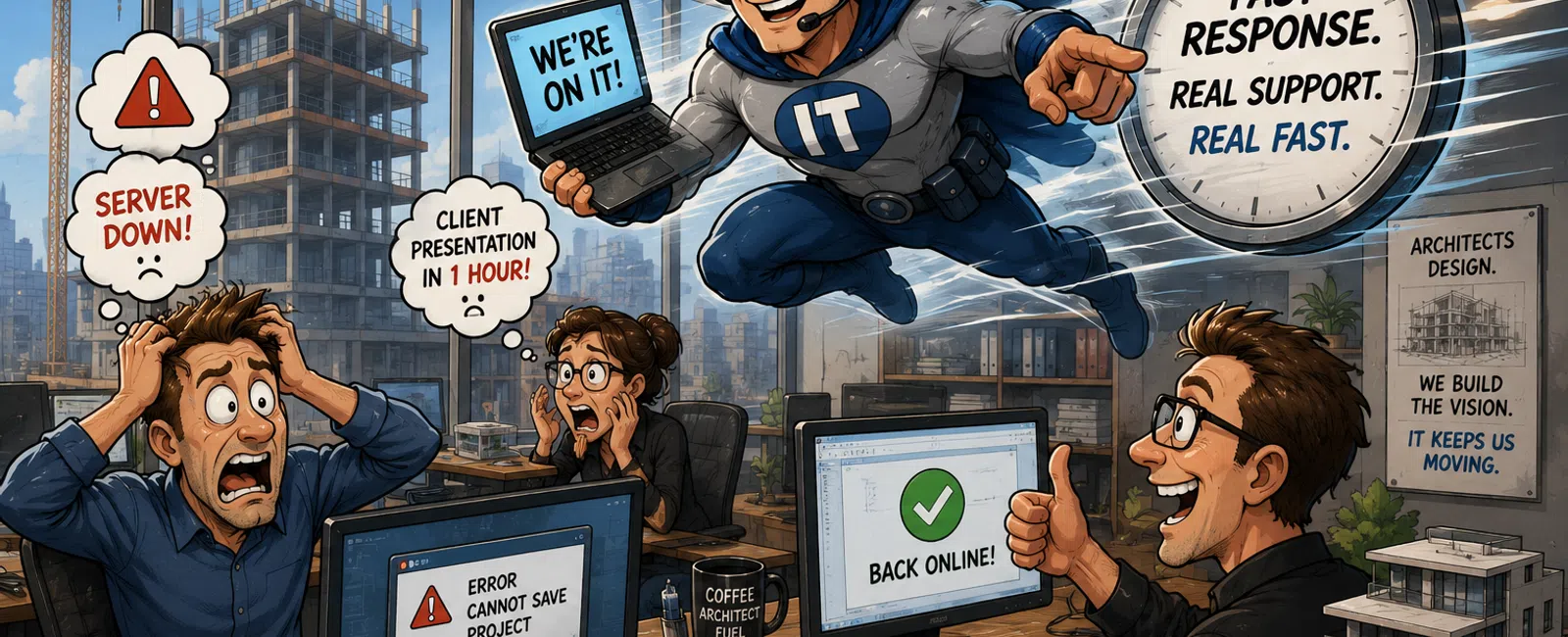
A 25–50 person architecture firm should expect a managed IT provider to respond to a firm-wide outage or active cybersecurity incident within 15–30 minutes, a high-impact project issue within 30–60 minutes, a standard employee problem within 1–4 business hours, and a routine request by the same or next business day.
Response time is only the beginning. The provider should also define escalation, communication, ownership, and expected restoration targets. A technician acknowledging a ticket in five minutes provides little value when a Revit team remains unable to work for six hours without updates.
A useful service-level agreement should answer five questions:
- How is the issue classified?
- How quickly will support respond?
- Who owns the issue until resolution?
- How often will the firm receive updates?
- When will the issue escalate to a specialist or leadership?
The Five-Part IT Support SLA Framework
1. Classify Issues by Business Impact
Ticket priority should be based on business impact and urgency rather than the title or seniority of the person submitting the request.
An architecture firm should use at least four priority levels:
| Priority | Architecture Firm Example | Illustrative Initial Response |
|---|---|---|
| Priority 1: Critical | Firm-wide outage, ransomware, server failure, internet failure, or loss of access to active BIM projects | 15–30 minutes |
| Priority 2: High | Multiple employees affected, major project deadline at risk, or a key Revit user unable to work | 30–60 minutes |
| Priority 3: Normal | One employee has an application, device, printing, or account problem | 1–4 business hours |
| Priority 4: Planned | New equipment, software installation, access request, or nonurgent change | Same or next business day |
The provider and the architecture firm should agree on examples before the service begins. Without clear definitions, every employee may label a request urgent, making true emergencies harder to identify.
2. Separate Response Time From Resolution Time
Response time measures how quickly the provider acknowledges and begins evaluating a request. Resolution time measures how long it takes to restore service or complete the request.
These are not the same.
A managed IT provider may respond to a failed Revit workstation within 20 minutes but require two hours to diagnose a graphics driver conflict, replace a component, or deploy another computer.
A service agreement should explain:
- When the response clock begins
- What qualifies as a meaningful response
- Whether automated acknowledgements count
- When a ticket is considered resolved
- How waiting for the employee or a vendor affects timing
- How target times change outside business hours
A meaningful response should include an assigned technician, an initial assessment, the next action, and an expected update time.
3. Define Escalation and Communication
Architecture employees should not have to repeatedly explain the same issue to several technicians. The provider should maintain ownership while involving additional specialists behind the scenes.
A documented escalation process should define:
- When the help desk escalates to a senior technician
- When a Revit, Microsoft 365, network, cloud, or security specialist becomes involved
- When the firm's internal IT employee or BIM manager is contacted
- When leadership receives an operational update
- When a vendor such as Autodesk, Microsoft, or an internet provider is engaged
For critical incidents, the firm should receive updates at least every 30–60 minutes, even when the technical status has not changed. Silence creates uncertainty and encourages employees to open duplicate tickets.
4. Match Coverage to Project Work
Architecture firms may work outside standard business hours during submissions, design competitions, permit deadlines, and construction administration. Support coverage should reflect the firm's actual schedule.
Clarify:
- Normal help desk hours
- After-hours emergency support
- Weekend coverage
- Holiday coverage
- Support for remote employees
- Coverage during major project deadlines
- Onsite response availability
- Additional after-hours fees
A provider that responds quickly from 8:00 a.m. to 5:00 p.m. may still be a poor fit when a substantial portion of the firm's production work occurs early in the morning or late at night.
5. Measure Results Quarterly
Service-level commitments should be supported by measurable reporting. The firm should review more than average response time because averages can hide serious failures.
Useful measures include:
- Percentage of tickets responded to within target
- Percentage of tickets resolved within target
- Average and median response time
- Average and median resolution time
- Critical incidents by month
- Tickets reopened after closure
- Recurring issue categories
- Employee satisfaction scores
- Tickets waiting on employees
- Tickets waiting on external vendors
- Escalation frequency
- After-hours incidents
The quarterly review should identify the root causes of recurring problems and assign corrective actions.
Recommended Response Targets by Issue Type
| Issue Type | Illustrative Response Target | Expected Next Step |
|---|---|---|
| Suspected ransomware | 15 minutes | Begin containment, protect accounts, and activate incident response |
| Firm-wide internet outage | 15–30 minutes | Confirm scope, test failover, and contact the carrier |
| Active BIM environment unavailable | 15–30 minutes | Determine whether the issue involves identity, Autodesk, network, storage, or the model |
| Server failure | 15–30 minutes | Assess hardware, virtualization, backups, and recovery options |
| Multiple Revit users affected | 30–60 minutes | Identify common application, model, network, add-in, or licensing factors |
| Project principal cannot access email | 30–60 minutes | Verify identity, device, account security, and Microsoft 365 status |
| One Revit workstation is slow | 1–4 business hours | Review hardware, model behavior, drivers, add-ins, storage, and user profile |
| Employee onboarding request | Same business day acknowledgement | Confirm start date, equipment, applications, permissions, and licensing |
| New workstation request | Same or next business day | Validate role, specifications, budget, availability, and deployment timing |
These are planning targets, not universal standards. The firm should adjust them according to project deadlines, employee count, system complexity, business hours, and budget.
How Quickly Should Critical Issues Be Restored?
Initial response targets do not guarantee restoration. Architecture firms should also define recovery expectations for critical services.
| System or Function | Illustrative Restoration Target |
|---|---|
| Identity and employee authentication | 2–4 hours |
| Firm-wide internet access | 1–4 hours through repair, failover, or alternate work procedures |
| Active project storage | 4–8 hours |
| Microsoft 365 access | 2–8 hours when the cause is within the firm's control |
| Critical Revit workstation | 2–8 hours through repair or replacement |
| Server recovery | 4–12 hours depending on design and failure type |
| Archived project data | 1–3 business days |
Actual recovery times depend on redundancy, backup design, spare hardware, internet availability, vendor response, and the nature of the incident. Recovery expectations should align with the firm's business continuity strategy.
Why Architecture Firms Need Industry-Specific Support
Generic IT support may resolve ordinary email, password, and printer issues but struggle with problems that cross Revit, BIM, networking, storage, graphics hardware, and cloud collaboration.
An architecture-focused support provider should understand:
- Revit system requirements
- Workstation CPU, memory, GPU, and storage performance
- Central and local model behavior
- Autodesk Construction Cloud
- Revit cloud worksharing
- Linked models
- Model synchronization
- Rendering and visualization workloads
- Point clouds
- Bluebeam workflows
- Plotters and large-format printing
- Consultant access
- Multi-office collaboration
911 IT provides specialized IT support for engineering and design environments, including workstations, networking, cybersecurity, cloud collaboration, and strategic planning.
How Revit Support Issues Should Be Escalated
Not every Revit problem belongs to the same team. Effective escalation separates application workflow, model health, workstation performance, and infrastructure.
| Problem | Likely Owner |
|---|---|
| Template, family, or model-standard question | BIM manager or Revit specialist |
| Application will not launch | IT support |
| Workstation freezes or crashes | IT support with Revit escalation |
| One model performs poorly for every user | BIM manager with IT infrastructure support |
| All cloud models are inaccessible | IT support, Autodesk administrator, and vendor escalation |
| Network latency affects model access | IT infrastructure team |
| Add-in causes application instability | IT support, BIM manager, and software vendor |
| User lacks project permissions | Autodesk project administrator |
The provider should know when to involve the firm's BIM manager instead of repeatedly reinstalling software or blaming the workstation.
What Counts as a Critical IT Incident?
A critical incident usually has one or more of these characteristics:
- Most or all employees cannot work
- Active project information is unavailable
- A security incident is in progress
- A major client deadline is immediately threatened
- Critical systems may be losing or corrupting data
- Multiple offices are affected
- There is no available workaround
- Financial operations or payroll are at risk
Examples include:
- Ransomware on a server or multiple workstations
- Loss of Microsoft 365 administrator control
- Failure of the primary file or application server
- Firm-wide internet or firewall failure
- Loss of access to all active cloud BIM projects
- Compromise of an executive email account during payment activity
- Backup failure discovered during an active data-loss event
The service agreement should include a dedicated emergency contact method rather than requiring employees to submit an ordinary portal ticket.
What Information Employees Should Include in a Support Request
Better ticket information helps technicians begin useful work faster. Employees should provide:
- The affected application or system
- The error message
- The time the problem began
- The number of employees affected
- The project or deadline at risk
- Whether the issue worked previously
- Recent changes
- Screenshots when appropriate
- The employee's location
- The best contact method
For a Revit problem, include:
- Revit version
- Project or model name
- Whether other users are affected
- Whether the model is local, server-based, or cloud-hosted
- The operation being performed
- Any related add-ins
- Whether another model works normally
Employees should not include passwords, sensitive client information, or protected project data in ordinary ticket descriptions.
How to Prioritize a Project Deadline Issue
A project deadline does not automatically make every issue critical. The provider should evaluate both urgency and business impact.
Consider:
- How many employees are affected?
- How soon is the deadline?
- Is there a workaround?
- Can work continue on another device or task?
- Is the issue limited to one file?
- Could continuing work damage data?
- Does the client need immediate notice?
A single employee unable to print a draft due next week may be a normal-priority issue. Ten employees unable to access a permit set due in three hours should be treated as high or critical.
How Onsite and Remote Support Should Work Together
Many problems can be resolved remotely, but architecture firms still need a defined onsite process for hardware, networking, conference rooms, plotters, cabling, and physical office issues.
A service agreement should clarify:
- When onsite support is dispatched
- Expected onsite arrival time
- Whether onsite visits are included
- Which geographic areas are covered
- Whether travel charges apply
- How emergency onsite work is approved
- Who coordinates building access
Remote troubleshooting should not become an excuse to delay an onsite visit when physical intervention is clearly required.
After-Hours Support for Architecture Firms
After-hours support should distinguish between emergencies and routine requests.
Typical after-hours emergencies include:
- Ransomware or active account compromise
- Firm-wide outage
- Critical server or network failure
- Loss of access affecting a deadline-sensitive project team
- Suspected payment fraud
- Major backup or recovery event
Routine requests such as software installation, equipment quotes, and standard access changes can usually wait until the next business day.
Confirm:
- How employees request emergency support
- Who can authorize after-hours work
- Whether fees apply
- Which response targets apply
- How leadership is notified
- When the issue transitions to the normal help desk
How to Evaluate Help Desk Quality
First-Contact Resolution
First-contact resolution measures how often the help desk resolves a request without escalation or repeated follow-up. A high rate can indicate effective technicians, but it should not encourage rushed or incomplete closures.
Reopened Tickets
Frequent reopening may indicate that issues are being closed before employees confirm the solution.
Employee Satisfaction
Simple post-ticket surveys can identify communication, professionalism, and resolution problems that technical metrics miss.
Recurring Issues
The same printer, login, synchronization, or workstation problem should not generate tickets every week. The provider should identify and correct the root cause.
Escalation Quality
Escalated tickets should include complete notes, troubleshooting history, screenshots, logs, and the current business impact. Employees should not start from the beginning with every technician.
Communication
Employees should know who owns the issue, what is happening, and when the next update will arrive.
Example: Critical Revit Access Incident
Consider a 38-person architecture firm with 18 employees preparing a permit submission. At 10:00 a.m., every project team member loses access to the active cloud models. The submission is due at 3:00 p.m.
An effective response process might look like this:
| Time | Action |
|---|---|
| 10:00 a.m. | Employee contacts the emergency support line and reports the number of users, project, deadline, and error |
| 10:10 a.m. | Provider acknowledges a critical incident, assigns an incident owner, and begins assessment |
| 10:20 a.m. | Technician confirms the issue affects multiple users and checks identity, internet, Autodesk status, and project permissions |
| 10:30 a.m. | Senior cloud and Autodesk resources are engaged; firm leadership and the BIM manager receive an update |
| 11:00 a.m. | The team identifies a project-access configuration problem and begins correction |
| 11:30 a.m. | Representative users confirm access and model synchronization |
| 11:45 a.m. | All affected employees are restored; the provider monitors for recurrence |
| Next business day | The provider delivers a root-cause summary and prevention actions |
The response combines technical work, clear ownership, scheduled communication, and post-incident improvement.
Example: Standard Revit Workstation Problem
A project architect reports that Revit has become slow over the previous week, but other employees and projects are unaffected.
A normal-priority response could include:
- Respond within one to four business hours.
- Confirm the Revit version, model, affected operations, and workstation.
- Compare performance with another model.
- Review memory, CPU, storage, graphics, drivers, add-ins, and available disk space.
- Check whether the issue follows the employee profile or device.
- Involve the BIM manager if the problem appears model-specific.
- Document the solution and watch for similar tickets.
This request matters, but it should not interrupt active response to a firm-wide outage or cybersecurity incident.
Service-Level Agreement Terms to Review
| SLA Term | Question to Ask |
|---|---|
| Business hours | Which hours and holidays are included? |
| Response target | How quickly will a qualified person begin work? |
| Resolution target | Is there a target for restoring service or providing a workaround? |
| Priority definitions | How are critical, high, normal, and planned requests classified? |
| Escalation | When does a ticket move to a senior or specialized resource? |
| Communication | How frequently will the firm receive updates? |
| Onsite service | When is onsite support available and what does it cost? |
| After-hours service | How are emergencies submitted, approved, and billed? |
| Vendor delays | How are tickets handled when Microsoft, Autodesk, or another vendor is involved? |
| Reporting | Which performance measures will leadership receive? |
| Remedies | What happens when the provider repeatedly misses commitments? |
Red Flags in an IT Support Proposal
Every Ticket Has the Same Response Target
A password reset and an active ransomware attack should not enter the same queue with the same priority.
Automated Replies Count as Responses
An automatic email confirms receipt but does not prove that a technician has reviewed the issue.
No Resolution or Communication Expectations
A fast acknowledgement is not enough when the provider gives no updates and no restoration estimate.
After-Hours Coverage Is Undefined
The firm should know exactly how to report a critical issue outside normal hours.
No Revit or BIM Escalation
Generic technicians may repeatedly reinstall software without understanding the model, Autodesk environment, network, or workstation workload.
Onsite Support Is Vague
The proposal should state whether onsite work is included, how quickly it is available, and what additional costs apply.
No Quarterly Reporting
The provider should be able to demonstrate whether it is meeting response and resolution commitments.
Tickets Close Without Employee Confirmation
Premature closure can improve provider statistics while leaving the employee's problem unresolved.
How Managed IT Reduces Support Delays
A proactive managed IT model can resolve some issues before employees submit tickets.
Proactive services may include:
- Device monitoring
- Patch management
- Disk-space alerts
- Hardware health monitoring
- Endpoint security
- Backup monitoring
- Network monitoring
- Microsoft 365 alerting
- Warranty and lifecycle tracking
- Standardized workstation configurations
- Documentation
911 IT's managed IT services combine responsive support with monitoring, maintenance, cybersecurity, documentation, and strategic planning.
How Co-Managed IT Improves Response Coverage
An architecture firm with an internal IT employee may still need help desk capacity, specialist escalation, after-hours coverage, or vacation backup.
A co-managed model can divide support responsibilities by:
- Time of day
- Issue type
- Technical complexity
- Employee location
- Application or system
- Onsite versus remote work
For example, the external provider may handle first-line support, cybersecurity, Microsoft 365, servers, and networking while the internal employee manages Revit deployment, plotters, conference rooms, and business-specific applications.
Learn more about co-managed IT services for firms that want to expand internal IT capacity without replacing their existing team.
Questions to Ask a Managed IT Provider
- What are your response targets for critical, high, normal, and planned requests?
- Do automated acknowledgements count as responses?
- What are your typical resolution times?
- How do you classify a project deadline issue?
- How do employees report a critical incident?
- What after-hours support is included?
- How frequently will we receive updates during a critical issue?
- Who owns the ticket when it is escalated?
- How many escalation levels do you have?
- Do you have Revit, Autodesk, Microsoft 365, network, and cybersecurity specialists?
- When will you dispatch onsite support?
- Are onsite visits included in the monthly fee?
- How do you handle Microsoft or Autodesk vendor cases?
- How do you prevent employees from repeating information?
- Do you track first-contact resolution?
- Do you report reopened and recurring tickets?
- How do you measure employee satisfaction?
- What happens when response targets are repeatedly missed?
- Can we review sample monthly and quarterly reports?
- Can you provide references from architecture or engineering firms?
A 30-Day Support Performance Review
Week 1: Gather the Data
- Collect 90–180 days of ticket history.
- Separate requests by priority, application, employee, and location.
- Calculate response and resolution times.
- Identify after-hours incidents.
Week 2: Identify Business Impact
- List incidents that delayed project work.
- Estimate employees and labor hours affected.
- Identify recurring Revit, network, account, and workstation problems.
- Review employee complaints and satisfaction surveys.
Week 3: Review the Service Agreement
- Compare actual performance with contractual targets.
- Clarify priority definitions.
- Review escalation and onsite procedures.
- Confirm after-hours coverage and fees.
Week 4: Approve Improvements
- Set revised response and communication targets.
- Assign owners for recurring technical problems.
- Create architecture-specific escalation procedures.
- Schedule quarterly service reviews.
- Document consequences for repeated missed commitments.
IT Support Performance Scorecard
| Category | Evaluation Question |
|---|---|
| Critical response | Does the provider begin work on emergencies within 15–30 minutes? |
| Normal response | Do employees receive meaningful assistance within the agreed timeframe? |
| Communication | Do employees know who owns the issue and when the next update will arrive? |
| Escalation | Are complex problems moved quickly to qualified specialists? |
| Architecture knowledge | Does the provider understand Revit, BIM, Autodesk, and design workflows? |
| After-hours coverage | Can the firm reach support during critical project or security events? |
| Onsite service | Can physical issues be addressed within an acceptable timeframe? |
| Resolution quality | Are tickets fully resolved without repeated failures or premature closure? |
| Root-cause analysis | Does the provider prevent recurring issues? |
| Reporting | Does leadership receive accurate quarterly performance data? |
Frequently Asked Questions
What is a reasonable IT support response time?
A reasonable target is 15–30 minutes for critical incidents, 30–60 minutes for high-impact issues, one to four business hours for normal problems, and the same or next business day for planned requests.
What is the difference between response and resolution time?
Response time measures how quickly support begins evaluating the issue. Resolution time measures how long it takes to restore service, provide a workaround, or complete the request.
Should an automated email count as an SLA response?
An automated acknowledgement should not count as a meaningful technical response. A qualified person should review the issue, assume ownership, and communicate the next step.
How often should support provide updates during an outage?
For critical incidents, updates every 30–60 minutes are generally appropriate. The exact frequency should be defined in the service agreement.
Should a project deadline make a ticket critical?
Not automatically. Priority should reflect the number of employees affected, deadline proximity, business impact, data risk, and availability of a workaround.
Does faster response always mean better support?
No. Fast acknowledgement is useful, but effective support also requires accurate diagnosis, qualified escalation, consistent communication, and complete resolution.
How quickly should onsite support arrive?
Onsite targets vary by geography, issue type, and contract. Critical physical failures may justify same-day dispatch, while routine equipment requests can be scheduled.
Should managed IT include after-hours support?
Many providers offer it, but the scope and fees vary. Confirm which incidents qualify, how support is requested, and which response targets apply.
Who should handle Revit support?
IT should handle devices, networks, access, installation, security, and infrastructure. BIM leaders should handle model standards, templates, families, and workflow questions. Complex issues may require both teams.
How often should an architecture firm review IT support performance?
Leadership should review service metrics at least quarterly and immediately after major outages, security incidents, or repeated missed commitments.
Demand Support That Protects Project Delivery
Architecture firms should measure IT support by its effect on employees, deadlines, project data, and client service. A strong provider combines fast response with clear ownership, architecture-specific expertise, proactive prevention, and measurable accountability.
911 IT helps architecture and engineering firms improve support response, Revit performance, cybersecurity, infrastructure, and technology planning through managed IT services, co-managed IT services, and specialized engineering IT support.
Schedule a discovery call to review your current support performance and build service-level expectations around your firm's project deadlines and business priorities.