
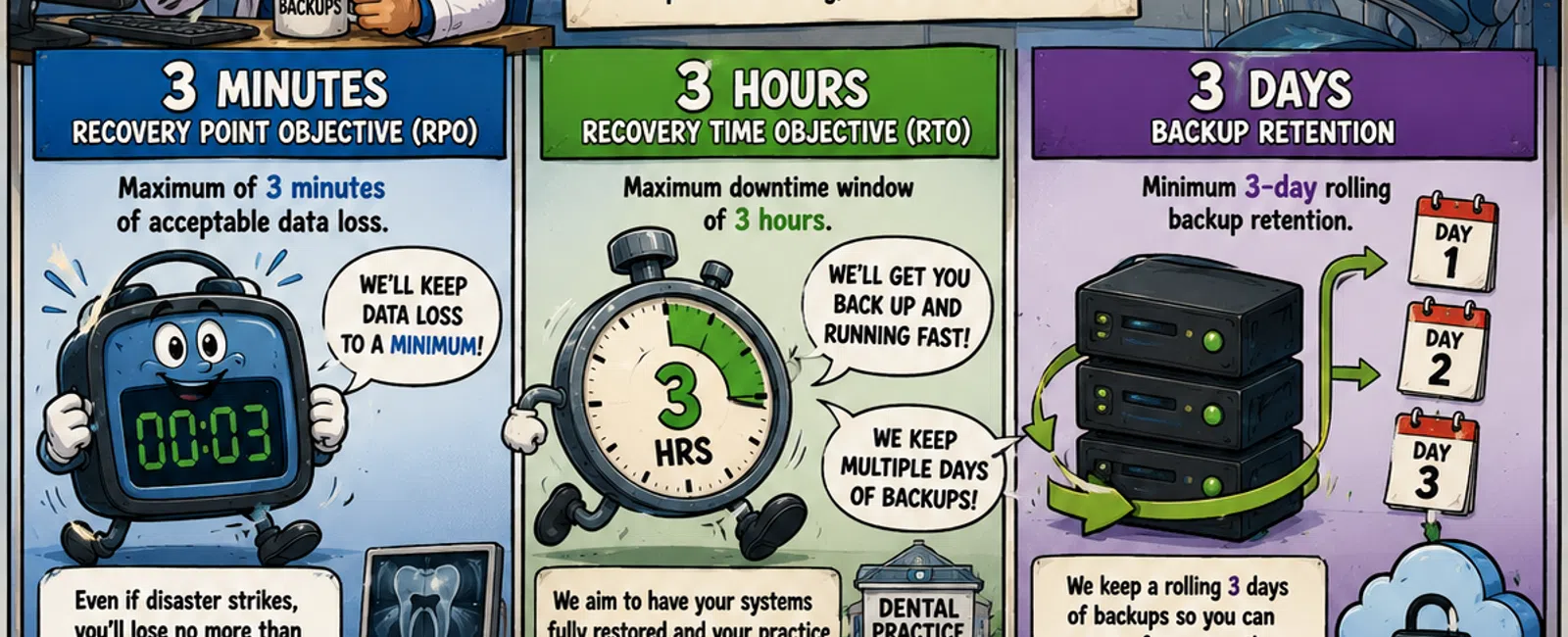
The 3-3-3 rule in dentistry is an IT resilience framework specifying three critical benchmarks: a maximum of 3 minutes of acceptable data loss (Recovery Point Objective), a 3-hour maximum downtime window (Recovery Time Objective), and a minimum 3-day rolling backup retention. These thresholds protect patient records, appointment schedules, and billing data from system failures while maintaining HIPAA compliance and operational continuity.
Why Do Dental Practices Need the 3-3-3 Rule?
Dental practices operate in a high-stakes environment where patient care, regulatory compliance, and revenue depend on continuous access to electronic health records. A single hour of downtime can cascade into dozens of missed appointments, delayed treatments, and frustrated patients who may seek care elsewhere.
The 3-3-3 rule addresses the unique vulnerabilities of dental IT infrastructure. Unlike general business data, protected health information (PHI) carries strict HIPAA retention and availability requirements. When your practice management software goes offline, you lose access to patient histories, treatment plans, digital radiographs, and insurance verification systems simultaneously.
Salt Lake City dental practices face additional pressure from Utah's competitive healthcare market. Patients expect seamless digital experiences - online booking, patient portals, and instant insurance verification. Any disruption erodes trust and sends patients to competitors who maintain reliable systems.
Sarah, a Salt Lake City dental practice manager, experienced this firsthand: "911 IT was phenomenal to work with! After calling tech after tech to come out to find out the issues with our phone lines, Adam came out within a few hours and FIXED our phones immediately! He took the time to LOOK what was wrong instead of just glancing at the issues and bidding us out at thousands of dollars."
The rule's three-minute data loss tolerance prevents scenarios where morning appointments, x-ray uploads, or payment processing vanish during a crash. Three hours represents the maximum window before patient care quality degrades and revenue loss becomes severe. Three days of backup retention provides multiple recovery points if corruption or ransomware goes undetected initially.
Dental practices that ignore these thresholds risk HIPAA breach notifications, which trigger federal investigations and patient notification requirements.
How Does the 3-Minute Recovery Point Objective Work?
The first "3" establishes how much data your practice can afford to lose during a system failure. Three minutes means your backup systems capture and store changes to your EHR database at least every three minutes throughout the business day.
Most dental practice management platforms - Dentrix, Eaglesoft, Open Dental - write data continuously as staff schedule appointments, update treatment notes, process payments, and capture digital images. Traditional nightly backups leave you vulnerable to losing an entire day's work if disaster strikes at 4:45 PM.
Modern continuous data protection (CDP) or near-CDP solutions snapshot your database every few minutes. When a server crashes, ransomware encrypts files, or a staff member accidentally deletes records, you restore to a point just minutes before the incident.
This granularity matters in dentistry because patient care decisions happen in real time. A hygienist documents periodontal measurements, the dentist reviews radiographs and updates the treatment plan, the front desk schedules a crown prep - all within a 15-minute appointment window. Losing even 30 minutes of data means recreating work, potential clinical errors, and compliance documentation gaps.
Practices using continuous backup solutions reduce data loss from hours to minutes, protecting both patient safety and HIPAA audit trails.
Implementing three-minute RPO requires backup infrastructure that runs locally and replicates to offsite or cloud storage. Business continuity services designed for healthcare environments automate this process without impacting practice management software performance during peak hours.
What Does the 3-Hour Recovery Time Objective Mean for Patient Care?
The second "3" defines your maximum acceptable downtime: three hours from system failure to full operational restoration. This window balances technical feasibility with business continuity requirements specific to dental practices.
Three hours allows your IT team to diagnose the failure, initiate recovery procedures, restore data from backup, verify system integrity, and bring your practice management software back online. It assumes you have proper disaster recovery infrastructure in place before the incident occurs.
For a dental practice, three hours of downtime typically affects 6-12 patient appointments depending on your schedule density. Front desk staff can handle some disruption by reverting to paper charts for active patients, but extended outages force appointment cancellations, which damage patient relationships and create revenue gaps that compound over subsequent weeks.
Amy, a healthcare practice manager, explained the impact of reliable IT: "We started using 911 IT when we tired of waiting for our issues to get resolved. Having a dedicated IT team, not a tech person that does it 'on the side' has saved me time and money. Since outsourcing our IT to 911, the 911 team has setup our new location and everything was running great before we opened our doors."
Meeting a three-hour RTO requires specific technical capabilities. Your backup solution must support rapid restoration - not 8-hour tape recoveries. Virtualized server environments allow you to spin up a backup instance while troubleshooting the primary system. Cloud-based disaster recovery can redirect operations to a failover environment within minutes.
Salt Lake City practices should verify their IT provider offers local support with rapid response guarantees. When your server fails at 10 AM on a Tuesday, you need technicians who arrive within the hour, not next-day appointments. Managed IT services with 24/7 monitoring detect failures immediately and initiate recovery protocols before staff even reports the problem.
Testing your RTO annually ensures your recovery procedures actually work under pressure. Many practices discover their backup strategy fails only during a real emergency when stakes are highest.
Why Is 3-Day Backup Retention Critical for Dental Practices?
The third "3" establishes minimum backup retention: maintaining at least three days of distinct recovery points. This retention window protects against delayed-discovery threats and provides multiple fallback options during complex recovery scenarios.
Ransomware and data corruption often remain undetected for hours or even days. Attackers increasingly deploy "slow-burn" ransomware that encrypts files gradually to evade detection systems. If your backup system only retains yesterday's snapshot, you might restore already-compromised data.
Three-day retention gives you multiple clean recovery points. When you discover corruption on Wednesday afternoon, you can restore from Monday's backup if Tuesday's snapshot also shows signs of compromise. This flexibility prevents scenarios where your only backup option contains the same malware or corruption that triggered the recovery.
HIPAA compliance adds another dimension to retention requirements. While the 3-3-3 rule specifies three days as a minimum operational threshold, federal regulations require longer retention periods for patient records - typically six years from the date of creation or last treatment. Your backup strategy must balance rapid operational recovery with long-term compliance archiving.
Dental practices should implement tiered retention:
- Frequent snapshots for operational recovery (the 3-day window)
- Weekly backups for medium-term protection
- Monthly archives for compliance
This approach provides granular recent recovery points while satisfying regulatory obligations.
Storage costs make indefinite retention of high-frequency backups impractical. Cloud backup solutions optimize costs by keeping recent snapshots on fast storage and aging older backups to cheaper archival tiers. HIPAA compliance services ensure your retention policies meet both operational and regulatory requirements without unnecessary expense.
The three-day minimum protects your practice from the most common disaster scenarios while remaining technically and financially feasible for small to mid-size dental offices.
How Do Salt Lake City Dental Practices Implement the 3-3-3 Rule?
Implementing the 3-3-3 rule requires aligning backup technology, IT support capabilities, and practice workflows. Salt Lake City dental practices benefit from Utah's strong technology infrastructure and access to specialized healthcare IT providers who understand both clinical workflows and regulatory requirements.
Start with a comprehensive IT assessment that documents your current backup systems, recovery capabilities, and gap areas. Many practices discover their existing solutions fall short on one or more dimensions - perhaps they have daily backups but no rapid recovery capability, or cloud backups with inadequate retention policies.
Modern backup solutions designed for dental practices combine local and cloud components. A local backup appliance provides rapid recovery for the three-hour RTO requirement, while cloud replication ensures offsite protection against facility-level disasters like fire or flood. Continuous or near-continuous replication satisfies the three-minute RPO threshold.
Your practice management software vendor may offer integrated backup solutions, but these often lack the granular control and rapid recovery capabilities the 3-3-3 rule demands. Third-party backup platforms provide vendor-agnostic protection that works regardless of which EHR or practice management system you use.
Staff training ensures everyone understands their role during system outages. Front desk personnel need procedures for handling appointments during downtime. Clinical staff require protocols for documenting care when digital systems are unavailable. Administrative leadership must know escalation paths and decision authority for invoking disaster recovery.
Regular testing validates your 3-3-3 implementation. Schedule quarterly recovery drills that simulate real failure scenarios:
- Restore a test database from backup
- Measure actual recovery time
- Verify data integrity
- Document gaps and refine procedures
Kris, a healthcare professional, valued this proactive approach: "I was pleasantly surprised by 911 IT's initiative to identify and fix issues beyond what I initially asked for. They kept me informed about what they were doing and why, which I gladly approved. This proactive approach and clear communication made all the difference."
Healthcare IT support providers in Salt Lake City understand local market dynamics, including Utah's Health Data Authority requirements and the challenges of serving multi-location practices across Utah's Wasatch Front.
What Are the Costs and Trade-offs of the 3-3-3 Rule?
Implementing the 3-3-3 rule involves technology investments, ongoing management costs, and operational considerations. Dental practices must balance comprehensive protection against budget constraints and resource limitations.
Backup and disaster recovery solutions that meet 3-3-3 requirements typically cost more than basic nightly backup services. The infrastructure for continuous data protection, rapid recovery capabilities, and multi-day retention requires more sophisticated hardware and software than simple file copying.
Industry-standard backup and disaster recovery services range from $10 - $30 per user per month, though healthcare-specific solutions with HIPAA compliance features and rapid recovery capabilities often fall at the higher end of this spectrum. Practices with large imaging databases or multiple locations face additional storage costs.
The alternative - inadequate backup and recovery - carries far greater financial risk. A single day of downtime costs the average dental practice thousands of dollars in lost revenue, not counting patient attrition, regulatory penalties, and reputation damage. The 3-3-3 rule represents insurance against catastrophic loss.
Resource allocation extends beyond technology costs. Someone must monitor backup systems, verify successful completions, test recovery procedures, and update documentation. Practices with limited IT staff often struggle to maintain consistent backup hygiene alongside daily operational demands.
Outsourcing to a managed service provider shifts this burden to specialists who monitor backup systems 24/7, respond immediately to failures, and maintain current disaster recovery documentation. This model provides enterprise-grade protection at a predictable monthly cost without requiring in-house IT expertise.
The 3-3-3 rule also influences technology decisions beyond backup systems. Virtualized server infrastructure supports faster recovery than physical servers. Cloud-based practice management platforms offer built-in redundancy that traditional on-premise installations lack. Network bandwidth affects how quickly you can restore large databases from cloud storage.
Salt Lake City practices benefit from competitive pricing among local IT providers and excellent internet infrastructure that supports cloud-based disaster recovery. Utah's business-friendly environment and concentration of technology talent create favorable conditions for implementing sophisticated IT resilience strategies.
The trade-off calculation is straightforward: invest in proper backup and recovery infrastructure now, or risk catastrophic data loss that could close your practice permanently.
Frequently Asked Questions
Can I use consumer backup services for my dental practice?
Consumer backup services like Dropbox or Google Drive lack the granular recovery capabilities, HIPAA compliance features, and rapid restoration speeds the 3-3-3 rule requires. Dental practices need healthcare-specific backup solutions with Business Associate Agreements, encrypted transmission and storage, audit logging, and sub-hour recovery capabilities that consumer services don't provide.
How often should I test my backup and recovery systems?
Test backup restoration quarterly at minimum, with annual full disaster recovery drills that simulate complete system failure. Monthly verification of backup completion and integrity provides ongoing assurance between formal tests. Document test results, measure actual recovery time against your three-hour RTO target, and address any gaps immediately to maintain 3-3-3 compliance.
Does cloud backup satisfy the 3-3-3 rule requirements?
Cloud backup can satisfy 3-3-3 requirements if properly configured with continuous or near-continuous replication, rapid recovery capabilities, and appropriate retention policies. However, cloud-only solutions may struggle with the three-hour RTO due to internet bandwidth limitations when restoring large databases. Hybrid approaches combining local and cloud backup typically provide the best balance of speed and protection.
What happens if my practice can't meet the three-hour RTO?
Failing to meet three-hour RTO means extended patient care disruptions, appointment cancellations, revenue loss, and potential HIPAA compliance issues if the outage affects access to protected health information. Practices that can't achieve three-hour recovery should document their actual capabilities, implement compensating controls like paper-based contingency procedures, and prioritize IT infrastructure upgrades to close the gap.
Are there industry standards beyond the 3-3-3 rule for dental IT?
HIPAA requires reasonable safeguards for electronic protected health information but doesn't specify exact RPO or RTO targets. The 3-3-3 rule represents industry best practices rather than regulatory mandate. Some practices adopt more aggressive targets like 1-minute RPO and 1-hour RTO, while others accept longer windows based on their specific risk tolerance and budget constraints.


