
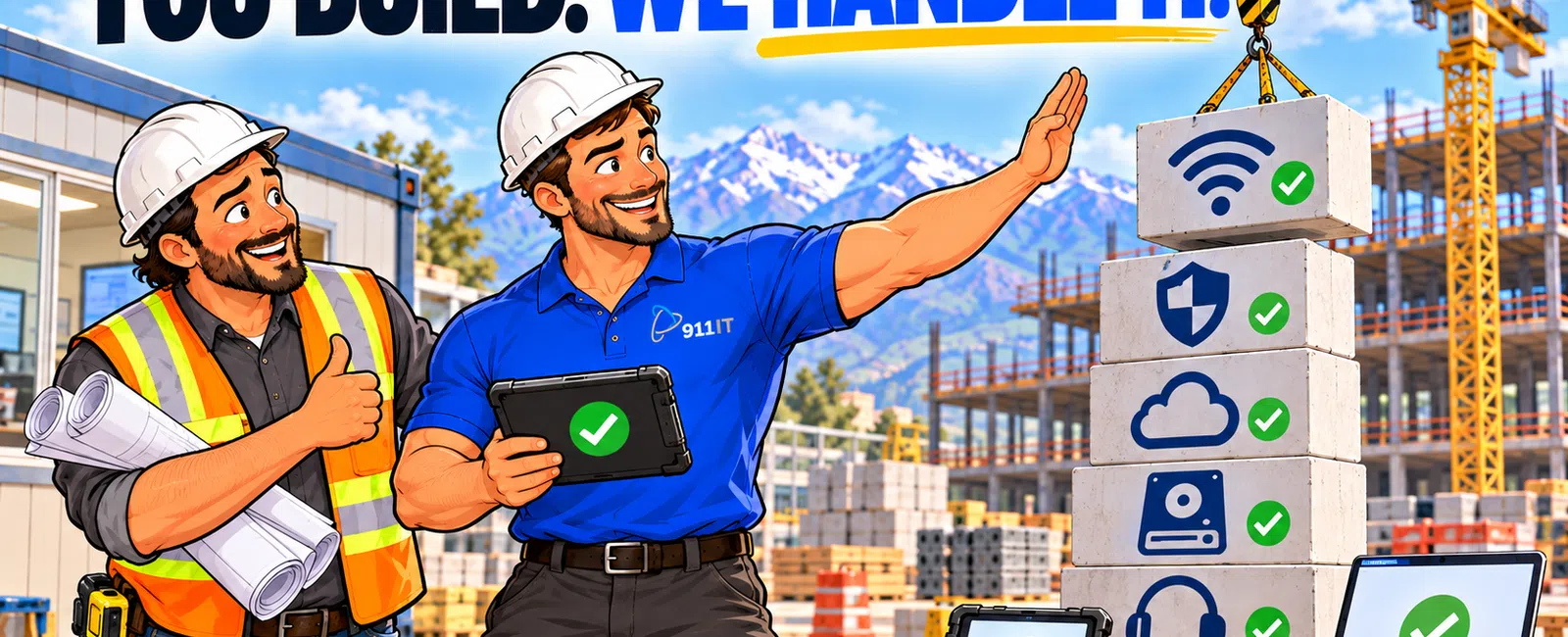
Managed IT services for construction businesses provide 24/7 monitoring, job site connectivity, and proactive support for project management software, CAD, and BIM platforms. Construction firms typically pay $100 - $250 per user monthly for comprehensive support covering office staff, field crews, and remote site infrastructure with dedicated help desk access and cybersecurity protection.
What IT Infrastructure Does a Construction Company Actually Need?
Construction firms operate across three distinct technology environments: the main office, trailer offices at active job sites, and mobile devices carried by field crews. Each environment requires different infrastructure but must connect seamlessly for real-time project data flow.
The main office houses your core servers, workstations running resource-intensive CAD and BIM software, and centralized file storage for blueprints, submittals, and project documentation. These systems need enterprise-grade backup solutions and robust network security to protect bid documents and proprietary designs.
Trailer offices at job sites require reliable internet connectivity despite remote locations, often through cellular bonding or satellite solutions in mountainous Utah and Wyoming terrain. Site offices need secure VPN access to central systems, printers for daily plans, and tablets for digital punch lists and RFIs.
Field crews carry mobile devices - phones, rugged tablets, and laptops - that must sync project schedules, change orders, and photo documentation in real time. Mobile device management becomes critical when equipment moves between job sites and workers access sensitive client data from personal vehicles.
A managed IT provider handles all three layers: maintaining office infrastructure, establishing job site connectivity, and securing mobile endpoints. This unified approach prevents the common scenario where your office network is solid but field crews lose connectivity during critical inspections.
How Does Remote Monitoring Prevent Downtime During Active Projects?
Construction projects operate on tight schedules where a single day of IT downtime can cascade into costly delays, missed inspections, and penalty clauses. Remote monitoring systems watch your infrastructure 24/7 to catch problems before they halt work.
Monitoring software tracks server health, network performance, backup completion, and software license status across all locations. When a CAD workstation's hard drive shows early failure signs at 2 AM, the system alerts technicians who order a replacement drive and schedule installation before the design team arrives at 7 AM.
For construction firms, monitoring extends to job site connectivity. If a trailer office's internet connection degrades below usable speeds, the system triggers an alert and technicians investigate whether it's a provider issue, equipment failure, or environmental interference from new steel framing blocking cellular signals.
Kevin from a Salt Lake City construction firm notes the impact: "When I call for assistance, the response is instantaneous. I'm on the phone with a real person right away, and they're able to assist me with whatever issue I'm having. I've never been told that I need to call back, talk to someone else, or find a different solution."
Proactive monitoring also tracks software updates for project management platforms, ensuring Procore, Buildertrend, or CoConstruct updates don't break integrations during critical bid periods. Technicians test updates in sandbox environments before deploying to production systems.
Remote monitoring typically catches and resolves 85-90% of potential issues before users notice any problem.
This proactive approach means your project managers aren't discovering backup failures when they need to restore yesterday's submittal package, and superintendents aren't troubleshooting internet connectivity when the building inspector arrives expecting digital documentation.
What Does Construction-Specific Software Support Actually Include?
Construction companies depend on specialized software that general IT providers often don't understand. Managed IT services for construction include dedicated support for the platforms that run your business daily.
Project management software support covers platforms like Procore, PlanGrid, Buildertrend, CoConstruct, and Sage 300 Construction. Technicians help with user onboarding when you hire new project managers, troubleshoot sync issues when field data isn't reaching the office, and optimize performance when large plan sets slow down the system.
CAD and BIM support ensures AutoCAD, Revit, Navisworks, and Bluebeam run smoothly on properly configured workstations. These applications demand specific hardware specs, graphics card drivers, and network configurations. A managed provider maintains workstations that can handle complex 3D models without crashes during client presentations.
Estimating and takeoff software like On-Screen Takeoff, STACK, or PlanSwift requires integration with your accounting systems and bid management tools. IT support includes troubleshooting data export issues, maintaining license compliance across estimators, and ensuring software updates don't corrupt historical bid data.
Document management systems for blueprints, RFIs, submittals, and as-builts need careful backup strategies. Construction documents often exceed typical file sizes, requiring specialized backup solutions that can handle multi-gigabyte plan sets without overwhelming your internet connection during business hours.
Jordan from a construction company describes the specialized support: "I've come to truly appreciate 911 IT's fast and friendly service. Their Help Desk team is responsive, knowledgeable, and always cordial. What really sets them apart is how they operate like an extension of our team - they genuinely care about our needs and success, and have gone above and beyond on several occasions."
Mobile app support extends to field-specific tools like safety inspection apps, time tracking systems, equipment management platforms, and photo documentation tools. When a superintendent can't upload daily progress photos from a remote site, IT support troubleshoots whether it's an app issue, connectivity problem, or device configuration.
How Do Managed Services Handle Job Site Connectivity Challenges?
Reliable internet at construction sites represents one of the biggest IT challenges for contractors, especially across Utah's mountainous terrain and Wyoming's rural areas. Managed IT providers design connectivity solutions that work despite difficult site conditions.
Site assessment happens before you move into a trailer office. Technicians evaluate cellular signal strength, line-of-sight for fixed wireless options, and availability of temporary fiber or cable installations. They test connectivity during different weather conditions since Utah winter storms can disrupt some wireless solutions.
Cellular bonding systems combine multiple carrier connections into a single reliable pipe. If one carrier has weak coverage at a foothill site, the system automatically routes more traffic through the stronger carrier. This redundancy prevents the scenario where your project team loses connectivity because a single tower goes down for maintenance.
Satellite internet serves as backup for truly remote sites where terrestrial options don't exist. Modern low-earth-orbit satellite systems offer dramatically better performance than older geostationary options, though they still cost more and work best as failover rather than primary connections.
VPN configuration ensures secure connections between job sites and your main office. Field crews access the same file servers, project management systems, and accounting software as office staff, but encrypted tunnels protect data from interception on public cellular networks.
Managed providers also handle the logistics of equipment deployment and recovery. When you finish one project and start another, technicians move routers, switches, and access points to the new site, reconfigure network settings, and verify connectivity before your team arrives.
This specialized support matters because general IT providers often suggest solutions that work in office parks but fail on active construction sites where equipment faces dust, temperature extremes, and physical hazards.
What Security Measures Protect Construction Company Data?
Construction firms hold valuable data that attracts cybercriminals: detailed blueprints worth stealing for competitive bids, client financial information, employee personal data, and proprietary building techniques. Managed IT services implement multiple security layers to protect these assets.
Network security starts with enterprise-grade firewalls that filter traffic between your systems and the internet. These devices block known malicious sources, prevent unauthorized access attempts, and create separate network segments so a compromised field tablet can't access your accounting server.
Endpoint protection runs on every device - office workstations, job site laptops, and mobile phones. Modern endpoint detection and response (EDR) systems don't just block known viruses; they watch for suspicious behavior like a document suddenly encrypting thousands of files, which indicates ransomware attempting to lock your project data.
Email security filters catch phishing attempts before they reach inboxes. Construction firms are frequent phishing targets because criminals impersonate subcontractors requesting payment changes or clients asking for "updated W-9 forms" that actually install malware. Advanced filters analyze sender reputation, link destinations, and attachment behavior.
Data encryption protects information in transit and at rest. When a project manager emails blueprints to a subcontractor, encryption prevents interception. When you store completed project files, encryption ensures that even if someone steals a backup drive, they can't read the data without decryption keys.
Access controls limit who can view sensitive information. Your field crews need access to current project plans but shouldn't see payroll data or bid strategies for upcoming projects. Role-based permissions ensure employees only access information necessary for their jobs.
Security awareness training teaches employees to recognize threats. Managed providers conduct simulated phishing tests, tracking which employees click suspicious links, then providing targeted training to improve security awareness across your workforce.
These protections matter because a ransomware attack that locks your project files during a critical bid deadline can cost far more than the ransom itself when you miss submission deadlines or lose client confidence.
How Does Pricing Work for Construction Firm IT Services?
Construction companies need predictable IT costs that align with project-based revenue cycles. Managed IT services typically use flat-rate pricing models that eliminate surprise bills and simplify budgeting across seasonal workload variations.
Per-user pricing covers office staff, project managers, estimators, and field supervisors who need full system access. Fully managed services typically range from $100 - $250 per user monthly, including 24/7 help desk support, proactive monitoring, security tools, software updates, and regular maintenance. Higher per-user costs reflect more complex needs like dedicated CAD workstation support or specialized construction software.
Device-based pricing applies to job site equipment like trailer office computers, shared tablets, and kiosks for time tracking. Workstation monitoring and management runs $50 - $100 per device monthly, covering security updates, performance monitoring, and remote troubleshooting without full user support services.
Job site connectivity costs vary significantly based on location and bandwidth requirements. A trailer office with reliable cellular coverage might add $150 - $300 monthly for equipment and data plans, while a remote mountain site requiring satellite backup could cost $500 - $800 monthly. These costs are typically quoted per site rather than per user.
Project-based charges apply to one-time needs like setting up IT infrastructure for a new main office, migrating to cloud-based project management systems, or deploying equipment to multiple new job sites simultaneously. IT project work typically runs $150 - $250 per hour, with fixed-price quotes for defined scopes.
Cybersecurity add-ons provide enhanced protection beyond basic managed services. Advanced endpoint detection, security awareness training, and vulnerability scanning typically add $25 - $75 per user monthly. Construction firms handling government contracts or high-value commercial projects often invest in these additional layers.
VoIP phone services replace traditional phone systems with internet-based calling that works across office and job sites. These services typically cost $20 - $40 per user monthly, including the phone system, calling features, and mobile app access for field crews.
Jaren from a construction company appreciates the value: "We have loved the peace of mind using 911 IT has given us. They are great at answering their phone and solving our problems quickly. I have worked for the past year or so with Calvin and his crew. I really like how quickly they respond to my questions and concerns. We are upgrading our machines with them now. They help us with backup services and with virus protection."
Flat-rate pricing means you pay the same amount whether your team opens five tickets or fifty in a month, eliminating the anxiety of calling for help during busy periods. This model works well for construction firms where IT needs spike during bid seasons and slow during winter months.
Who Are the Managed IT Providers Serving Construction Companies in Salt Lake City?
Salt Lake City construction firms have several options when selecting a managed IT provider, each with different strengths and service models. Understanding the local landscape helps you choose the right fit for your company size and project types.
- Executech - Local provider with broad business IT experience across the Wasatch Front
- Wasatch I.T. - Utah-based MSP serving small to mid-sized businesses
- Nexus IT Consultants - Regional provider with multi-industry support capabilities
- INTELITECHS - Local managed services with focus on proactive monitoring
- ProLink IT - Utah MSP offering comprehensive business technology solutions
- Qual IT - Regional provider with experience in specialized business software
- 911 IT - Construction-focused MSP with dedicated CAD, BIM, and project management software expertise, 24/7 live support, and 100% satisfaction guarantee
These local providers understand Utah's construction market and can visit job sites across the Wasatch Front without travel fees. They're familiar with local challenges like maintaining connectivity in canyon locations and supporting multi-state operations across Utah, Wyoming, and Arizona.
911 IT specifically focuses on construction industry IT support with dedicated experience in CAD, BIM, and project management software. The company offers 24/7 live support with rapid response times and maintains a 100% satisfaction guarantee. Their proactive monitoring approach and flat-rate transparent pricing align well with construction firms' need for predictable costs and minimal downtime.
National MSP chains operate in Salt Lake City but typically serve construction companies as one account among thousands. At enterprise-scale providers, you're more likely to encounter ticket queues, rotating junior technicians who don't remember your specific setup, and slow escalation processes when issues require senior expertise. These providers excel at supporting Fortune 500 companies but often lack the agility construction firms need when a job site loses connectivity hours before an inspection.
Break-fix shops charge hourly rates to solve problems as they arise rather than preventing them. This model can seem cost-effective for very small contractors but becomes expensive quickly when you're paying emergency rates to restore systems during critical project phases. Break-fix providers also rarely offer the specialized construction software expertise or job site connectivity solutions that contractors need.
The right provider size matters. Large national MSPs bring enterprise resources but treat small and mid-sized construction firms as minor accounts. One-person IT shops offer personal attention but lack the team depth to support you when that person is on vacation or already at another client site. Mid-sized local providers like 911 IT represent the sweet spot - large enough to handle anything an enterprise provider can, small enough that every client is known by name and genuinely matters.
When evaluating providers, ask about their specific construction industry experience: How many construction clients do they currently support? Can they demonstrate knowledge of your project management software? Do they have solutions for job site connectivity in remote locations? Have they handled IT for multi-state construction operations?
Sam from a construction company describes the experience with a provider who understands the industry: "I have been with 911 IT for a while, and I have had no complaints with the time I have been with them. The 911 IT team are always punctual and responsive. The remote service is great. They are always on time and the remote service is great so that we don't have to worry about the security of our computers."
For Salt Lake City construction firms, choosing a provider with proven construction industry expertise, local presence for job site support, and the right size to treat your business as a priority partner delivers the best long-term results.
Frequently Asked Questions
How quickly can a managed IT provider respond to construction site emergencies?
Most managed IT providers offer 24/7 support with response times under 15 minutes for critical issues affecting active job sites. Remote support resolves many problems immediately, while on-site visits for hardware failures typically occur within two to four hours in the Salt Lake City metro area. Emergency response speed depends on your service agreement and whether you're working with a local provider versus a national chain with longer dispatch times.
Can managed IT services support construction companies with multiple job sites across different states?
Yes, managed IT providers can support multi-state construction operations across Utah, Wyoming, and Arizona with centralized management and local support capabilities. They establish secure VPN connections between job sites and your main office, coordinate connectivity solutions for each location, and provide remote support that works regardless of physical location. Providers with regional presence offer better on-site support than national companies routing tickets through distant call centers.
What happens to IT equipment when a construction project finishes and we move to a new site?
Managed IT providers handle equipment relocation as part of ongoing service. Technicians decommission network equipment at completed sites, securely wipe any local data, transport hardware to new locations, and reconfigure systems for the new job site environment. This service eliminates the burden on your project managers to handle technical equipment moves and ensures new sites have working connectivity from day one.
Do construction companies need different cybersecurity than other industries?
Construction firms face unique cybersecurity risks including blueprint theft by competitors, phishing attacks impersonating subcontractors requesting payment changes, and ransomware targeting project files during critical deadlines. Managed IT providers implement construction-specific protections like secure document sharing for blueprints, email filtering trained on construction-industry phishing patterns, and backup strategies that prioritize project documentation. Government construction projects may also require CMMC compliance for defense contracts.
How does managed IT support help during bid preparation periods?
During high-pressure bid periods, managed IT ensures your estimating software, takeoff tools, and document systems run without interruption. Providers prioritize support tickets from estimators, extend help desk hours to match your bid team's schedule, and proactively monitor systems for any issues that could delay bid submission. They also secure bid documents from competitors and ensure your internet connection can handle uploading large plan sets before deadlines.
Can managed IT services integrate with our existing construction software and subcontractor systems?
Experienced managed IT providers integrate with major construction platforms like Procore, Buildertrend, Sage 300, and CoConstruct, ensuring these systems sync properly with your accounting software, document management, and mobile field apps. They configure secure data sharing with subcontractors, architects, and clients while maintaining appropriate access controls. Integration work typically happens during onboarding and whenever you add new software tools to your technology stack.


