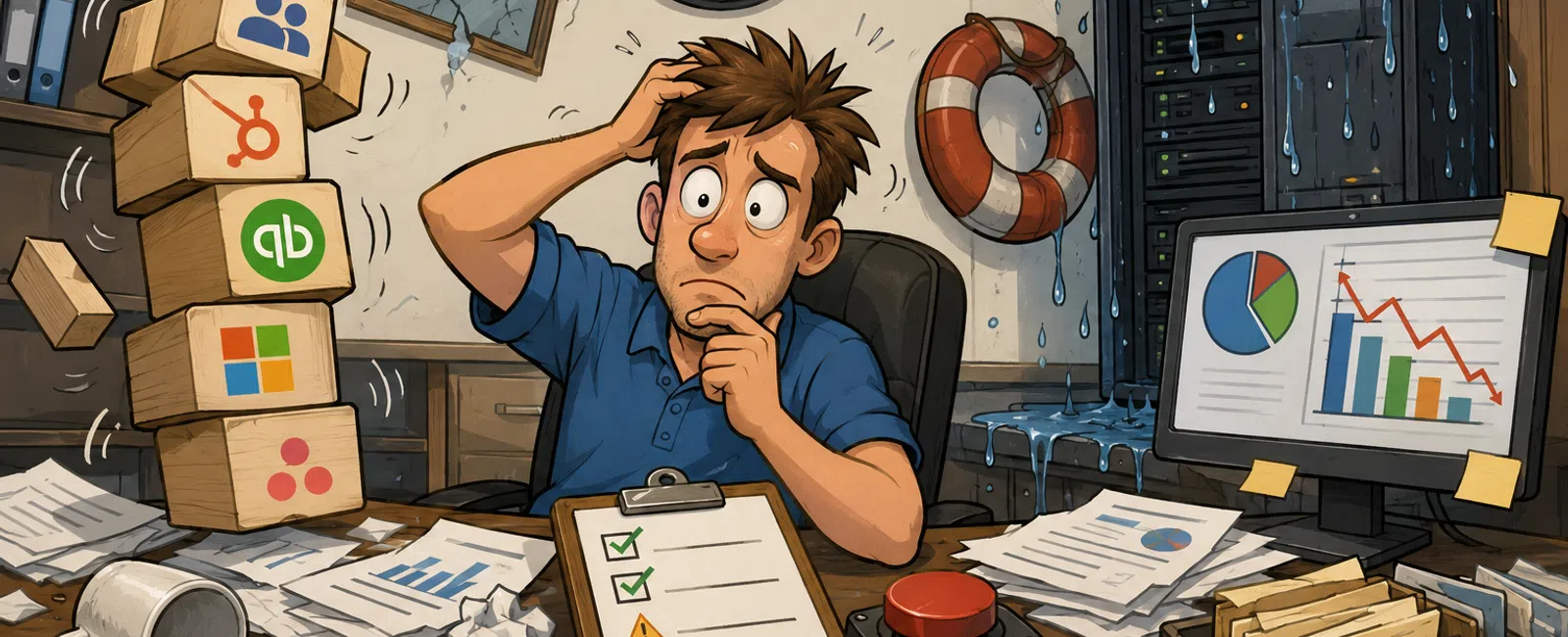
Midyear Reality Check: What Changed in Your Systems Is Now a Business Risk
January feels controlled.
Roles are clear. Systems are intentional. Ownership exists—even if
undocumented.
By July, that control has drifted.
Not because anything failed. Because your business moved fast and your
systems changed just as quickly without being revalidated.
That's where risk forms.
This matters most if you are responsible for reporting accuracy,
financial data, or operational visibility. When systems drift, your numbers
and decisions are the first to feel it.
What "Controlled" Actually Looks Like
Here is what a controlled environment looks like in practice—not theory.
Access Report (must exist and be current)
- User: Sarah
Chen
- Role: Marketing
Manager
- Systems:
HubSpot, SharePoint
- Permission
Level: Standard (no export access)
- Last Reviewed:
June 5
- Approved By: IT
Lead
If you cannot produce this quickly, you don't have verified control.
System Ownership Table (example)
System: HubSpot
Owner: Marketing Director
Backup: Sales Operations
Last Access Review: May 12
Risk Status: Yellow
System: QuickBooks
Owner: Finance Manager
Backup: Controller
Last Access Review: April 3
Risk Status: Red
System: Microsoft 365
Owner: IT
Backup: External Vendor
Last Access Review: June 1
Risk Status: Green
This is the level of visibility auditors expect and leadership relies on.
Recovery Standard (minimum acceptable)
- CRM restored
within 4 hours
- Finance system
restored within same business day
- Named recovery
lead
- Last tested
date documented
If recovery isn't tested, you are relying on assumption.
The Midyear System Scorecard
Score your actual environment—not your intention.
Access Control
- Green: Fully
mapped and reviewed in last 90 days
- Yellow: Exists
but outdated or inconsistent
- Red: No clean
visibility
System Alignment
- Green: Data
consistent across systems
- Yellow: Manual
fixes required
- Red: Reports
conflict
Backup & Recovery
- Green: Tested
with defined timelines
- Yellow: Backups
exist, recovery unclear
- Red: No
ownership or plan
Ownership
- Green: Named
owner per system
- Yellow: Shared
or unclear
- Red: No defined
responsibility
Two Yellows = drift
One Red = exposure
What This Looked Like for a 42-Person Company
Environment:
- HubSpot (CRM)
- QuickBooks
(billing)
- Asana
(operations)
- Microsoft 365
(email and file storage)
Before
- No confirmed
system ownership
- Access reviews
not done in over 6 months
- HubSpot-QuickBooks
sync partially failing
- Finance and
sales reporting did not match
What was fixed in 90 minutes
- Pulled and
reviewed access across Microsoft 365 and HubSpot
- Removed 18
unnecessary permissions
- Assigned single
owner to each system
- Identified and
corrected the broken CRM-billing sync
Measured impact
- Reduced
reconciliation time from 12 hours to under 2 hours
- Restored
reporting consistency across sales and finance
- Eliminated
duplicate data exports from marketing
Nothing was "down." But the business was operating with distorted
information.
Top 5 Red Flags We See Midyear
These show up consistently:
- No one can name
the recovery owner in under 10 seconds
- Access reviews
are older than 90 days
- Multiple
systems contain the same revenue data
- Teams export
data instead of trusting system reporting
- Vendors have
access, but no one tracks what level
If you recognize even one of these, your systems have drifted.
Where This Breaks (Sharpened Example)
Marketing exports a HubSpot report to build a campaign.
The export includes revenue fields pulled from the QuickBooks sync.
The sync has been failing silently for two weeks.
Now:
- Campaign
decisions are based on incorrect revenue numbers
- Finance reports
different totals
- Leadership
pauses planning because data isn't trustworthy
No alerts. No outage.
The problem is discovered only after decisions are already impacted.
The Compliance and Financial Risk Layer
This isn't just operational.
It directly affects:
Data Exposure
- Users retaining
access they no longer need
- Financial or
customer data accessible outside intended roles
Financial Accuracy
- Disconnected
systems producing conflicting reports
- Manual
reconciliation increasing error risk
Audit Readiness
- No documented
access reviews
- No system
ownership clarity
- No proof of
recovery capability
At that point, this stops being an IT issue. It becomes a finance and
executive issue.
Where an External Reviewer Looks First
If an external party walked in, they would not look for failures.
They would look for signals of weak control:
- Access not
aligned to roles
- Inconsistent
reporting across systems
- No clear
ownership structure
- Untested
recovery processes
- Vendor access
without visibility
None of these trigger alarms immediately.
Together, they signal risk.
System-Specific Reality Checks
Ground this in actual systems your team uses:
- Pull access
reports from Microsoft 365 Admin Center
- Review user
roles and permissions directly in HubSpot
- Check sync
status between HubSpot and QuickBooks
- Confirm Asana
project ownership and admin rights
These are not audits. These are visibility checks.
What This Actually Takes
Most teams overestimate the effort.
Typical timeline:
- Access review:
~30 minutes
- Ownership
mapping: ~30-45 minutes
- Integration
validation: ~30 minutes
- Recovery
clarity: ~15 minutes
Most businesses resolve the largest blind spots in under 2 hours.
The blocker is not time. It's awareness.
Your Next-Week Action
Block 60 minutes and do this in order:
- Pull access
lists from your core systems
- Identify one
owner per system
- Spot-check one
integration for accuracy
- Ask your team:
"Who owns recovery if systems go down?"
Anything unclear is a real gap.
The Bottom Line
Risk doesn't come from what's broken.
It comes from what changed and was never revalidated.
By midyear, most businesses are operating on assumptions. That is where
reporting errors, access exposure, and decision delays show up first.
Schedule your 10 minute discovery call. We'll walk through your current
systems and identify exactly where control has drifted and where it hasn't. 911
IT will give you a direct, diagnostic answer on what actually needs attention.