
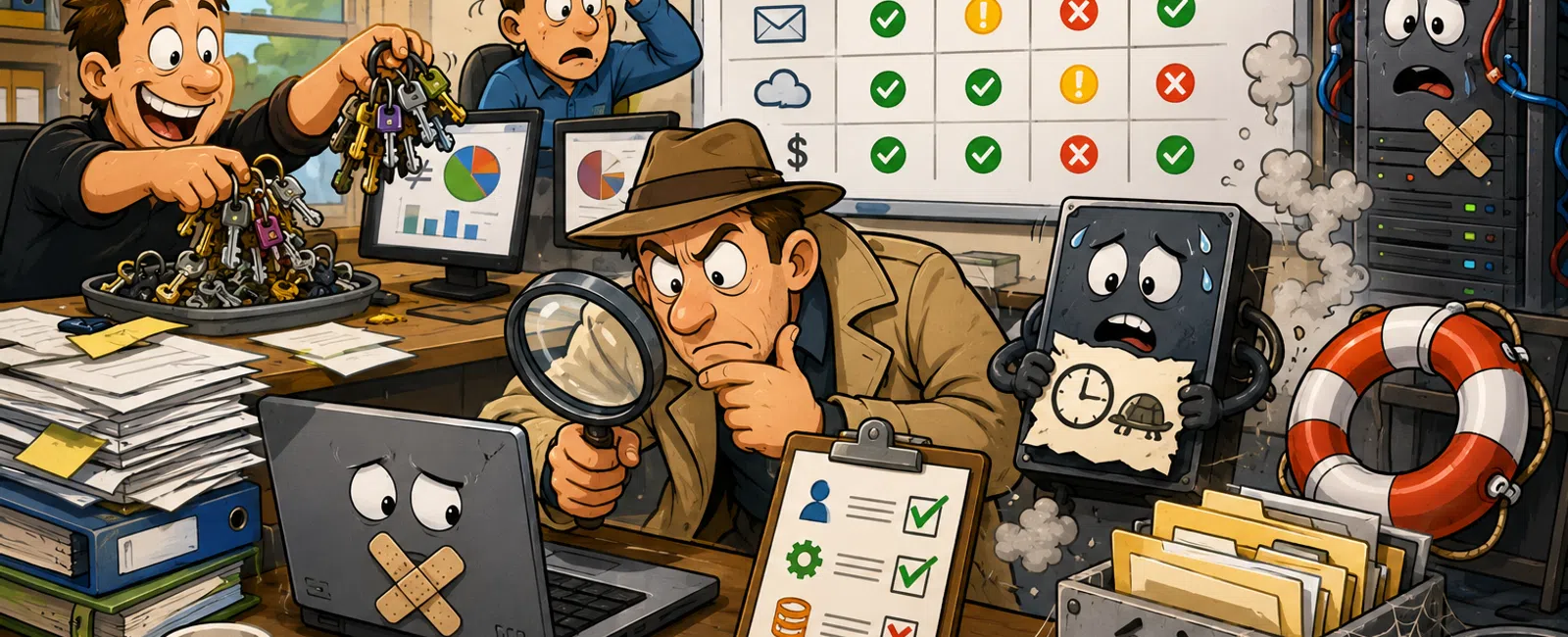
Midyear Reality Check: Where Your Systems Drifted—and How to Prove It
Here's the thing.
By July, most firms aren't dealing with broken systems.
They're dealing with unchecked change.
Access expanded. Tools stacked. Backups were "set and forgotten."
Responsibility blurred.
Nothing feels urgent.
Until it is.
In our experience, that's the exact point where risk is highest—right
before something forces you to prove what you thought was true.
The Pattern We See Repeatedly
This isn't a one-off observation.
Across midyear reviews, the same patterns show up:
- 20-30% of user
accounts have excess access in at least one system
- Integrations
fail silently without alerts
- Backups
exist—but recovery has never been tested under pressure
Nothing looks broken on the surface.
But underneath, the system isn't aligned anymore.
Top 3 Risk Indicators (Quick Read)
You likely have exposure right now if:
- You cannot
answer access questions in under 10 minutes
- Your reports
don't match across systems
- You have not
tested recovery this year
If one of these is true, you're operating on assumption—not verification.
What "Clean" Systems Look Like by July
Clarity is measurable.
Access → Visibility
- Less than 5%
inactive or unnecessary accounts
- Quarterly
access review completed
- Privileged
admin accounts tracked and reviewed separately
Tools → Alignment
- Microsoft 365,
CRM, and financial systems produce consistent reporting
- Integrations
are documented and monitored
- No overlapping
tools solving the same function
Backup → Certainty
- Backup tested
within the last 90 days
- RTO defined
(how fast systems must be restored)
- RPO defined
(how much data loss is acceptable)
Ownership → Accountability
- One accountable
owner per system
- Escalation path
documented
- No ambiguity
between internal team vs vendor responsibility
If you don't see this, you don't have a stable system.
You have a temporary one.
The Midyear Check—Run This Like an Audit
Not questions.
Actions—with interpretation.
1. Access
Action
- Export users
from Microsoft 365 and key systems
- Compare against
your current employee roster
What You Should See
- Expect 5-10%
mismatch in most firms
- If it's over
10%, that's a high-risk flag
- Admin accounts
are often overlooked or excessive
Advanced Insight Privileged access is rarely reviewed with the same
frequency as standard users—and that's where the highest exposure sits.
2. Tools
Action
- Identify your
core systems (Microsoft 365, CRM, QuickBooks)
- Compare key
reports across them
What You Should See
- Minor
differences happen
- Consistent
discrepancies signal integration failure
- Duplicate data
usually means no defined source of truth
Advanced Insight Integrations fail quietly. API connections break
without notice, and teams compensate manually without realizing the system
itself is drifting.
3. Backup
Action
- Run a
file-level restore test this week
- Measure the
time to complete
What You Should See
- Recovery should
complete within an expected timeframe (your RTO)
- Restored data
should include correct permissions—not just files
- If you don't
know your RTO, you don't have one
Critical Clarification Cloud systems like Microsoft 365
store data—but they are not designed to guarantee full operational recovery on
their own.
Failure Pattern We See Often
- Backup exists
- Restore process
is untested
- Permissions
fail during recovery
- Data comes
back—but isn't usable without manual rework
Advanced Insight The failure is rarely the backup. It's the restore
under pressure—especially when permissions and dependencies don't carry over.
4. Ownership
Action
- Assign one
accountable owner per system
- Document
escalation paths in plain language
What You Should See
- Clear ownership
across all systems
- No shared
accountability
- Immediate
clarity when something goes wrong
Advanced Insight Vendors often assume ownership unless explicitly
defined. That assumption creates gaps the moment an issue crosses systems.
What an External Review Sees Immediately
An external evaluator doesn't look for what's working.
They look for misalignment.
It becomes visible quickly:
- Access that
doesn't match roles
- Systems
producing conflicting outputs
- Backup
confidence without testing
- Ownership gaps
delaying resolution
This is where exposure shows up first—not in failure, but in
inconsistency.
How This Fails in the Real World
A finance lead leaves in March.
They had access to QuickBooks and reporting files in Microsoft 365.
Access is partially removed—but not fully.
By April:
- An integration
tied to their account begins failing
- Reports start
drifting slightly
By May:
- Discrepancies
increase across financial reports
- Manual
workarounds begin
By June:
- Leadership
identifies reporting inconsistencies
- Several hours
are spent reconciling numbers before decisions can be made
Impact
- 6-10 hours lost
on validation
- Delayed
financial decisions
- Reduced
confidence in reporting
Root Cause Access was never fully cleaned up, and no one owned the integration.
Nothing broke all at once.
It drifted until it mattered.
If You Only Do One Thing This Week
Test your recovery process.
Not your backup.
Your recovery.
That's the difference between believing you're covered and knowing you
are.
What to Do Next Week
Block 45 minutes.
Pick one area—Access, Tools, Backup, or Ownership.
Run the steps above until you have a verified answer, not an assumption.
Stop where clarity breaks.
That's your highest priority.
Confirm Where You Actually Stand
Schedule your 10 minute discovery call with 911 IT.
This is a fast way to validate whether these gaps exist in your
environment and how serious they are. It gives you a clear answer without
adding more complexity.


