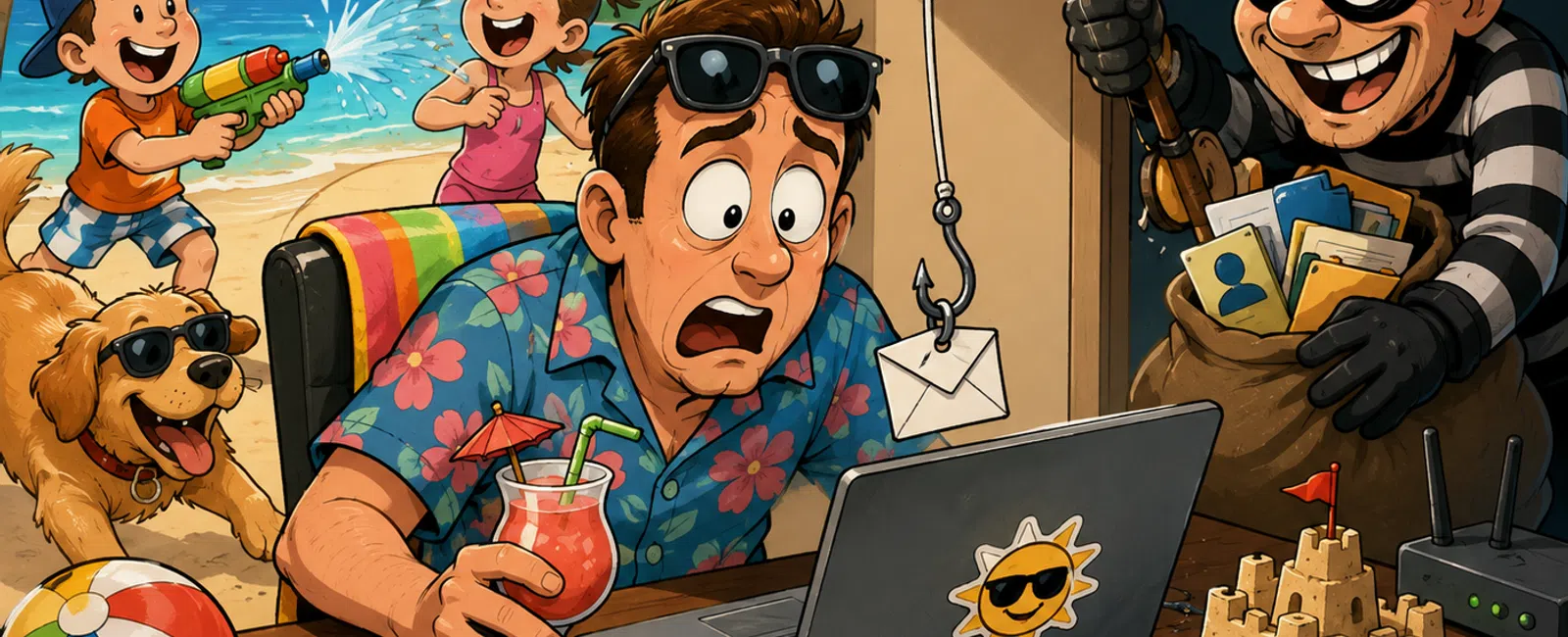
SCHOOL'S OUT. CYBERCRIMINALS ARE IN.
School's out, and for a lot of growing businesses, the
workday quietly changes.
Hours shift. Focus fragments. Work happens between drop‑offs, background noise,
and shorter stretches of uninterrupted time. Nothing feels broken. It just
feels faster.
Cybercriminals plan for this.
They don't wait for chaos. They wait for distraction. When
routines loosen and attention is split, a single ordinary moment is enough. Not
a dramatic failure. Just a fast decision made while your brain is somewhere
else.
THIS ISN'T YOUR NORMAL WORKDAY — AND THAT MATTERS
Summer doesn't introduce new risks. It exposes existing
ones.
Most attacks don't arrive looking suspicious. They look
routine: an invoice, a shared file, a quick request that feels familiar. The
timing is the trick. Not when someone is focused. When they're busy.
In those moments, speed wins over scrutiny. That's where
businesses get hurt.
THE CLICK ISN'T THE REAL PROBLEM
When someone clicks a phishing link or opens a malicious
attachment, the damage doesn't stop with that one action.
That click inherits whatever access that user has.
Email accounts. Shared drives. Line‑of‑business systems.
Cloud admin portals.
In real environments, nothing is isolated. Once access is
gained, it often moves laterally—quietly spreading across accounts and systems
before anyone notices. By the time the alert shows up, the impact is already
much larger than a single mistake.
This is where boards ask uncomfortable questions later:
"Why could one click reach so much?"
WHY "JUST BE MORE CAREFUL" ALWAYS FAILS
Telling people to be more careful assumes they have time to
stop and evaluate every decision.
They don't.
Your team is juggling conversations, switching contexts, and
moving quickly to keep operations running. That's not a discipline problem.
It's a reality problem.
Security that depends on perfect attention will eventually
fail—usually at the worst possible time.
WHAT PROTECTION LOOKS LIKE IN THE REAL WORLD
The goal isn't flawless behavior. It's limiting blast
radius.
When guardrails are in place, a normal workday mistake stays
small instead of becoming a company‑wide incident. For most midsized Utah
businesses, that means focusing on a few non‑negotiables.
THE SUMMER SECURITY MINIMUM CHECKLIST (PRINT‑READY)
Use this as a baseline. If any box is unchecked, one mistake
can travel too far.
Unique passwords everywhere
One compromised login should never unlock multiple systems.
Multifactor authentication on all critical accounts
Especially email, remote access, and admin‑level logins.
Email filtering that stops threats before they reach users
Fewer bad messages means fewer risky decisions.
Clear "pause and ask" path
One obvious way for employees to flag something that feels off without slowing
work down.
Restricted access by role
Users should only touch what they need to do their job—nothing more.
Hand this list to anyone responsible for IT oversight. If
they hesitate on an answer, that's the signal.
WHERE THIS USUALLY BREAKS FIRST
Earlier this year, we worked with a midsized professional
services firm during the early weeks of summer. Schedules were flexible.
Leaders were in and out. Nothing felt unusual.
An employee clicked a routine‑looking email while juggling a
meeting and a personal interruption. The message wasn't obviously malicious. No
red flags. Just familiar enough to move quickly.
That one click didn't cause the damage.
What mattered was what came next.
The compromised email account had access to shared folders
and could trigger password resets tied to other systems. From there, the
attacker quietly expanded access into billing data before any alerts fired.
No malware. No exotic tools. Just ordinary systems connected
too loosely.
When we reviewed the environment, the gaps were simple:
Email didn't require MFA everywhere
Shared access hadn't been restricted by role
There was no clear way for employees to pause and flag something suspicious
without slowing work down
Once guardrails were put in place, the same mistake would
have stopped at the inbox instead of spreading.
That's the difference between relying on perfect
attention—and designing for real workdays.
WANT TO SEE HOW FAR ONE CLICK COULD REALLY GO?
Want to know how far one click could actually go in your
business?
We'll walk through a real scenario in your environment and show you exactly
where it stops—or exactly where it doesn't.
WHAT TO DO THIS WEEK — NOT SOMEDAY
Before next Friday, pick one real scenario and pressure‑test
it.
Ask:
"If someone clicked the wrong link this afternoon, how far could it go before
we stopped it?"
If the answer is unclear, that's your next action.
FIX THIS BEFORE THE PACE GETS WORSE
Summer doesn't slow attackers down. It speeds them up.
If your business still relies on everyone catching
everything perfectly, you're exposed right now—even if nothing has happened
yet.
Fix this today. Reach out to 911 IT now and lock down the
guardrails before one mistake turns into a much bigger problem.