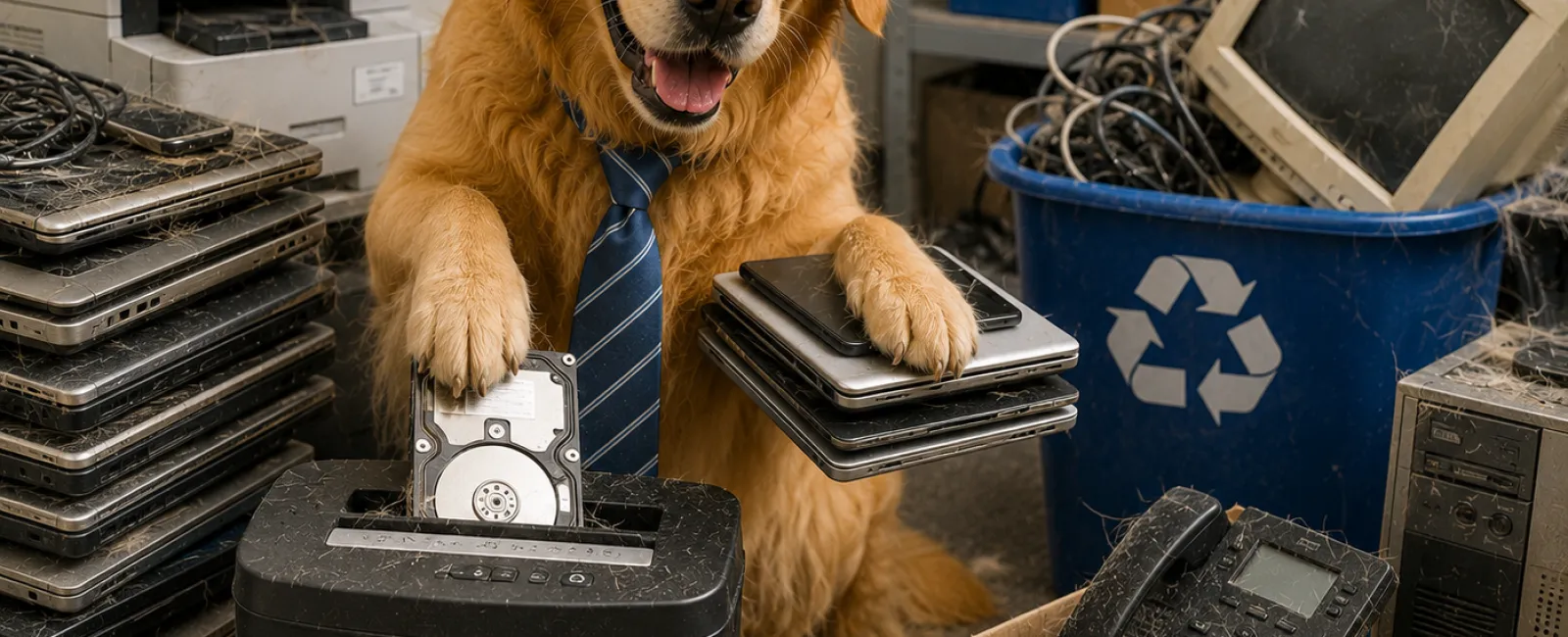
TECHNOLOGY RETIREMENT IS WHERE FINANCIAL FIRMS ACTUALLY FAIL COMPLIANCE
Most financial firms believe their biggest technology risk
lives in production systems. In reality, it shows up months later—during an
audit, an insurance renewal, or a board review—when someone asks a simple
question:
"Can you prove what happened to that device?"
At that moment, intention stops mattering. Documentation
does.
I've seen strong IT programs stumble not because systems
were mismanaged, but because retired technology was never treated as a control.
Laptops, printers, backup drives, and phones quietly exit use—and quietly fall
out of governance. That's where compliance breaks.
This isn't theoretical. This is where remediation starts.
WHERE THIS FAILS IN THE REAL WORLD
Here's the most common failure pattern I see in regulated
financial environments:
A leased multifunction printer is returned at end of term.
IT assumes the vendor handles wiping.
Finance closes the lease.
No wipe certificate is retained.
Six months later, during a compliance review, the auditor
asks for proof that stored scans—tax returns, IDs, signed documents—were
destroyed according to standard.
There is none.
The result isn't a breach headline. It's worse: a documented
control failure that triggers remediation, follow‑up testing, and uncomfortable
insurer questions about data handling practices.
This happens because retirement is treated as an operational
afterthought instead of a governed lifecycle phase.
THE STANDARDS THAT ACTUALLY MATTER (AND WHEN)
Saying "we follow best practices" does not survive scrutiny.
Auditors expect alignment to specific standards, applied correctly.
Here is what holds up:
NIST 800‑88
This is the primary standard auditors look for in data sanitization. It defines
clear, purge, and destroy methods, verification requirements, and media‑specific
handling for SSDs, HDDs, and flash storage.
DoD 5220.22‑M
Legacy, but still commonly referenced in contracts and questionnaires. If you
claim it, you must prove overwrite methodology—not just state it.
NAID AAA, R2, eStewards
These apply to vendors, not you—but you are accountable for selecting partners
who can produce serial‑level certificates and chain‑of‑custody records.
If your documentation cannot name the standard used and show
evidence tied to the device, you are exposed.
WHO OWNS THIS INTERNALLY (AND WHY FIRMS GET IT WRONG)
Technology retirement fails when ownership is assumed
instead of assigned.
A defensible split looks like this:
IT owns inventory accuracy, data wiping or
destruction method, and vendor execution and verification.
Operations owns physical custody until transfer,
storage controls, and movement tracking.
Finance owns asset disposition approval, lease return
timing, and confirmation that financial close aligns with data handling close.
Compliance or Risk owns record retention, audit
readiness, and policy enforcement.
If Finance closes an asset before IT documentation exists,
you have a gap.
If IT wipes a device without a retained certificate, you have a gap.
Ownership must overlap by design.
WHAT "CERTIFIED" ACTUALLY MEANS ON PAPER
Auditors don't accept assurances. They accept artifacts.
A defensible certification record includes device type and
serial number, sanitization method used, named standard, date performed, who
performed it, and a verification or certificate reference.
What does not pass includes recycler receipts without serial
numbers, invoices labeled "data destruction," or statements like "factory reset
performed."
If a third party handled it, their certificate must tie back
to your inventory. Anything else is narrative, not proof.
THE TECHNOLOGY RETIREMENT CONTROL CHECKLIST
Use this as a minimum acceptable standard:
Device inventoried with serial number and last known owner
Destination assigned: reuse, recycle, or destroy
Data handled using a named standard
Verification or destruction certificate retained
Chain of custody documented from removal to final disposition
Access credentials, MDM, and authentication removed
Records retained per policy, typically three to seven years
If any item is missing, the control is incomplete.
This checklist should stand on its own in an audit.
THE EXTERNAL LENS THAT ACTUALLY MATTERS
Ask yourself this—not as IT, but as the firm:
If an auditor, regulator, or cyber insurer asked today how
you retire technology, would you hand them records—or walk them through a
story?
Stories trigger testing. Records end conversations.
That distinction defines whether retirement is a control or
a liability.
WHAT TO DO IN THE NEXT SEVEN DAYS
Do one thing this week.
Physically walk your offices, storage rooms, and IT areas
and inventory everything no longer in active use. No decisions. No cleanup.
Just visibility.
That list alone usually exposes more risk than any
assessment tool.
FIX THIS NOW
Reach out right now and get your technology retirement
process documented, certified, and audit‑ready before this becomes a
remediation issue. This is straightforward to fix—but only if you do it
deliberately.