
The First Week Mistake Nobody Plans For
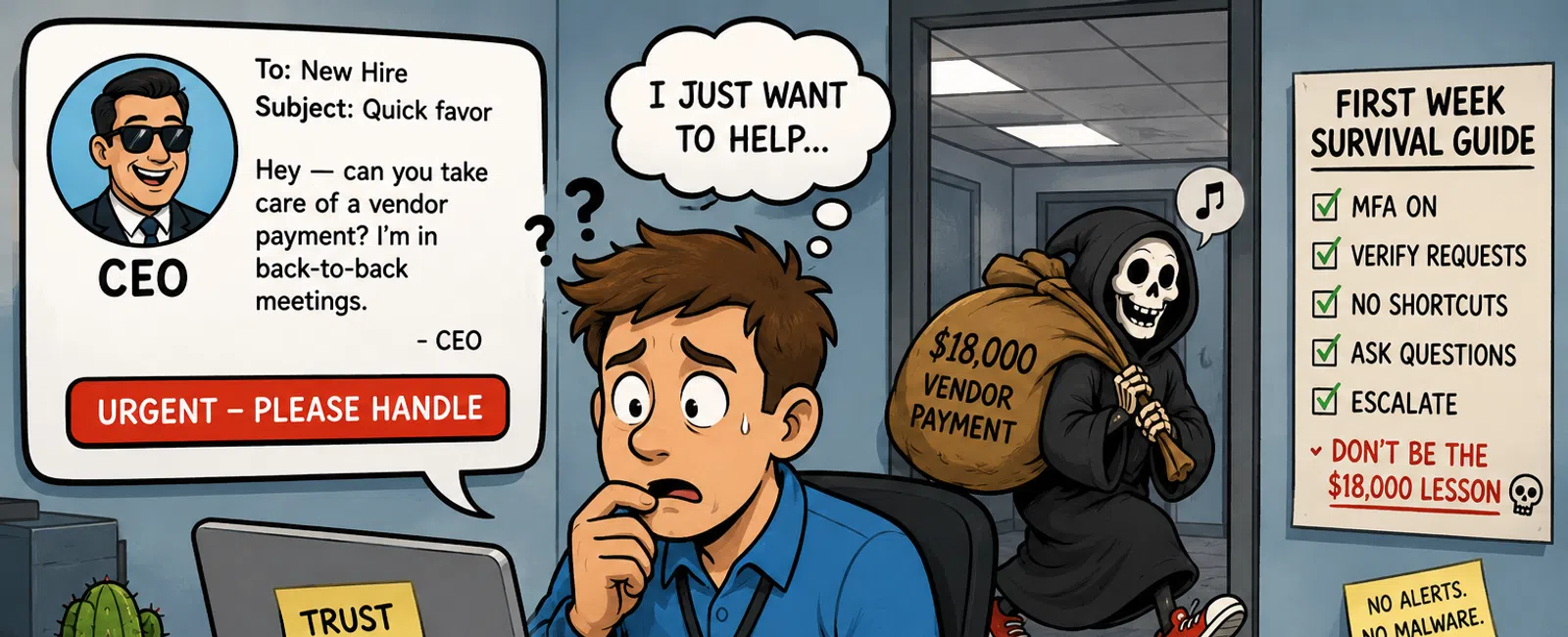
The email shows up on a Tuesday morning.
It looks like it's from the CEO.
The name matches. The tone feels right.
"Hey — can you take care of a vendor payment? I'm in back-to-back
meetings."
Your newest hire pauses.
They've been here four days. They don't know what's normal yet. But they
do know one thing: they want to be helpful.
So they act.
And just like that, the system fails—not because of a bad employee, but
because the system expected judgment where it should have enforced control.
How Common This Really Is
Let's be direct: this pattern shows up constantly—but most businesses
don't measure it clearly.
What is consistently documented:
- New hires are
more likely to act on impersonation-style requests than experienced
employees
- Attacks target
uncertainty, not technical weakness
- Financial fraud
through routine workflows (like vendor payments) happens without
triggering traditional security alerts
What you won't often see tracked internally:
- How many "near
misses" happen in week one
- How many
requests get acted on without verification
- How many
processes rely on assumption instead of enforcement
That's the gap.
The absence of data inside most businesses is exactly why the problem
persists.
What This Looks Like Across Multiple Organizations
This isn't one scenario. It repeats across roles and departments.
We've seen the same pattern in different forms:
Finance role
- New hire
processes a payment update without a second approval
- No enforced
verification workflow
- Outcome: funds
redirected without detection
Operations role
- Employee
receives a "temporary access request"
- Shares
credentials to keep things moving
- Outcome: access
exists with no accountability trail
Administrative role
- Calendar or
document request appears to come from leadership
- No guidance on
what's normal vs abnormal
- Outcome:
internal data shared without review
Different roles. Same root issue:
The system allows action before enforcing control.
A Real Scenario (Specific, Not Hypothetical)
A 40-person firm onboarded a project coordinator.
Here's where it broke:
- Access was
created after the employee started
- No enforced MFA
at first login
- No defined
process for vendor change requests
- No escalation
contact named
Day three: An email arrives. Vendor banking update.
They process it.
Loss: $18,000.
No malware. No alerts. No system failure.
Just a normal workflow—without enforced controls.
Afterward, three changes fixed it:
- Identity
secured before access
- MFA enforced
immediately
- Financial
actions required verification
Same team. No repeat incident.
Minimum Stack to Make This Work
This is where abstraction usually hides the real issue.
Here's what enforcement actually looks like:
- Identity
provider (such as Microsoft Entra or Okta): centralizes access and enforces
login policies
- MFA policies: required
before the first successful login—not optional later
- Role-based
provisioning: access assigned by role, not manually granted
- Email
protection: impersonation detection layered into inbound filtering
- Device
management (MDM): only approved devices can access company systems
These controls align with how modern security frameworks structure
identity, access, and enforcement as core safeguards—not optional add-ons.
How to Enforce This (Not Just Define It)
This is where most businesses fail—they define rules but don't enforce
them.
Enforcement requires configuration, not intention:
- MFA is required
through identity policy—not suggested in onboarding
- Conditional
access restricts login to managed devices—not dependent on employee choice
- Financial
requests require approval workflows—not verbal confirmation
- Access is
pre-provisioned—not created reactively
If a control can be bypassed, it's not a control.
It's a guideline.
Order of Operations (Where It Actually Breaks)
Before Hire
- Account created
under identity system
- Role-based
permissions assigned
- MFA enforced at
account level
Day 0
- Device
configured and enrolled
- Access tested
in real conditions
- Email
protections active
Day 1
- Clear
explanation of "normal vs abnormal" requests
- Explicit
examples (payments, credentials, sensitive data)
- One named
escalation contact
Week 1
- No shared
credentials
- No workarounds
- No
improvisation
When any of this happens late, risk shifts from system → employee.
That's the failure point.
The First Week Risk Score (Use This)
Green
- Access ready
before start
- MFA enforced
automatically
- No shared
credentials
- Verification
path is obvious
Yellow
- Partial access
created after start
- Some MFA gaps
- Occasional
workarounds
Red
- Shared
credentials used
- Access built
reactively
- No defined
verification
If you're in Yellow or Red, your system is relying on behavior instead of
enforcing it.
What Happens If You Ignore This
This doesn't stay isolated.
It escalates.
First incident
- Financial loss
- Often written
off as "human error"
Second incident
- Insurance
scrutiny
- Questions about
control maturity
Third incident
- Operational
disruption
- Internal trust
breakdown
- Leadership
confidence damaged
At that point, the issue isn't technical.
It's organizational.
How an External Reviewer Sees This
An external auditor doesn't ask:
"Did you train your employees?"
They ask:
- Is identity
secured before access is granted?
- Are actions
gated by control or by judgment?
- Are systems
enforcing policy automatically?
- Are users
operating inside defined boundaries from day one?
This is exactly how modern security frameworks evaluate maturity—through
enforcement, not intent.
Why This Hits Harder Than It Looks
This isn't just about the money.
It's about exposure.
- Being the
person responsible when something slips
- Getting
questioned by leadership or clients
- Realizing the
system wasn't as controlled as it felt
That pressure compounds fast—and it's entirely preventable with structure
put in place early.
Your Next-Week Action
Take your next planned hire—even if they start in a month—and simulate
day one.
Walk through it:
- Can they log in
securely without help?
- Is access
already correct?
- Is there
anything they'd have to "work around"?
Fix anything that relies on improvisation.
That's where your exposure is.
CTA
Schedule your 10 minute discovery call with 911 IT.
We'll run your First Week Risk Score and show exactly where you fall—Green,
Yellow, or Red—and what to fix before your next hire starts.


