
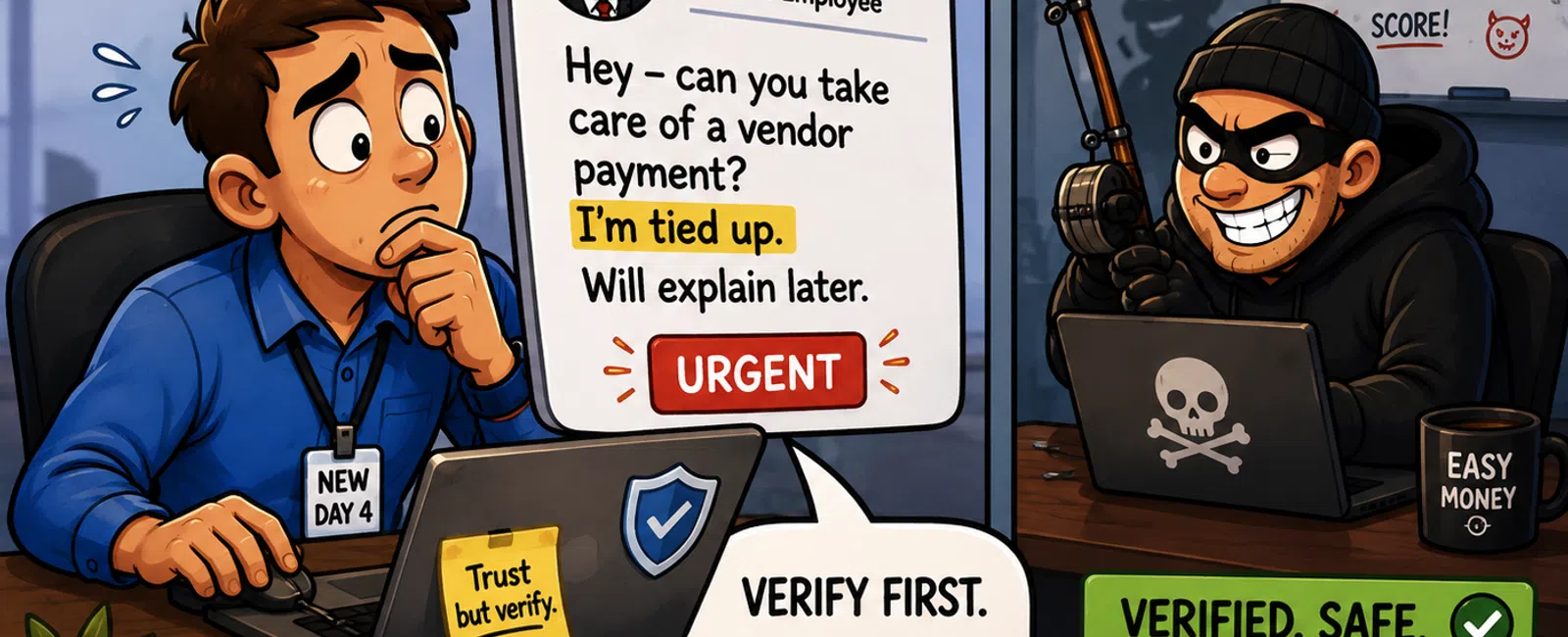
The First Week Mistake That Creates a Breach Nobody Saw Coming
The email shows up on a Tuesday morning.
It looks like your CEO. The tone fits. The timing makes sense.
"Hey — can you take care of a vendor payment? I'm tied up. I'll explain
later."
Your newest employee sees it.
Four days in. Still figuring things out. Still trying to prove they
belong.
So they act.
And the failure doesn't happen in that moment.
It happened days earlier—when your system allowed that decision to exist.
Why This Keeps Happening (Even in Well-Run Companies)
If you're responsible for keeping operations stable, this isn't a
training issue.
It's a control failure.
Most breaches tied to Business Email Compromise (BEC) don't involve
technical exploits. They rely on timing, impersonation, and process gaps.
And week one has more gaps than any other point in your business.
New hires step into:
- Partially
configured access
- Inconsistent
enforcement of security controls
- Unclear
approval workflows
- Zero confidence
in what's "normal"
Attackers don't need sophistication.
They wait for this exact moment.
Industry data continues to show that BEC is one of the most frequent and
financially damaging forms of cyber fraud, with losses often discovered days or
weeks after the action is taken.
That delay isn't bad luck.
It's lack of enforced process.
Where These Controls Come From (Not Opinion)
Everything in this framework aligns with what external evaluators expect:
- CIS Control 6
(Access Control) → Unique identities, MFA, role-based access
- SOC 2 (Logical
Access + Change Management) → Controlled provisioning,
traceability, approvals
- BEC Prevention
Standards → Multi-channel verification for financial actions
Auditors don't assess intent.
They assess whether your system makes failure possible.
What This Looks Like in the Real World (Scenario 1)
A 12-person company hires a finance admin.
- Day 1: Email
active
- Day 2: MFA not
yet enforced
- Day 2
afternoon: "CEO" requests a vendor payment
The employee hesitates—but processes it. No defined verification protocol
exists yet.
$37,000 gone.
No approval log. No second verification.
Just a normal week-two action inside an uncontrolled system.
A Second Failure Most Teams Miss (Scenario 2)
An HR coordinator joins your company.
They receive a login invite and set a password—but MFA isn't enforced
yet.
Later that day, they get what looks like a Microsoft login prompt. It
matches everything they just experienced.
They enter their credentials.
That's credential theft.
From there:
- Email inbox is
accessed
- Internal
conversations are read
- Payment
requests are staged from a legitimate account
No spoofing required.
The system now trusts the attacker.
And it started with a missing control—not a bad decision.
The Minimum Control Stack for Week One
This is not guidance.
This is baseline.
Identity & Access
- MFA enforced
before first login → prevents unauthorized access even if credentials are
exposed (Microsoft Entra / Google Workspace)
- Unique
credentials only → eliminates shared accountability risk
- Role-based
access pre-set → removes improvisation
Device Control
- Managed device
enforcement (Intune) → blocks unknown or personal devices automatically
- Conditional
access → denies suspicious login attempts in real time
Financial Controls
- No payment from
email alone → removes single-channel attack path
- Multi-channel
verification → forces human confirmation outside attacker control
- Approval
workflow inside accounting/ERP → creates traceability and auditability
Controls only matter if they enforce behavior.
Vendor Payment Verification Protocol (Non-Negotiable)
If a request involves money, this is the rule:
- Do not act on
email alone
- Verify using a
known contact method (not the message)
- Require dual
approval (requester + financial authority)
- Log the request
and authorization in your system
Policy Snippet
"No financial transaction may be executed based solely on email
communication. All payment-related requests must be independently verified
through a secondary, pre-established channel and documented within an approved
system prior to execution."
If this isn't written and enforced, it doesn't exist.
Where This Still Breaks (If You're Not Careful)
Even strong systems fail in edge cases:
- Executive
unreachable → define a fallback approver, not a delay bypass
- Urgent vendor
change request → enforce a minimum delay + verification, no exceptions
- Internal
account compromise → treat all financial requests
as untrusted until verified
Mature businesses don't remove friction.
They place it exactly where risk lives.
What Attackers Are Actually Looking For
This is targeted, not random:
- New hires
announcing roles publicly
- Predictable
email formats
- Clear reporting
structures
- Companies
actively onboarding
They don't guess who to target.
They choose who is most likely to act without certainty.
First 48 Hours: Where Exposure Is Created
Day 0
- Identity
created
- MFA enforced
- Role access
configured
Day 1
- Managed device
issued
- Conditional
access enforced
- No workarounds
allowed
Day 2
- Financial
workflow explained
- "What never
happens here" clearly stated
- Escalation
contact assigned
If any step is delayed, you've created a decision your employee shouldn't
be making.
First-Week Security Diagnostic Score
Answer Yes or No:
- All users have
provable unique credentials
- MFA is enforced
before first login
- Payment
requests cannot be processed from email
- Multi-channel
verification is required and logged
- New hires are
shown what legitimate vs suspicious looks like
- Every employee
has a defined escalation contact
Your Score:
- 0-1 No →
Controlled environment
- 2 No → Elevated
exposure (most common early-stage gap)
- 3+ No → High
likelihood of exploitable failure
Most common failure points we see:
- MFA delayed
"until later in the week"
- Payment
verification defined verbally, not enforced
- Escalation
paths unclear during onboarding
This isn't a checklist.
It's a pass/fail control test.
What an External Audit Will Flag Immediately
- Shared or
unclear credential ownership → automatic fail
- Email-driven
financial actions → high-risk finding
- Undefined
onboarding controls → systemic vulnerability
Auditors assume employees will act.
They expect your systems to control how.
What to Do Next Week
Run a 30-minute walkthrough:
- Map a new
hire's first 48 hours exactly
- Identify every
moment requiring judgment or improvisation
- Replace each
with a defined, enforced control
Fixing even one of these points removes an entire class of preventable
risk.
The Next Step
Schedule your 10 minute discovery call with 911 IT and walk through your
first-week process step by step. You'll get a clear pass/fail view of your
controls and see exactly where a new hire could be exploited right now. You
leave with a defined answer—not a guess—about your exposure.


