
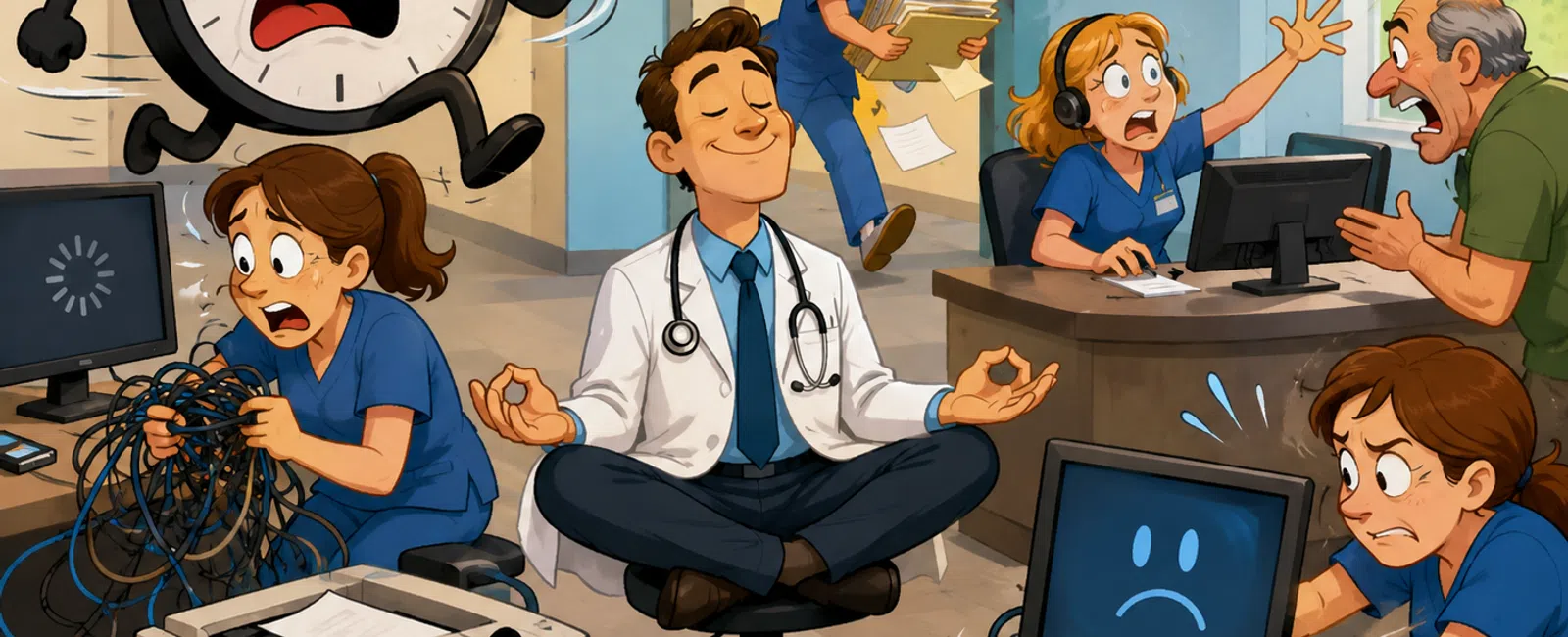
The Longest Day of the Year—and You're Still Running Behind
Every June, the day gets longer.
More light. More hours. More opportunity to get ahead.
And yet most practices feel exactly the same.
Behind by 10:30. Adjusting schedules before lunch. Still catching up at
the end of the day.
That's the moment most people misdiagnose the problem.
They think they need more time.
What they actually need is a system that protects it.
The Real Problem Isn't Time — It's Instability
Your day doesn't fall apart in one big failure.
It breaks in small, predictable ways.
A login issue slows down check-in.
A system lags when everyone logs in at once.
A file isn't accessible when it should be.
A device stalls during a handoff.
Individually, none of these seem serious.
But stacked together, they quietly take control of your schedule.
By mid-morning, you're no longer running the day.
You're recovering it.
And that's where most practices stay stuck.
The 4 Layers of a Stable Practice Day
If you want to fix this, you need a simple way to see where the day is
breaking.
Every stable practice operates across four layers:
Access
Can your team log in, access systems, and move without friction?
Performance
Do systems load quickly and predictably, especially during peak times?
Support
When something breaks, is there a clear path to fix it without disrupting the
doctor?
Redundancy
If one system fails, can the team still move the patient forward?
If even one of these layers is weak, your day becomes reactive.
If two or more are weak, instability becomes your default.
Who Should Handle Each Type of Problem
Most practices don't fail because of technology.
They fail because no one owns the fix.
Here's the simplest model that works:
Tier 1 — Internal Team
Front desk or admin handles basic issues: logins, simple restarts, known
workarounds
Tier 2 — IT Support
Recurring issues, system slowdowns, device problems, access inconsistencies
Tier 3 — Vendor or Escalation
Software failures, integrations, or anything requiring deeper system changes
The rule is simple:
If the doctor is still solving Tier 1 or Tier 2 issues, the system is
broken.
The Failure Patterns That Actually Matter
You don't need to fix everything.
You need to fix patterns.
The most common ones:
Slow mornings
Fix: stagger system load so everything doesn't hit at once
Login issues
Fix: centralized credential management and consistent access rules
Printer or scan delays
Fix: isolate the device and remove shared queue conflicts
Missing files
Fix: standardize where everything lives and who owns it
Repeat weekly issues
Fix: stop working around it and remove the root cause
Patterns are predictable. Which means they're fixable.
What This Looked Like in a Real Practice
One office started every day the same way:
10-15 interruptions before mid-morning
Doctor pulled in multiple times
Schedule already slipping by 9:30
Nothing major. Just constant friction.
After stabilizing their systems:
Interruptions dropped to 2-3 per day
The first hour became predictable
Schedule delays were reduced significantly
The doctor stayed focused instead of stepping in repeatedly
The biggest change wasn't speed.
It was control.
Practice Stability Scorecard
Use this to identify where your day is breaking.
Give yourself one point for each:
- Staff struggle
with logins at least once per day
- Mornings feel
slower than they should
- Files aren't
always easy to locate
- The doctor gets
pulled into small issues
- The same
problems repeat weekly
- Issues are
fixed after they happen, not before
- Devices cause
patient or workflow delays
- No clear owner
exists for system problems
- The team
doesn't have backup workflows
- Small issues
regularly impact the schedule
What Your Score Means
0-2 → Maintenance gap
3-5 → Workflow risk
6+ → System instability
At 6 or higher, your day isn't inefficient.
It's unprotected.
Your 30-Day Stabilization Path
If you want real change, follow this sequence:
Week 1 — Identify patterns
Track every interruption. Focus on what repeats.
Week 2 — Eliminate the biggest issue
Remove the single pattern that disrupts your day the most.
Week 3 — Standardize workflows
Make sure everyone knows where things live and what to do when something
breaks.
Week 4 — Implement prevention
Put monitoring, ownership, and process in place so the problem doesn't return.
Do this right, and your day will feel different within a month.
What the Outside World Sees
Patients don't see your systems.
They feel delays.
They feel disorganization when things don't flow.
They feel friction when handoffs aren't smooth.
Your team feels stress.
Your schedule reflects inconsistency.
And over time, that becomes your reputation.
Not based on your skill.
Based on how your day runs.
If Nothing Changes
You won't notice one big failure.
You'll lose an hour a day in small pieces.
That compounds into days, then weeks, of lost production every year.
And it will keep feeling like you're working hard without gaining ground.
Your Next-Week Action
For the next five days, track every interruption.
Write down: What happened
Who got pulled in
How long it took
At the end of the week, pick the one pattern that showed up the most.
Fix that first.
What to Do Next
Schedule your 10 minute discovery call and bring your scorecard along
with the top issues you tracked. 911 IT will help you identify which layer of
your system is breaking and what to fix first. You'll leave knowing whether
your day is stable—and exactly how to improve it.


