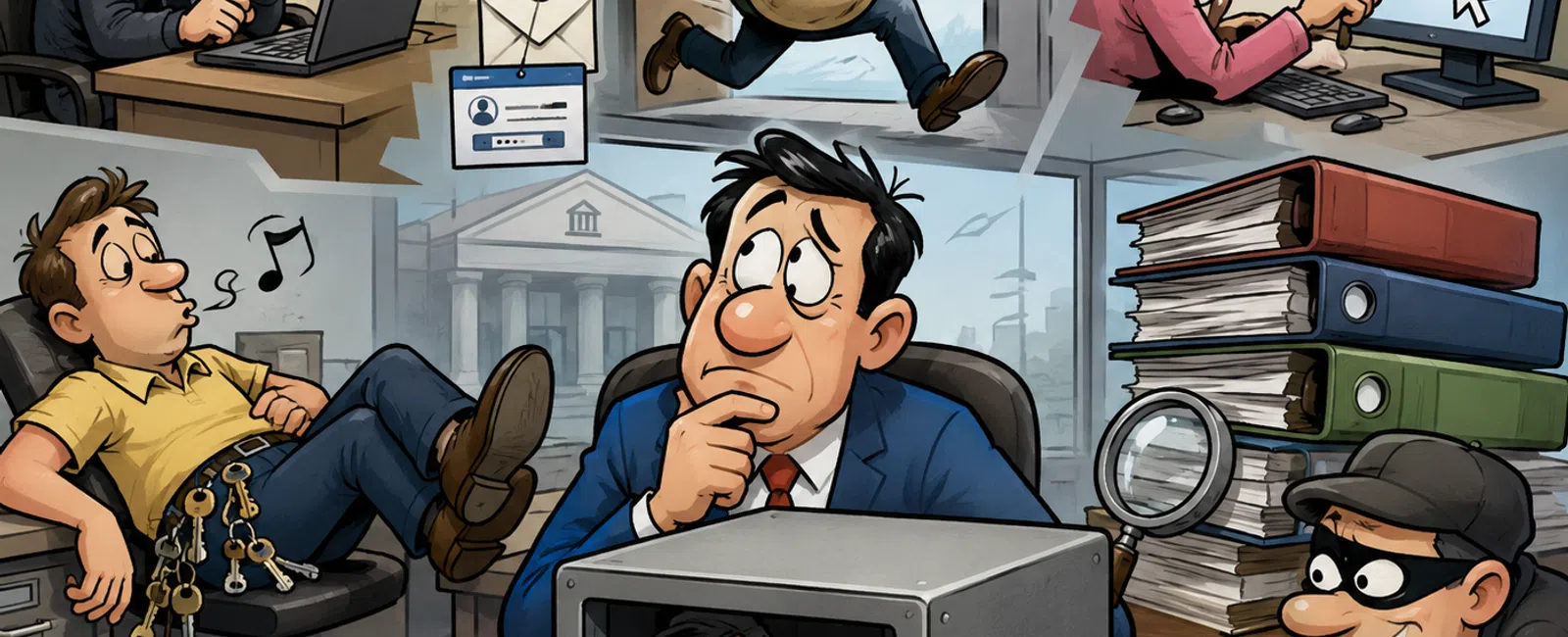
The Most Dangerous Risks in Your Bank Don’t Sit on the Surface
I remember a night before an exam when nothing looked wrong.
That’s what kept me there longer than I wanted to be.
If you carry IT and compliance, you already know this: the risk that matters most is rarely visible. It moves through normal operations—quiet, routine, familiar—until the moment a control has to prove itself and doesn’t.
Most banks don’t fail because they ignore risk. They fail because they assume the process holds… without ever forcing it to hold under pressure.
Here’s where that breaks—and what it looks like when you fix it properly.
1. The Payment That Gets Approved Because It Feels Normal
Most financial losses don’t start with a breach. They start with a believable request.
A vendor email arrives. The name is familiar. The format looks right. The regular approver is out. Someone steps in and moves it forward.
Where This Breaks in Real Life
A temporary approver sees a payment marked urgent. They recognize the vendor name—but not the cadence, not the formatting nuance, not the expected contact path. There’s no enforced verification tied to their role. So they approve it.
This isn’t negligence. It’s a control that wasn’t built to survive normal operational variance.
What Happens When This Fails
- Money moves before verification
- Retrieval becomes time-sensitive or impossible
- Internal control review is triggered
- Audit findings shift from “process exists” to “process not enforceable”
That last one is what stays on record.
2. The Click That Happens Because Timing Wins
Phishing doesn’t break systems. It breaks timing.
A login prompt appears right before a meeting. A request lands with just enough urgency to feel legitimate. The decision shifts from verification to speed.
Behavioral Failure Example
An employee receives what looks like a routine password reset request between meetings. They click without pausing—not because they don’t know better, but because nothing in the process requires them to slow down.
That’s the gap.
What Reinforces This Properly
- Quarterly simulation testing (not annual training)
- Clear escalation paths when something feels off
- Explicit expectation that slowing down is correct behavior
Without those, your environment rewards speed. And speed becomes the vulnerability.
3. The Vendor Access Nobody Reviewed This Quarter
This is the quietest one—and the one that grows.
A vendor completes a project. Their access remains. A contractor leaves. Their credentials still exist. An integration is deployed. Nobody documents the dependency clearly.
Individually, these feel minor. Collectively, they create unmanaged entry points.
The Vendor Access Lifecycle That Actually Holds
Onboarding
- Business owner assigned
- Access scope defined
- Systems mapped
Ongoing
- Quarterly review with ownership confirmation
- Documentation retained
Offboarding
- Accounts removed
- API keys invalidated
- Integrations verified
In most environments, access exists. Ownership does not.
How This Maps to Regulatory Expectations
This is not theoretical. This aligns directly with how control environments are evaluated.
Information security expectations center on defined controls, clear ownership, and consistent enforcement.
Access control principles require least privilege and ongoing validation.
Vendor oversight requires active management, not passive trust.
The standard isn’t “we have a policy.”
The standard is:
Can you show that it works—consistently, under real conditions?
How This Shows Up in Audit Findings
This never shows up as:
“Someone approved the wrong payment.”
It shows up as:
Inconsistent enforcement of verification procedures
Lack of documented approval evidence
Incomplete vendor access reviews
Failure to maintain least privilege controls
Typical finding language looks like:
“Controls are not consistently applied across operational scenarios”
“Evidence of review and approval could not be validated”
“User access levels exceed documented business need”
That’s the shift. Operational gaps become control failures when they can’t be proven.
Where This Lives Operationally
This is where most teams are still one layer short.
Controls don’t live in policy documents. They live in systems.
Ticketing system — payment verification evidence, timestamps, approvals
Access review logs or spreadsheets — quarterly vendor and user validation
Approval workflows — sign-offs tied to named owners
Exception logs — documented deviations and escalation paths
If evidence is buried in email—or worse, memory—you don’t have a control system. You have a best effort.
Repeatable Control: Weekly Control Verification Sheet
This isn’t a checklist. It’s a control artifact. Something you run weekly and retain as evidence.
Payment verification
All payment changes independently verified
Owner: _______
Evidence: _______
User behavior validation
One employee walked through a real verification scenario
Owner: _______
Evidence: _______
Vendor access review
One vendor’s access confirmed as necessary and scoped correctly
Owner: _______
Evidence: _______
Exception handling
Any skipped verification documented and reviewed
Owner: _______
Evidence: _______
Access cleanup
Former vendors or contractors reviewed for lingering access
Owner: _______
Evidence: _______
This is what a control looks like when it’s alive—not documented.
What You Should Do Next Week
Take one real payment request, one employee scenario, and one vendor connection. Run them through your actual process.
Not the ideal version. The real one.
If you can’t clearly identify:
- Who owns it
- Where it’s documented
- How it’s verified
- What evidence exists
Then you’ve found your exposure.
Not theoretical. Operational.
Final Thought
The banks that get surprised aren’t careless. They’re confident in controls that haven’t been pressure-tested.
You don’t need more tools. You need proof that your controls work when things aren’t perfect.
Schedule your 10 minute discovery call. We’ll walk through your weekly control verification process together and confirm whether these gaps exist in your environment or if your controls are holding the way they should.