THE QUIET RISK IN YOUR PROPERTY MANAGEMENT OPERATION THAT NO ONE OWNS
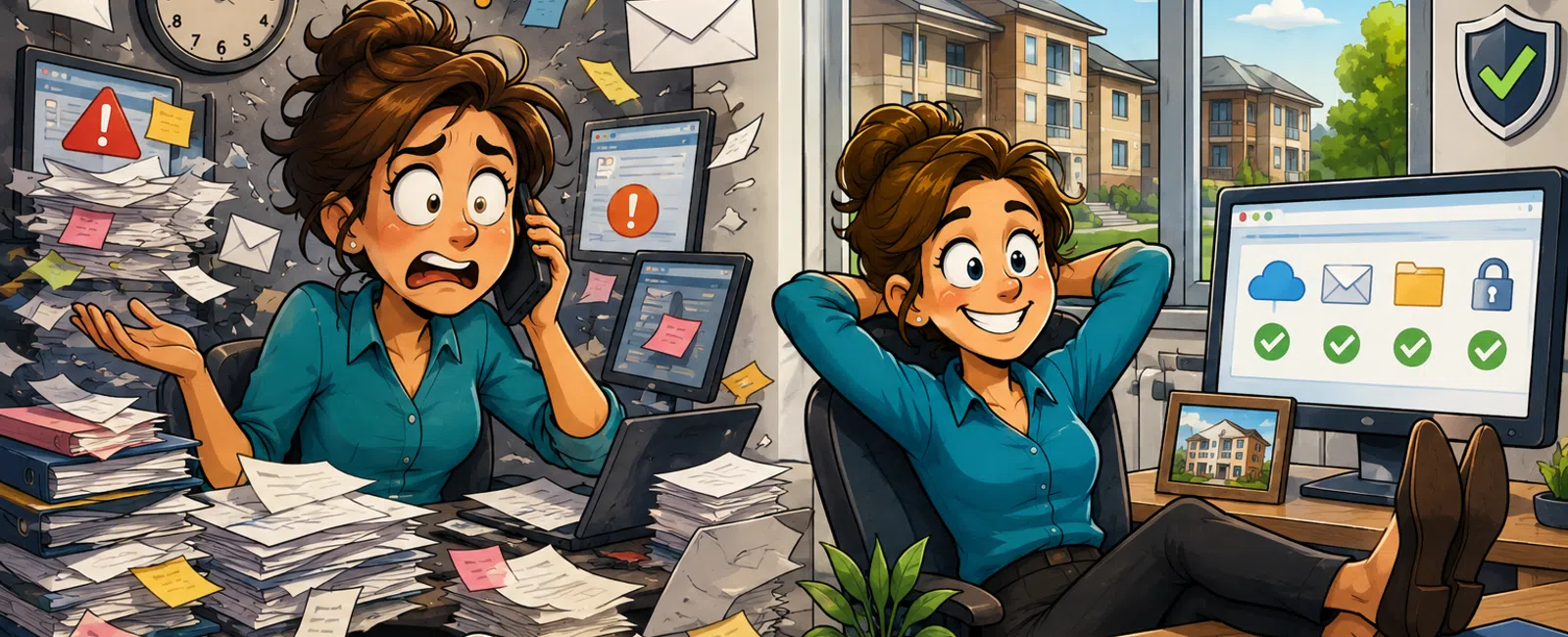
If you're the one
holding operations together, this will feel familiar.
You start your day
in your inbox. Maintenance tickets. Owner questions. System alerts. A sync
issue you didn't expect. A compliance update you haven't had time to read.
And underneath it
all, one quiet assumption:
Everything is
working.
Backups. Email
delivery. Remote access. Audit logs. Security controls.
No one says it out
loud. But everyone is operating like it's true.
That assumption is
the risk.
Because in property
management environments—where systems like SharePoint, Outlook, and CRM
platforms all intersect—responsibility is everywhere, but verification is
rarely consistent.
THE REAL PROBLEM: "OWNED" DOESN'T MEAN VERIFIED
Most teams assign
ownership:
- IT manages
backups
- Vendors manage
integrations
- Staff follow
workflows
But what we see
repeatedly is this:
Systems are assumed
to work because nothing has failed yet.
Most teams don't
discover gaps until something is tested under pressure.
And when that moment
comes, ownership alone doesn't matter.
Only proof does.
WHAT BREAKS FIRST (AND WHAT FOLLOWS)
When verification is
missing, failure doesn't happen all at once.
It unfolds in a
chain.
Backup Failure
- Files stored in
SharePoint or Dropbox
- Backup exists
on paper
- Restore is
never tested
- A recovery is
needed
- Restore is
incomplete or delayed
Audit Log Gaps
- Logging is
enabled
- Retention
policies are unclear
- Access review
is requested
- Logs are
missing or unusable
Email Delivery Failure
- Messages sent
through Outlook
- No delivery
monitoring or validation
- Tenant or owner
never receives critical notice
- Disputes begin
immediately
Remote Access Exposure
- Teams access
systems from multiple devices
- Sessions aren't
centrally logged
- Activity cannot
be reconstructed during review
Individually, these
look small.
Combined, they
create operational uncertainty that spreads fast.
A REAL SCENARIO: WHERE IT ACTUALLY BREAKS
A property
management team believed their document system was secure and compliant.
They had:
- Cloud storage
- Role-based
access
- Backup policies
On paper, everything
was in place.
Then an audit
request came in.
Here's what
happened:
- Files were
split between systems with no clear system of record
- Audit trails
were incomplete
- Documents
couldn't be produced quickly
There was no breach.
No outage.
Just hesitation.
And in that moment,
hesitation became the risk—because it signals loss of control.
WHAT THIS LOOKS LIKE IN AN AUDIT OR LEGAL REVIEW
This is where
assumptions fail fast.
An auditor doesn't
ask what your system should do.
They ask what you
can prove.
The sequence is
predictable:
- Logs or
documents are requested
- The team
gathers data—but it's inconsistent
- Follow-up
requests increase
- Internal
scrambling begins
- Confidence in
the operation drops
Once confidence
drops, scrutiny increases.
Not because
something catastrophic happened.
Because the system
couldn't prove itself.
And in regulated
environments handling sensitive or compliance-adjacent data, that lack of proof
matters.
COMMON VERIFICATION FAILURES (THAT LOOK "DONE")
These show up
constantly across property management operations:
- Backups exist
but full restore is never tested
- Audit logs are
enabled but not retained long enough
- Email systems
send but aren't monitored for delivery
- Access controls
exist but aren't periodically reviewed
- Multiple
systems exist without a defined system of record
Every one of these
passes a surface-level check.
None of them pass a
real test.
WHO VERIFIES WHAT (SO THIS ACTUALLY GETS FIXED)
Verification only
works when responsibility is clear.
Here's what that
looks like in practice:
- IT verifies
backup integrity and restore capability weekly
- Operations
verifies document access and system-of-record clarity
- Leadership
validates audit readiness quarterly
- Email systems
are checked for actual delivery outcomes
- Remote access
sessions are logged and reviewed centrally
This is what turns
"we think it works" into "we know it works."
THE 60-MINUTE REALITY CHECK (DO THIS NEXT WEEK)
Block one hour.
No prep. No
overthinking.
Walk through your
systems and answer:
THE "CAN WE PROVE IT?" CHECKLIST
- Can we restore
critical documents immediately?
- Can we produce
complete audit logs for access and changes?
- Do we know our
emails are actually delivered?
- Is remote
access fully traceable?
- Do we have one
clear system of record?
- Can we show how
systems connect and depend on each other?
Mark each:
- Confirmed
- Assumed
- Unknown
You're not fixing
anything yet.
You're exposing
where assumption is carrying your operation.
That alone increases
control.
WHAT YOU GAIN WHEN THIS IS FIXED
You're already doing
most of this right.
This is about the
final layer—the one that removes second-guessing.
When verification is
clear, you get:
- Confidence
going into audits
- Fewer fire
drills
- Less dependency
on memory or "who knows this system"
- Clear
visibility across systems and vendors
And most
importantly:
You stop wondering
if things will hold.
Because you've seen
them hold—before it mattered.
CTA
Schedule your 10
minute discovery call with 911 IT. This helps you confirm exactly where your
operation relies on assumption instead of proof. It's a fast way to see what's
solid—and what needs attention.