
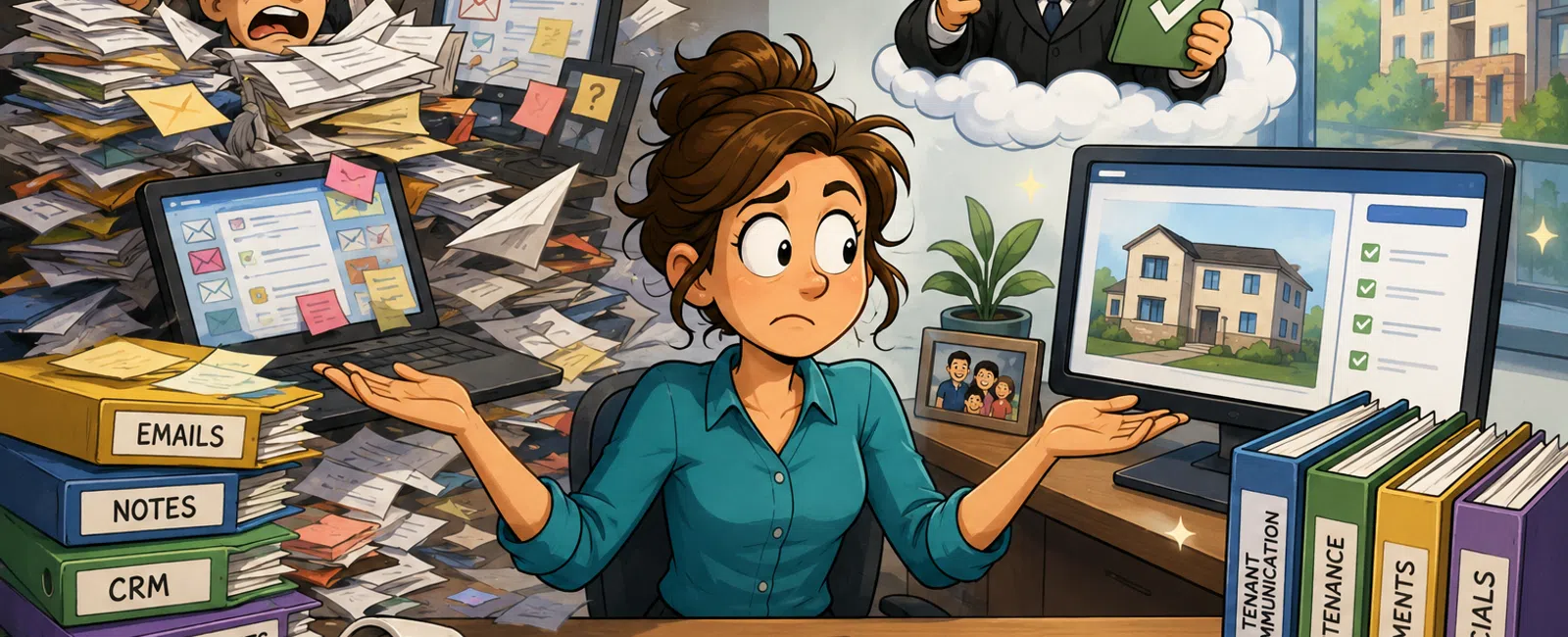
The Quiet System Problem That Turns a Simple Property Issue Into a Legal Mess
If your inbox is already full before 9 a.m., this is for
you. You are not just managing owners, tenants, vendors, and maintenance. You
are also carrying the record of what happened, who said what, and whether your
team can prove it when the pressure hits. That pressure is real for operations
leaders in property management, especially when compliance, owner complaints,
audit requests, and system conflicts all land on the same desk.
The mistake is not using too many tools. The mistake is
letting multiple tools behave like they all hold the truth. When your team has
one version of a tenant issue in KW Command, another in Salesforce, and more
context buried in email, you do not have a system. You have competing memories.
That is exactly the kind of inconsistency that creates audit failures, owner
distrust, and legal exposure.
What This Looks Like in the Real World
In our experience, this usually shows up in firms that are
busy, competent, and moving fast. The team has a property platform, a CRM,
email, maybe a maintenance system, and everyone assumes the systems are "close
enough" because the day-to-day work gets done. That assumption breaks the
moment someone outside the team asks for a clean record.
Picture a mid-sized portfolio with tenant communication
spread across email, task notes, and a CRM. An owner complains about how a
resident issue was handled. The operations lead pulls the record and finds
three problems at once: a missing email thread, conflicting timestamps, and
notes that do not fully match the official account. Now the team is not just
answering the complaint. They are reconstructing history. That is when a normal
operations issue starts turning into lost time, lost trust, and a much more
defensive conversation.
How These Situations Escalate
When a matter reaches outside review, the question changes
fast. It is no longer "What do we think happened?" It becomes "What can we
produce, what can we verify, and who changed what and when?" Property
management workflows often involve owner agreements, lease documents, financial
records, and sensitive resident information, which is why the control set in
this industry keeps coming back to access controls, audit controls, retention,
and secure sharing with owners and attorneys.
If your records conflict, the first consequence is delay.
The second is credibility loss. The third is that leadership starts wondering
whether the issue is bigger than the original complaint. That is the part many
teams miss. The legal pain is not only about the event itself. It is about how
hard it becomes to defend your timeline once your records stop agreeing with
each other. For leaders already carrying the fear of being the one who gets the
firm fined or sued, that is where the emotional weight gets heavy fast.
Where Systems Break Even When You Think They Do Not
Most record failures do not come from dramatic outages. They
come from quiet friction.
A sync runs late, so the CRM and the property system do not
match. Integration support exists, but nobody defines which platform is the
system of record. A team member answers from email because it is faster, then
forgets to log the response. A document gets shared outside the main workflow,
so the audit trail is incomplete. None of this feels catastrophic in the
moment. Together, it creates the exact kind of data inconsistency your
operation cannot afford.
That is why this keeps happening in property management
specifically. The work is mobile. The communication volume is high. The tools
are interconnected. The margin for sloppy recordkeeping is low. The role itself
already includes decision fatigue, translation between departments, and
constant noise. When the system adds friction instead of removing it, people
bypass it.
What a Clean System Looks Like
A clean system does not mean one platform does everything.
It means every platform has a job, and only one of them has authority.
One workable model looks like this:
- Tenant
communication lives in the property system and must be logged there if it
happens elsewhere
- The
CRM tracks leads, pipeline, and follow-up, but it is not the final tenant
history
- Financial
records live where accounting and disbursements are controlled
- Shared
documents keep version history, audit visibility, and role-based access
- The
team knows which record is final before a dispute ever happens
That is what "good" looks like in practice. Clear ownership.
Clear auditability. Clear enforcement. Not more software. More clarity.
Before and After
Before:
- Multiple
systems compete to tell the same story
- Email
replies happen outside the approved workflow
- Timestamps
and notes do not line up cleanly
- A
simple request turns into manual reconstruction
- Leadership
loses confidence in the record
After:
- One
system holds the authoritative timeline
- Off-system
communication gets logged back into the record
- Access,
edits, and document history are visible
- Owner
and audit requests can be answered with confidence
- The
operations lead gets relief instead of another fire drill
The Cost of Inconsistency
The cost is rarely just technical. It is operational and
reputational.
You lose time because staff have to search inboxes, chat
threads, and side systems. You lose trust because owners hear hesitation when
they want a clean answer. You increase risk because property management now
sits inside a tighter recordkeeping and auditability environment, especially
with Utah's evolving licensing framework under HB 337. You also create
unnecessary pressure on the person already carrying too much of the system in
her head.
And that is the part I do not want you to miss. This is not
just a systems problem. It is a leadership burden problem. The more your
operation depends on memory, heroics, and cleanup, the more fragile it becomes.
The more it depends on documented truth, the calmer it gets. That is the whole
shift.
How to Fix It in Real Life
Here is the execution version, not the idealized version.
Assign authority
Decide who owns the record model. In most firms, that is
operations leadership with system admin support. If nobody owns it, nobody
enforces it.
Document the authority map
Write down which platform is authoritative for tenant
communication, financial records, maintenance history, and contracts. If it is
not written, your team will default to habit.
Define what counts as a violation
A violation is any critical communication, task update, or
document change that happens outside the official record and never gets logged
back. That includes email replies, side messages, exported files, and manual
overrides. The goal is not punishment. The goal is record integrity.
Correct it the same day
If someone answers outside the system, log it back into the
system that day. If a sync fails, note the gap and reconcile it before the next
handoff. If a document was shared somewhere else, move it back into the
governed workflow with version history and restricted access.
Review one live record every month
Pull one real tenant or owner timeline and test it. Can your
team see the communication history, who changed what, and where the supporting
documents live? If not, do not wait for an audit request to discover the gap.
Score Your System Clarity in 10 Minutes
Give yourself one point for every yes.
- We
have one defined system of record for tenant communication
- Our
team knows where to log off-platform communication
- We can
show who changed a document and when
- We
retain the audit trail for contracts and financial records
- Our
CRM and property platform do not compete for final authority
- We
review sync failures instead of ignoring them
- We use
role-based access for sensitive records
- We can
answer an owner or audit request without rebuilding the timeline by hand
- We
have a written rule for what happens when staff bypass the system
- Leadership
has approved the record map and enforces it
If you scored low, do not panic. You are probably doing 90
percent right already. This is about cleaning up the last 10 percent so your
systems support you instead of exposing you. That is how you move from fragile
to defensible. That is how you get closer to the peace of mind this role almost
never gives you on its own.
What To Do Next Week
Block 30 minutes with your ops lead, your system admin, and
whoever touches owner reporting. Answer one question in writing: "What is our
authoritative system for tenant communication, and what is our rule when
someone works outside it?" If that answer is fuzzy, that is your starting
point.
Schedule your 10 minute discovery call with 911 IT. This
helps you confirm whether this risk applies to your operation and where the
record gaps actually are. It only takes 10 minutes.


