
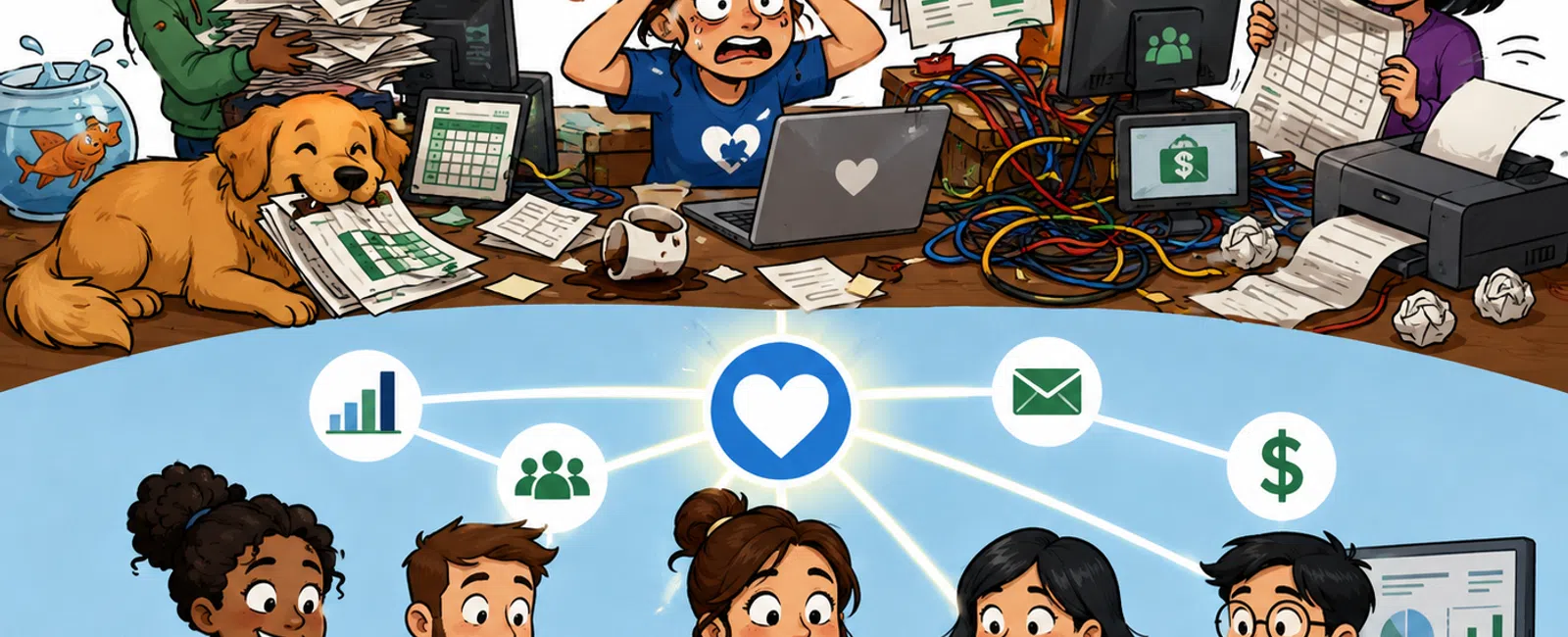
The Moment It Breaks Isn't Loud—It's Public
You are in a board meeting.
A board member pauses on your report and asks a simple question:
"Why doesn't this donor total match what was sent last month?"
You know the answer instantly.
One report came from your CRM. Another came from a spreadsheet your team
adjusted before a campaign. Finance pulled a third version.
None of them are technically wrong.
But they don't match.
And in that moment, it does not matter how hard your team works. It does
not matter how strong your mission is. What the room feels is uncertainty.
That is the real cost of fragmented systems.
Not inefficiency. Not inconvenience.
Loss of trust.
Most nonprofits do not fail because something breaks. They lose
confidence slowly because their systems never aligned in the first place. That
usually happens in small, growing teams running 3-5 disconnected tools without
a defined system of record—and it compounds quietly until it shows up in rooms
that matter.
Where This Actually Breaks (Real Scenario)
Here is the pattern we see repeatedly:
Development tracks donors in a CRM.
Programs update participant data in Excel.
Marketing exports lists into email tools.
Finance reconciles in QuickBooks.
Every team is doing the right thing—inside their own system.
The breakdown happens in the handoffs.
A donor gives through a platform. That record enters one system. It is
exported into a spreadsheet for segmentation, then imported into an email tool.
Somewhere in that process, duplicate donor records or mismatched fields appear.
Now your organization has:
- Two donor IDs
for the same household
- Missing gift
history in one system
- Conflicting
email addresses
- A campaign list
built from incomplete data
The campaign underperforms. A donor gets emailed twice. Another is missed
completely.
It looks like a marketing failure.
It's a data flow failure.
What Bad vs Clean Donor Data Actually Looks Like
This is where most blogs stay abstract. Here is what it looks like when
you open the records.
BAD (What most nonprofits are working with):
Name: John & Jane Smith
Email: johnsmith@gmail.com / jane@gmail.com
Duplicate IDs: 2 records
Donation History: Split across two systems
Last Gift: Missing in one report
Campaign Tags: Applied to one record, not the other
CLEAN (What a working system produces):
Separate donor records
Matched, verified email fields
Single unified donor ID
Fully synced donation history
Consistent campaign tagging across systems
This is not a technical upgrade. It is clarity.
Your systems either create a consistent identity for each donor—or they
do not.
What This Looks Like After Fixing It
A real fix is simple, visible, and boring in the best way.
You define one system of record—almost always your CRM.
Then you align everything around it:
Donor Entry → CRM → Integration → Campaign Tool → Reporting Dashboard
What changes is not the tools. It is the ownership and flow.
Before:
- Manual exports
- Duplicate
cleanup
- Spreadsheet-based
segmentation
- Rebuilt board
reports
After:
- Automated sync
from donation platform to CRM
- Campaign tools
pulling directly from CRM
- Reports
generated from one consistent dataset
- Board numbers
that match without explanation
That shift removes the invisible burden your team has been carrying.
It also gives you something concrete when leadership asks, "Are we
aligned?"
What to Look At Inside Your CRM (5-Minute Check)
Open your CRM right now. Do not overthink this. Just check:
- Duplicate
record count: Are there obvious duplicates tied to the same household?
- Email
consistency: Do records have multiple or conflicting email fields?
- Donation
history: Are there gaps or missing entries?
- Field usage:
Are different teams using fields differently for the same purpose?
- Campaign tags:
Are they applied consistently or manually overwritten?
If you feel hesitation answering any of these, your system is not
aligned.
That is not a failure. It is a signal.
The Reporting Artifact: Before vs After
This is where leadership actually feels the difference.
Before (Manual Board Report):
- Export from CRM
- Adjust totals
in Excel
- Cross-check
against finance data
- Reconcile
discrepancies
- Rebuild charts
manually
After (System-Driven Report):
- Pull directly
from CRM dashboard
- Predefined
fields tied to donor records
- Synced donation
and finance data
- No manual
adjustment before presentation
Same report. Completely different confidence level.
That is what operational clarity buys you.
How to Fix One Data Problem This Week (Step-by-Step)
Do not fix everything. Fix one workflow.
- Identify one
report used across teams
- Trace every
system that feeds it
- Mark every
manual step
- Choose your
system of record
- Compare fields
across systems
- Assign one
owner to that report
- Document the
final "clean" version
If your team cannot agree on step four, that is the core issue.
Fixing one report removes more friction than another tool ever will.
How to Keep This From Breaking Again
This is where most organizations stop too early.
You fix the data once—and then drift back into old habits.
Instead, set a simple governance loop:
- Monthly data
hygiene check (duplicates, field consistency)
- Clear ownership
of key fields and reports
- Limits on
spreadsheet exports for core data
- A decision
rule: new tools must map to the system of record
- Documented data
flow map updated when systems change
This does not require a committee. It requires consistency.
Without this loop, you are rebuilding the same problems silently every
quarter.
How You're Being Judged (Whether You See It or Not)
Your board is not evaluating your systems.
They are evaluating your confidence.
Donors are not evaluating your integrations.
They are evaluating how intentional your communication feels.
Funders are not auditing your workflows line by line.
They are watching whether your reporting feels reliable.
When your systems align, those signals feel effortless.
When they do not, people start asking questions.
And once that starts, you are always explaining instead of leading.
Your Next-Week Action
Take your next board report.
Circle every number that requires manual adjustment before it is "ready."
Trace where those numbers came from.
That is your highest-risk data flow.
Fix that first.
What to Do Next
Schedule your 10 minute discovery call. We'll identify your system of
record, map one broken workflow, and show you exactly where your data is
drifting. 911 IT will help you confirm what's actually at risk—without
overhauling everything at once.


