
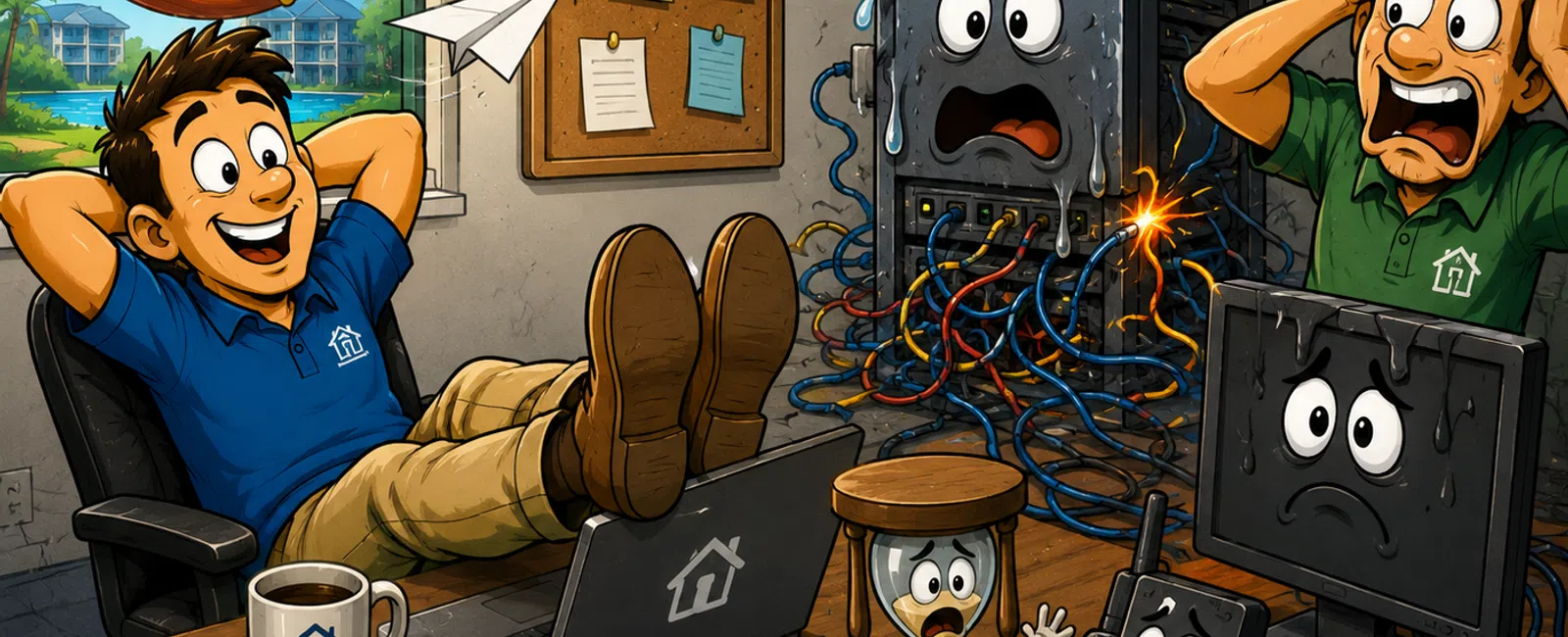
When "We'll Fix It Later" Turns Into a System-Wide Shutdown
It never starts as a crisis.
A system slows down slightly. An update gets postponed. A backup throws a
warning that feels easy to ignore. Nothing actually breaks, so nothing gets
prioritized.
Until everything does.
Not one issue—several. At the same time. What should have taken 20
minutes to fix early now takes hours. Manual work spreads across teams.
Workarounds pile up. And instead of solving the problem once, your team is
reacting all day.
This isn't bad luck.
It's what happens when small issues aren't operationally managed.
The Pattern Behind Every Fire Drill
Reactive environments don't fail because of a single event.
They fail because there is no system for:
- Detecting early
signals
- Prioritizing
issues correctly
- Assigning
ownership
- Escalating at
the right time
From the outside, this isn't seen as "things running fine."
It's seen as unmanaged risk accumulation.
If an external auditor reviewed your environment, they wouldn't ask
what's working today. They would look for what's quietly building toward
failure.
Where This Breaks in the Real World
A property management team delayed a routine update during a leasing
surge.
Everything appeared stable, so the update stayed pushed.
Weeks later, a core system stopped syncing with another application.
Leasing data had to be re-entered manually across teams.
What Failed
- System
category: application integration
- Root cause:
compatibility failure due to delayed updates
Warning Signs That Were Missed
- Update
postponed multiple cycles
- Sync delays had
already started
- No defined
owner responsible for execution
What Would Have Prevented It
- Enforced update
cadence
- Assigned
ownership
- Monitoring
thresholds tied to sync performance
The update would have taken under an hour.
The disruption lasted multiple days.
Additional Patterns You See Every Month
These aren't rare events. They repeat in different forms:
- Accounting
system slowdown right before month-end close, forcing delayed reporting
and manual reconciliation
- VoIP latency
that starts as minor call issues, then turns into unusable phone service
during peak hours
Each one follows the same pattern: small signal → no action → full
disruption.
How Issues Actually Get Prioritized
Without a framework, everything feels equally urgent—or equally
ignorable.
That's the problem.
Issue Prioritization Matrix
|
Criteria |
Low Priority |
Medium Priority |
High Priority |
|
Business Impact |
No disruption |
Slows workflow |
Stops operations |
|
Users Affected |
1 user |
Small group |
Multiple teams/company-wide |
|
System Criticality |
Non-essential tool |
Important system |
Core operational system |
How It Drives Action
- Low → Log and
review in weekly triage
- Medium →
Address within 24-48 hours
- High → Escalate
same day
This removes guesswork. Issues are no longer judged by instinct—they're
evaluated consistently.
A Complete Escalation Framework
Speed matters more than effort.
Use clear triggers:
- 1 user impacted
→ log and review
- 3+ users
impacted → escalate same day
- System-wide
issue → immediate response
Without this, teams lose hours just deciding whether something is urgent.
The Operational System That Prevents This
This is what separates reactive environments from controlled ones.
Step 1: Monitoring with Defined
Thresholds
- Response time
limits
- Error rate
triggers
- Alert
thresholds tied to performance
These are typically managed through monitoring systems (RMM tools), not
manual checks.
Step 2: Weekly 15-Minute Triage
- Review all
minor issues
- Re-evaluate
risk level
- Assign or close
This is where small problems get contained.
Step 3: Enforced Update Cadence
- Security
updates: every 30 days
- System updates:
quarterly
- Delays require
acknowledgment of risk
Step 4: Assigned Ownership
One role owns:
- Monitoring
review
- Update
execution decisions
- Escalation
authority
Not "IT." A named owner.
Step 5: Ticketing and Issue Logging
Every issue is logged in a ticketing system:
- Slowdowns
- warnings
- repeat problems
If it's not logged, it doesn't get managed.
The Reactive Risk Scorecard
Use this to quickly assess your environment:
|
Issue |
Risk Level |
Action Required |
Owner |
|
Slow system ignored |
HIGH |
Investigate this week |
Operations |
|
Updates delayed repeatedly |
HIGH |
Schedule immediately |
IT Lead |
|
Backups not tested in 90+ days |
CRITICAL |
Run validation now |
IT/MSP |
|
No issue tracking system |
HIGH |
Implement ticketing |
Operations |
|
No clear ownership |
CRITICAL |
Assign immediately |
Leadership |
If even one item is High or Critical, you are already operating inside a
failure pattern.
What Good Actually Looks Like
Baseline standards for a controlled environment:
- Monitoring
alerts triggered by defined thresholds
- All issues
logged in a ticketing system
- Updates
completed within 30 days
- Backups tested
quarterly
- Clear ownership
for all IT decisions
This is not advanced. It's the minimum required to prevent predictable
breakdowns.
Internal vs External Responsibility
Most environments fail here—not on tools, but on accountability gaps.
Internal Team Responsibility
- Reporting
issues
- Prioritizing
based on business impact
- Escalation
decisions
- Accountability
MSP / IT Partner Responsibility
- Monitoring
systems and alerts
- Executing
updates
- Managing
backups and validation
- Responding to
escalations
If either side assumes the other is handling something, it doesn't get
handled.
The Summer Risk Multiplier (Pre-Check)
Before coverage drops, confirm:
- All pending
updates are scheduled
- Backups have
been tested recently
- Monitoring
thresholds are active and reviewed
- Backup
decision-makers are assigned
Summer doesn't create problems. It exposes weak systems.
What To Do Next Week
Pick one system your team has been working around.
Not broken—just slower, inconsistent, or "a little off."
Schedule time to investigate it before the week starts.
That single action interrupts the failure cycle.
The Bottom Line
Fire drills are not random.
They are the result of small, visible issues that were never
operationalized, prioritized, or owned.
What takes minutes to fix early becomes hours later—and multiplies across
your team.
Schedule your 10 minute discovery call with 911 IT.
This helps you validate your current risk level against this system and
identify what's already building.
It's a quick way to confirm whether these gaps exist in your environment.


