
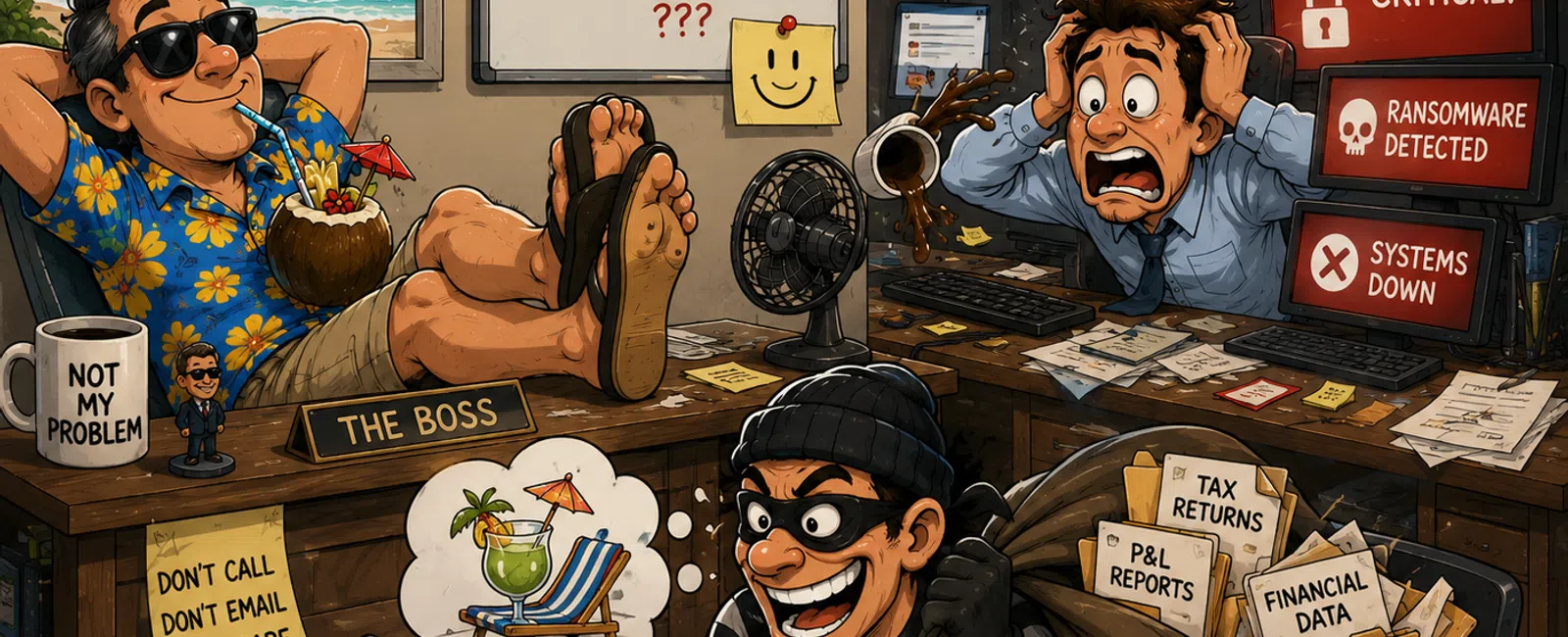
While You're Out of Office, Your Risk Profile Is Wide Open
When your office calendar shows "OOO," your systems don't
slow down.
They stay connected. They stay authenticated. They stay exposed.
And the people who look for cracks in financial firms know
exactly when leadership steps away.
Holiday weekends, conference travel, long Fridays—these
aren't downtime. They're low-noise windows. Fewer eyes. Slower response. Less
internal friction when something unusual happens.
The uncomfortable truth for financial firms is this: your
controls aren't tested when everything is staffed and alert—they're tested when
no one is watching closely.
That's the moment your environment either holds or quietly
fails.
The Real Risk Starts Before You Leave
The vulnerability doesn't begin when the office locks up. It
starts days earlier.
Midweek, shortcuts creep in:
- Temporary
access granted so a task can "just get done"
- Vendor
credentials shared without a clear expiration
- A
contractor wrapped up, but their account stayed active
- A VPN
login that hasn't been used in months but still works
None of this feels reckless in the moment. It feels
efficient.
But efficiency without cleanup creates silent exposure.
By the time leadership is traveling or out for a long
weekend, those decisions are already baked in. And no one is actively
reconciling them.
The firm didn't step away. The oversight did.
What Attackers Assume About Firms Like Yours
This isn't speculation. It's pattern recognition.
Adversaries targeting financial environments assume:
- Security
staffing thins outside normal business hours
- Alerts
route to inboxes, not active response teams
- Access
reviews are periodic, not continuous
- Escalation
paths are slower when decision-makers are unavailable
They don't need chaos. They need quiet.
A single overlooked credential is enough.
Where it usually breaks:
A legacy VPN account tied to a former vendor still authenticates. It isn't
monitored because it's "rarely used." That login succeeds at 2:14 a.m. from an
unusual geography. No one sees it until Monday. By then, the access has already
been leveraged.
This is how incidents start—not with noise, but with
silence.
The External Lens You'll Be Judged By
If an incident occurs during a holiday weekend, the question
won't be why attackers tried.
It will be why no one noticed.
Auditors, regulators, and boards don't care that people were
out of office. They ask:
- Was
access governance enforced continuously?
- Were
anomalous logins detected and acted on?
- Did
monitoring function independently of staff availability?
In regulated financial environments, silence is not a
defense.
Continuous oversight is the expectation.
What "Covered" Actually Looks Like
A resilient model doesn't rely on someone noticing a problem
and making a call.
It looks like this:
- Authentication
events monitored continuously, not sampled
- Behavioral
baselines established for users and systems
- Alerts
reviewed by a live response team that can act
- Access
reviewed and reconciled before leadership steps away
It assumes people will be unavailable—and designs around
that reality instead of hoping it won't matter.
Security isn't proven during busy weeks. It's proven when
the office is quiet.
Print-Ready: Pre-Absence Risk Control Checklist
Use this before any long weekend, executive travel, or
holiday closure.
Minimum acceptable setup:
- Vendor
and contractor accounts reviewed and either validated or disabled
- VPN
and remote access logs reviewed for dormant-but-active accounts
- MFA
enforced on every external access path with no exceptions
- Alert
routing confirmed to a live response team, not voicemail
- Escalation
authority defined if leadership is unreachable
If even one box is unchecked, you're relying on luck.
This checklist is designed to be handed directly to your
internal team or MSP and executed without interpretation.
What You Can Do in the Next Seven Days
Schedule a pre-absence access review.
Not a quarterly audit.
Not a policy discussion.
A real review of who can still get in, how, and why—before
the office goes quiet.
The Only Sensible Next Step
Fix this now. Reach out to 911 IT right now to put
continuous monitoring and access oversight in place before the next quiet
window turns into a reportable incident.


