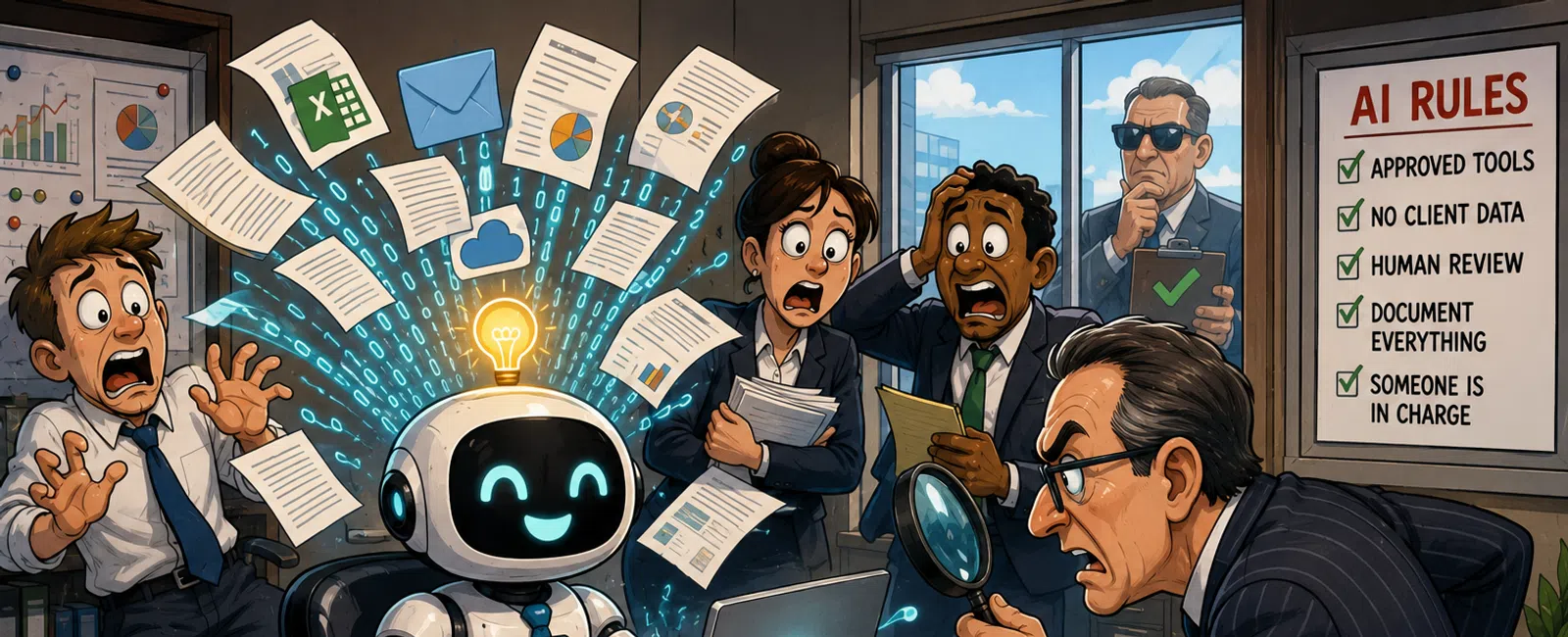
YOUR AI INTERN IS ALREADY WORKING INSIDE YOUR FIRM
THE REAL RISK IS THAT NO ONE CAN PROVE WHO'S SUPERVISING IT
The document looked right. Clean structure. Confident
language. Professional tone. That's usually the moment leadership relaxes and
moves on.
Then someone asks the question that changes the room.
"Where did this information come from?"
Not philosophically. Practically.
And suddenly no one can point to a source, a reviewer, or a
documented process that explains how that content was created, validated, and
approved.
AI didn't introduce this risk. It exposed the fact that many
financial firms never decided how AI should be supervised before it quietly
went to work.
WHAT AN UNSUPERVISED AI INTERN BREAKS FIRST
AI doesn't fail loudly. It fails politely.
In financial firms, unsupervised AI almost always causes the
same three problems before anyone notices.
Sensitive data leaves the firm without visibility. Staff
paste client summaries, financial details, or draft agreements into AI features
embedded in email and document tools. There's rarely malicious intent, but
intent doesn't matter when confidentiality obligations or compliance
expectations are crossed.
Shadow AI becomes invisible infrastructure. AI capabilities
activate inside CRMs, reporting platforms, and productivity software without IT
approval. When asked where data goes, how long it's retained, or who owns the
risk, no one can answer clearly.
Confident output bypasses verification. AI fills gaps with
plausible language. Placeholder numbers become "reasonable" figures. Draft
conclusions turn authoritative. Without a mandatory human review step, errors
move directly into client‑facing materials.
This is how reputational damage starts. Quietly.
Competently. And without warning.
THE QUESTION THAT EVENTUALLY MATTERS MOST
At some point, internal discussion stops mattering.
The question that counts comes from the outside.
"How did this information leave your firm without validation
or documented oversight?"
That question may come from an auditor reviewing controls, a
regulator examining data handling practices, or a board member responding to
client fallout.
AI does not get audited.
Your firm does.
And "we didn't know people were using it that way" is not a
defensible answer.
WHERE THIS USUALLY BREAKS IN FINANCIAL FIRMS
The earliest failures almost always show up in client‑facing
documents generated from internal drafts.
A proposal, advisory memo, or client summary contains
partial data or placeholders. AI is used to tighten or strengthen the language.
The system fills gaps with plausible detail. No one re‑verifies the inputs. The
document goes out looking better and being wrong.
Nothing looks suspicious until someone traces the source.
THE MINIMUM ACCEPTABLE AI SUPERVISION FRAMEWORK
A PRINT‑READY CHECKLIST YOU CAN HAND TO YOUR TEAMIf your firm cannot confidently check every item below, AI
use has already outpaced control.
AI Supervision Checklist
- An
approved AI tool list exists
A maintained list of allowed and prohibited AI tools, reviewed regularly
Owner: IT and Security - Clear
data boundaries are documented
Explicit rules defining what may never be entered into AI tools, including client identifiers, financial data, contracts, and employee information
Owner: Compliance and Legal - Human
review is mandatory for client‑facing content
AI drafts are never final for proposals, reports, or advisory materials
Owner: Business unit leadership - One
role owns AI governance
A single accountable executive owns AI oversight, enforcement, and escalation
Owner: CIO, CTO, or CISO depending on firm structure - AI
usage is visible to IT
IT has visibility into where AI is embedded, what systems it touches, and how data flows
Owner: IT
This is not optimization.
This is containment.
WHAT TO DO IN THE NEXT SEVEN DAYS
This week, do one thing.
Ask your team which AI tools they actually use, not which
ones are approved.
Put those two lists next to each other.
That gap is where your real exposure lives.
WHY THIS IS NOT A GENERIC IT SECURITY CONVERSATION
Most IT partners start with tools.
We start with audit defensibility, client trust, and who is
accountable when something breaks.
In financial firms, AI supervision is not about innovation.
It is about being able to demonstrate control when someone external asks
uncomfortable questions.
DO THIS NOW
Reach out right now and get a documented AI supervision
framework mapped to your firm before this becomes a client or compliance issue.
Not a discussion.
A defensible deliverable.