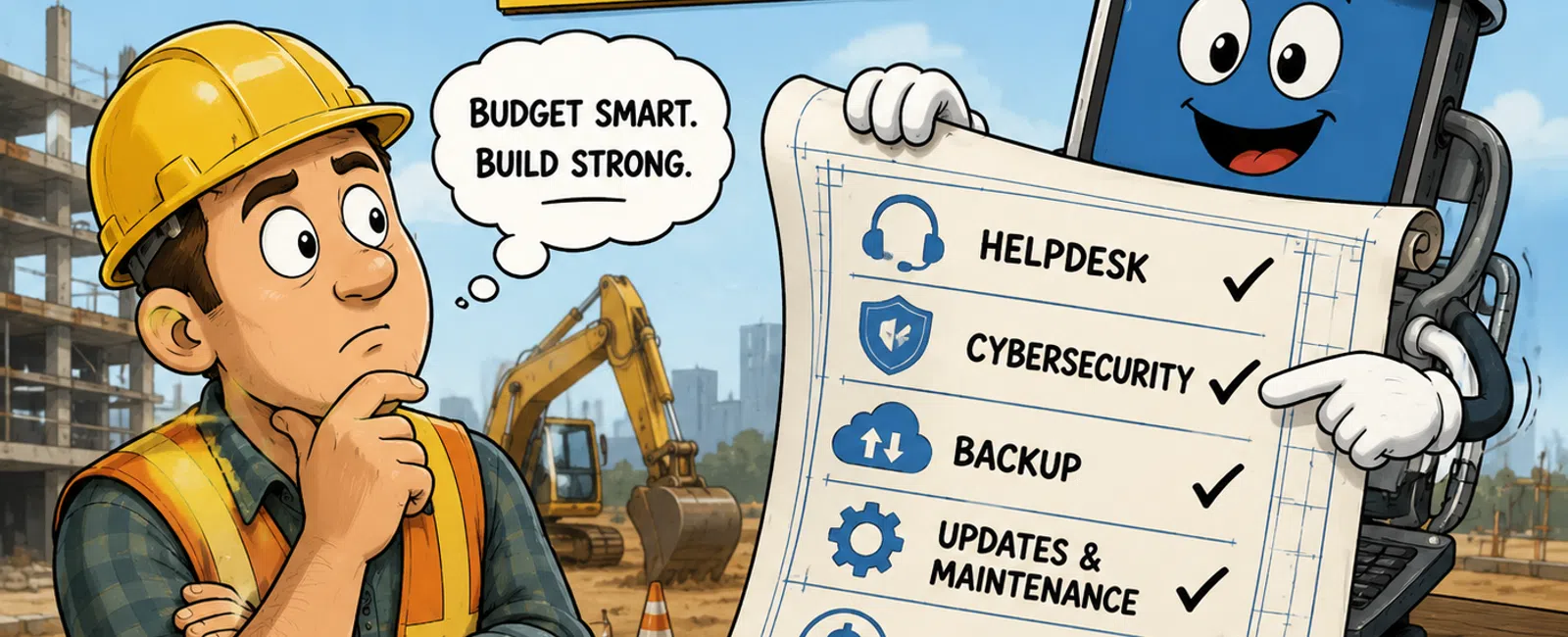
Construction businesses should budget $100 - $250 per user per month for fully managed IT services, which covers helpdesk support, monitoring, and maintenance. Additional costs include $25 - $75 per user monthly for cybersecurity protection, $20 - $40 per user for VoIP phone systems, and project-based expenses of $150 - $250 per hour for job site connectivity buildouts and software implementations.
How Much Do Construction Companies Typically Spend on IT Support?
Most construction firms allocate 3-5% of their annual revenue to technology and IT support combined. For a mid-sized construction company with 25 employees, this translates to approximately $2,500 - $6,250 monthly for comprehensive IT services.
The baseline investment covers managed IT services at $100 - $250 per user monthly. This includes 24/7 helpdesk support, proactive monitoring, patch management, and regular maintenance. Salt Lake City construction firms working across Utah, Wyoming, and Arizona benefit from providers offering multi-state coverage without additional travel fees.
Clay from a local construction company shares: "911 IT's response time has been so great! Most of the time they will resolve our issue before we hang up the phone. When we find ourselves in IT trouble we are usually in a mess until we call 911 IT and they get things working again."
Beyond the base managed services, construction-specific needs add to the budget. CAD and BIM software support, project management platform integration, and construction software optimization require specialized expertise that general IT providers may not offer.
Job site connectivity represents a significant variable cost. Remote sites in Utah's mountainous terrain or Wyoming's rural areas require dedicated internet solutions, often involving cellular failover systems, satellite connectivity, or point-to-point wireless bridges costing $150 - $250 per hour for initial setup.
A 25-person construction firm should expect to budget $4,000 - $8,000 monthly for comprehensive IT support including managed services, cybersecurity, and VoIP communications.
Flat-rate pricing models eliminate surprise bills and make budgeting predictable, especially important when managing multiple active projects with varying technology demands.
What IT Services Should Construction Firms Prioritize in Their Budget?
Managed IT services form the foundation. This covers your office network, server maintenance, workstation management, and helpdesk support for both office staff and field crews. Without this baseline, every IT issue becomes an emergency requiring expensive hourly support.
Cybersecurity protection is non-negotiable. Construction firms hold valuable data including blueprints, bid documents, client information, and financial records. Ransomware attacks targeting construction companies have increased significantly, with attackers knowing project delays cost thousands daily.
Cybersecurity add-ons cost $25 - $75 per user monthly and include endpoint detection and response (EDR), email filtering, dark web monitoring, and security awareness training. This investment prevents the average $200,000 cost of a successful ransomware attack.
Data backup and disaster recovery services at $10 - $30 per user monthly protect against data loss from hardware failure, cyberattacks, or natural disasters. Utah's winter weather and Arizona's monsoon season create real risks for construction firms operating across the region.
VoIP phone services at $20 - $40 per user monthly replace traditional phone systems with flexible, mobile-friendly communication. Field superintendents can take office calls on their cell phones, and project managers can conference with subcontractors from job sites.
Kevin from a construction company notes: "When I call for assistance, the response is instantaneous. I'm on the phone with a real person right away, and they're able to assist me with whatever issue I'm having. I especially enjoy that I have one of 911 IT's employee that makes frequent visits to our office."
Construction software support deserves dedicated budget allocation. Procore, Buildertrend, Sage 300 Construction, and similar platforms require optimization, integration, and troubleshooting expertise that general IT techs often lack.
Prioritize services that prevent downtime first, then add capabilities that improve efficiency and competitiveness.
How Do Job Site Connectivity Costs Affect IT Budgets?
Remote job sites create unique connectivity challenges that significantly impact IT budgets. Unlike office-based businesses, construction firms need reliable internet at temporary locations, often in areas without existing infrastructure.
Initial job site network buildouts cost $150 - $250 per hour for planning, equipment procurement, and installation. A typical trailer office setup with reliable internet, WiFi, and network security requires 8-12 hours of professional services, totaling $1,200 - $3,000 per major project site.
Recurring connectivity costs vary by location and solution:
- Cellular-based internet with business-grade routers and failover capabilities runs $100 - $300 monthly per site
- Satellite internet for extremely remote Wyoming or rural Utah locations costs $150 - $500 monthly depending on bandwidth requirements
- Point-to-point wireless solutions for elevation-challenged areas require line-of-sight surveys and specialized equipment
- Mobile device management for field crews adds $5 - $15 per device monthly
Salt Lake City construction firms working on projects in Park City, Heber Valley, or along the Wasatch Front face elevation-related connectivity challenges that may require custom solutions.
Budget for connectivity as a project cost, not just an overhead expense. Reliable job site internet enables real-time collaboration, reduces rework from outdated plans, and allows instant communication with architects and engineers.
Companies managing 3-5 simultaneous projects should budget $500 - $1,500 monthly specifically for job site connectivity and mobile workforce support.
What Are the Hidden IT Costs Construction Companies Often Miss?
Software licensing represents a frequently underestimated expense. AutoCAD, Revit, Bluebeam, and construction management platforms charge per user annually. A 15-person team using industry-standard software easily spends $15,000 - $30,000 yearly on licenses alone.
Compliance requirements create additional costs for construction firms handling government contracts or working with regulated clients. CMMC compliance for Department of Defense projects costs $50 - $200 per user monthly, depending on the required level.
Hardware refresh cycles often catch companies unprepared. Workstations running CAD and BIM software need replacement every 3-4 years at $1,500 - $2,500 per high-performance machine. Servers require refresh every 5-7 years at $5,000 - $15,000 depending on capacity.
Project-based IT work includes office moves, network expansions when adding staff, and software migrations. These one-time projects at $150 - $250 per hour can total $3,000 - $10,000 annually for growing firms.
Rhonda from a construction company explains the value of predictable support: "911 IT has been a godsend to our company, especially to me. They are always available and can take care of any need we have right away. I never panic anymore when something isn't working right."
Downtime costs dwarf IT support expenses but rarely appear in budgets. When project managers can't access schedules, estimators can't submit bids, or field crews can't view updated plans, the company loses billable hours and risks missing deadlines.
Training represents another hidden cost. New construction software requires staff training, either through formal sessions at $1,000 - $3,000 per software platform or through ongoing support time helping users learn features.
Emergency support outside normal business hours costs significantly more than proactive managed services. A single after-hours server failure requiring emergency repair can cost $500 - $1,500, while 24/7 monitoring prevents most emergencies entirely.
Budget for the total cost of technology ownership, not just the monthly service bill.
How Should Small vs. Large Construction Firms Budget Differently?
Small construction companies with 5-15 employees should focus on essential services first. A lean IT budget includes managed services at the lower end of the range ($100 - $150 per user), basic cybersecurity protection, and cloud-based backup. Total monthly investment: $1,500 - $3,000.
Small firms benefit from co-managed IT services at $75 - $150 per user monthly if they have an internal tech-savvy person handling basic tasks. This hybrid approach reduces costs while maintaining professional support for complex issues.
Cloud-first strategies minimize capital expenditure. Instead of purchasing servers, small firms use cloud-based construction management software, cloud file storage, and hosted email. This shifts costs from large upfront purchases to predictable monthly subscriptions.
Mid-sized firms with 15-50 employees need more robust infrastructure. Budget for full managed services ($150 - $200 per user), enhanced cybersecurity including employee training, and dedicated support for construction-specific software. Monthly investment: $4,000 - $10,000.
These companies often manage multiple simultaneous projects requiring reliable job site connectivity at each location. Budget $300 - $500 monthly per active major project for site networking and mobile workforce support.
Large construction firms with 50+ employees require enterprise-grade solutions. This includes redundant systems, advanced security operations, vCIO strategic planning at $1,000 - $3,000 monthly, and dedicated account management. Monthly investment: $12,000 - $25,000+.
Large firms working on government contracts must budget for compliance services. CMMC compliance preparation and maintenance adds significant costs but enables access to lucrative federal construction projects.
Scale your IT investment with your revenue and complexity, not just headcount. A 20-person firm managing $15 million in annual projects needs more sophisticated IT than a 20-person firm doing $3 million in smaller residential work.
What ROI Should Construction Companies Expect from IT Investment?
Properly implemented IT support delivers measurable returns that justify the investment. The primary return comes from prevented downtime. When estimators can't access bid software or project managers lose connection to job sites, companies lose $500 - $2,000 per hour in productivity.
Proactive monitoring and maintenance prevent 70-80% of potential IT issues before they cause downtime. A construction firm experiencing even two fewer outages monthly saves more than the cost of managed services.
Improved collaboration reduces project delays and rework. Real-time access to current plans, instant communication with subcontractors, and cloud-based document management cut project completion time by 5-10%. On a $500,000 project, this represents $25,000 - $50,000 in reduced overhead costs.
Enhanced cybersecurity prevents devastating losses. The average cost of a construction industry data breach exceeds $200,000 when accounting for ransom payments, recovery costs, project delays, and reputational damage. Spending $2,000 - $4,000 monthly on comprehensive security provides exceptional risk mitigation.
Better mobility enables competitive advantages. Field crews with tablet access to plans, instant photo documentation, and mobile time tracking complete tasks 15-20% faster than crews relying on paper processes and office check-ins.
Reliable technology improves employee satisfaction and retention. Construction firms compete for skilled project managers and estimators. Providing modern, functional technology reduces frustration and demonstrates company professionalism.
Scalability supports growth without proportional IT cost increases. Cloud-based systems and managed services allow firms to add users quickly when winning new projects, without major infrastructure investments or hiring internal IT staff.
Most construction companies see 3:1 to 5:1 ROI on IT investment through prevented downtime, improved efficiency, and avoided security incidents.
Frequently Asked Questions
What is the minimum IT budget for a construction startup?
A construction startup with 3-5 employees should budget minimum $500 - $1,000 monthly for basic managed IT services, cybersecurity essentials, and cloud backup. This covers helpdesk support, email security, and basic network monitoring. Add $200 - $400 monthly for job site connectivity solutions and mobile device management for field workers accessing project information remotely.
Should construction companies hire internal IT staff or use managed services?
Most construction firms under 100 employees find managed services more cost-effective than internal IT staff. A qualified IT professional costs $65,000 - $90,000 annually plus benefits, while comprehensive managed services for a 25-person firm cost $48,000 - $96,000 yearly and provide broader expertise, 24/7 coverage, and no vacation gaps. Internal IT makes sense only for very large construction companies.
How much should construction firms budget for cybersecurity specifically?
Construction companies should allocate $25 - $75 per user monthly specifically for cybersecurity beyond basic managed services. This includes endpoint protection, email filtering, security awareness training, and dark web monitoring. For a 20-person firm, budget $500 - $1,500 monthly for comprehensive cybersecurity. This investment prevents the average $200,000 cost of successful ransomware attacks targeting construction firms.
What IT costs are tax-deductible for construction businesses?
Monthly IT service fees, software subscriptions, cybersecurity services, and cloud storage are fully tax-deductible as ordinary business expenses. Hardware purchases under $2,500 per item can be deducted immediately under de minimis safe harbor rules. Larger equipment purchases may require depreciation over 3-5 years. Consult with your CPA about Section 179 deductions for technology investments.
How often should construction companies review their IT budget?
Review IT budgets quarterly to align with project pipeline changes and semi-annually for strategic planning. Construction firms experience seasonal fluctuations and project-based staffing changes that affect IT needs. Annual comprehensive reviews should assess whether current services meet growth objectives, evaluate new construction technology tools, and adjust cybersecurity investments based on evolving threats and compliance requirements.