
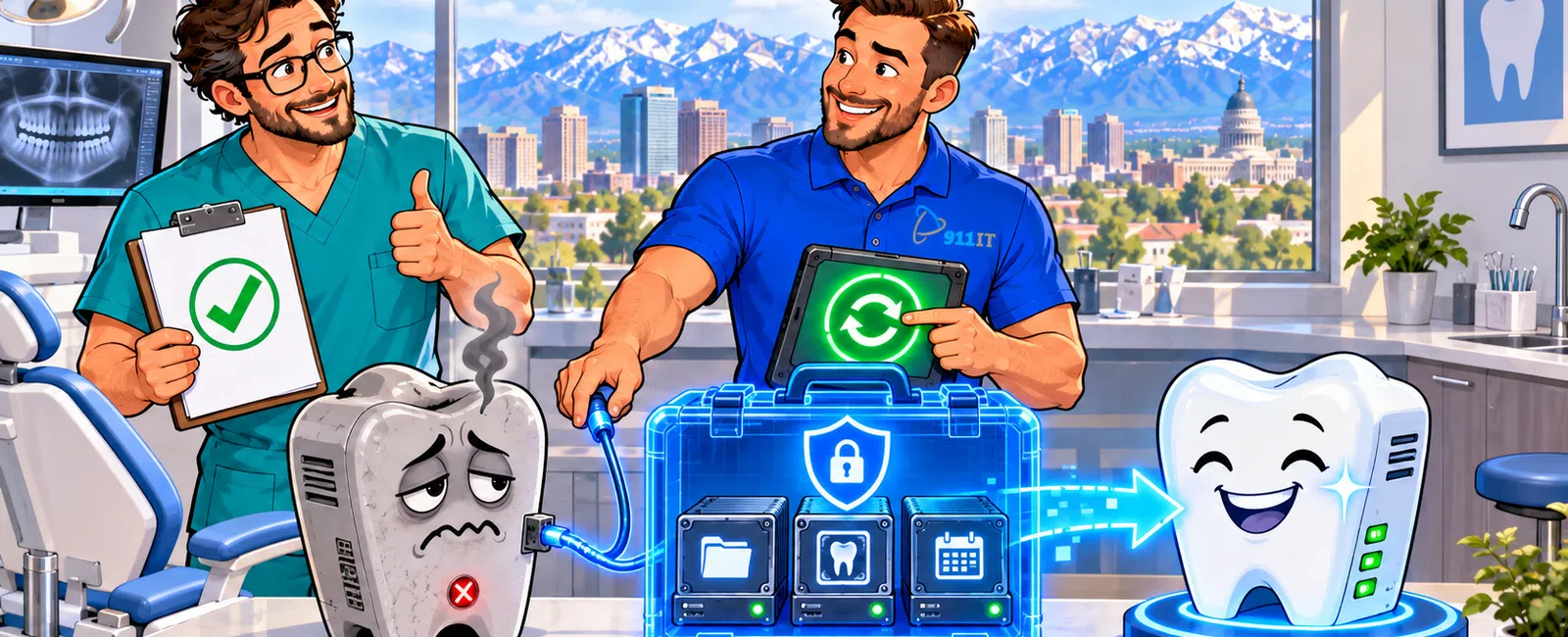
Backup and disaster recovery for dental businesses involves automated, encrypted backups of practice management systems, patient records, and digital imaging files stored both on-site and in secure cloud locations. Most dental practices require a Recovery Time Objective (RTO) of 4 hours or less to resume patient care, with Recovery Point Objectives (RPO) of 15 minutes to avoid losing appointment data, treatment notes, or billing information during system failures.
What Types of Data Do Dental Practices Need to Protect?
Dental practices generate and store multiple categories of mission-critical data that require different backup strategies. Patient health information (PHI) including treatment histories, medical alerts, and insurance details lives in your practice management system and must meet HIPAA encryption standards both at rest and in transit.
Digital radiography files and PACS imaging data represent your largest storage challenge. A single cone-beam CT scan can exceed 500 MB, and practices accumulate terabytes of imaging data annually. These files must remain accessible for patient care continuity and legal retention requirements that span 7-10 years in most states.
Your financial data - including accounts receivable, insurance claims in process, and payroll records - requires daily backup with minimal data loss tolerance. Losing even a few hours of billing entries creates reconciliation nightmares and cash flow disruptions.
Chair-side technology configurations, CAD/CAM design files, and treatment planning software settings also need protection. Rebuilding these systems from scratch after hardware failure can halt operatories for days without proper backups.
Comprehensive dental backup strategies protect all four data categories with appropriate frequency and retention policies.
How Often Should Dental Practice Data Be Backed Up?
Backup frequency for dental practices depends on data change rates and acceptable loss windows. Practice management systems handling appointment scheduling, treatment notes, and billing should run continuous or near-continuous backups with 15-minute intervals during business hours.
This aggressive schedule ensures that if your server fails mid-afternoon, you lose at most one appointment's worth of documentation rather than an entire day. The difference between recovering Tuesday morning's state versus Tuesday at 3:47 PM matters enormously when patients are in chairs and staff are documenting treatments.
Digital imaging files can follow a less frequent schedule since radiographs and scans are typically finalized before being committed to the patient record. Hourly backups during clinical hours capture new imaging without the storage overhead of minute-by-minute snapshots.
Financial and administrative data benefits from end-of-day backups that capture completed billing batches, insurance submissions, and reconciled transactions. Many practices add a mid-day backup during peak billing periods.
Industry standard for dental practices: 15-minute incremental backups during business hours with nightly full backups retained for 30 days.
Weekend and after-hours backup schedules can extend to daily snapshots since most practices aren't generating new patient data outside clinical hours.
What Is the Difference Between Backup and Disaster Recovery for Dental Offices?
Backup refers to creating copies of your data - the insurance policy that preserves information. Disaster recovery encompasses the entire process of restoring operations after a catastrophic event, including hardware replacement, system rebuilding, and returning to normal patient care.
A dental practice might have excellent backups but poor disaster recovery if those backups take 48 hours to restore or require specialized expertise the practice doesn't have access to. The gap between "we have your data safe" and "your practice is seeing patients again" defines disaster recovery planning.
Recovery Time Objective (RTO) measures how quickly you can resume operations. For dental practices, an RTO of 4 hours means patients scheduled that afternoon can still be seen. An RTO of 24 hours means rescheduling a full day of appointments, frustrated patients, and lost revenue.
Recovery Point Objective (RPO) measures how much data you can afford to lose. An RPO of 15 minutes means your backup captured everything except the last quarter-hour of work. An RPO of 24 hours means recreating an entire day's documentation from memory and paper notes.
Disaster recovery plans for dental practices must address hardware failures (server crashes, ransomware), facility disasters (fire, flood, theft), and regional outages (power grid failures, internet disruptions). Each scenario requires different recovery procedures.
Julie Bigler experienced why disaster recovery expertise matters: "911 IT got all of our pictures and data off of a damaged hard drive that we thought was toast. We were actually told by another company it was too damaged to recover. But not for 911 IT!" When backups fail or hardware damage exceeds normal recovery procedures, specialized disaster recovery capabilities become critical.
Effective disaster recovery means having both the data backups and the technical capability to rebuild your practice infrastructure quickly.
How Do HIPAA Requirements Affect Dental Backup Systems?
HIPAA regulations mandate that dental practices implement backup and disaster recovery as part of their Security Rule compliance. The regulation doesn't specify exact technologies but requires "data backup plans" and "disaster recovery plans" as addressable implementation specifications.
Encryption requirements apply to all PHI backups. Data must be encrypted during transmission to backup locations and while stored (encryption at rest). Many dental practices fail HIPAA audits because their backup systems use outdated encryption protocols or store unencrypted data on external drives.
Business Associate Agreements (BAAs) are required with any vendor who handles your backup data. Your backup provider becomes a business associate under HIPAA because they have access to PHI. Cloud backup services, off-site storage facilities, and disaster recovery providers must all sign BAAs accepting liability for protecting patient data.
Access controls and audit logging must extend to backup systems. HIPAA requires you to track who accessed patient data, including backup administrators and recovery technicians. Your disaster recovery plan must document who has authority to initiate restores and how access is authenticated.
Testing requirements often surprise dental practices. HIPAA expects you to periodically test your disaster recovery procedures to ensure they actually work. Annual or semi-annual recovery drills verify that backups are valid, restoration procedures are documented, and staff know their roles during an emergency.
Salt Lake City dental practices benefit from working with HIPAA compliance specialists who understand both the technical backup requirements and the documentation needed for OCR audits.
What Backup Solutions Work Best for Different Practice Sizes?
Solo and two-doctor practices with single locations can often manage with hybrid backup systems combining local network-attached storage (NAS) devices and cloud replication. This approach provides fast local recovery for common issues like accidental file deletion while maintaining off-site protection against facility disasters.
These smaller practices typically manage 500 GB to 2 TB of total data, making cloud backup economically feasible. Daily full backups to local storage with hourly incrementals to cloud services balance speed and protection. Recovery times of 2-4 hours meet most single-location needs.
Mid-sized practices with 3-6 doctors or multiple operatories generate substantially more imaging data and have lower tolerance for downtime. These practices benefit from image-based backup systems that capture entire server configurations, not just files. When disaster strikes, you restore a complete working system rather than rebuilding from scratch.
Practices at this scale should target RTOs under 2 hours and RPOs of 15 minutes or less. The revenue impact of a half-day closure - cancelled hygiene appointments, rescheduled procedures, and staff idle time - justifies more robust disaster recovery infrastructure.
Dental service organizations (DSOs) and multi-location practices require enterprise-grade backup orchestration with centralized management. Each location needs local backup appliances for fast recovery, coordinated with centralized cloud repositories and potential hot-standby systems for critical locations.
Large practices often implement tiered recovery strategies: critical systems like appointment scheduling and patient lookup restore within 30 minutes, full practice management within 2 hours, and complete imaging archives within 4-8 hours. This prioritization gets patients flowing while background processes complete full restoration.
- Solo/Small Practices (1-2 doctors): Hybrid NAS and cloud backup with 2-4 hour RTO, managing 500 GB to 2 TB of data
- Mid-Sized Practices (3-6 doctors): Image-based backup systems with under 2-hour RTO and 15-minute RPO for multiple operatories
- Large Practices/DSOs: Enterprise orchestration with tiered recovery (30-minute critical systems, 2-hour full practice management, 4-8 hour complete archives)
- Cost Range: $10-$30 per user per month baseline, with higher costs for practices with extensive imaging libraries
Industry average backup and disaster recovery costs range from $10-$30 per user per month, though comprehensive solutions for dental practices with large imaging libraries often exceed this baseline.
Which Salt Lake City Providers Offer Dental-Specific Backup and Disaster Recovery?
Salt Lake City dental practices have several qualified IT providers with healthcare experience, though capabilities vary significantly. Executech and Wasatch I.T. both serve healthcare clients and understand HIPAA requirements, offering managed backup services suitable for dental practices.
Nexus IT Consultants and INTELITECHS provide business continuity services that include backup and disaster recovery, though their focus spans multiple industries rather than dental-specific optimization. ProLink IT and Qual IT round out the local provider landscape with general IT services that can accommodate dental practice needs.
National healthcare IT providers and large MSPs often appear in searches, but Salt Lake City dental practices should understand the trade-offs. At enterprise-scale providers, your 8-person practice becomes ticket #47,392 in a queue managed by rotating junior technicians across time zones. When your practice management system crashes at 7:30 AM and patients start arriving at 8:00, you need someone who answers recognizing your voice and already knows your systems.
911 IT serves dental practices throughout the Salt Lake City area with business continuity services that include both proactive backup management and rapid disaster recovery. Their 24-7 live support means you reach an actual technician immediately, not an answering service or offshore call center.
The company's healthcare experience includes supporting EHR and practice management software with the HIPAA compliance documentation dental practices need for audits. Their South Jordan location at 1124 South Jordan Parkway enables rapid on-site response when remote recovery isn't sufficient - a critical advantage when hardware replacement is needed to restore operations.
What sets 911 IT apart is their process-driven approach to disaster recovery. Rather than treating each incident as a unique crisis, they follow documented recovery procedures tested through regular drills. This methodology reduces recovery time and eliminates the guesswork that extends outages when providers are figuring out solutions in real-time.
Their 100% Satisfaction Guarantee backs up their commitment to keeping practices operational. For dental practices where every hour of downtime means cancelled appointments and frustrated patients, this guarantee provides meaningful accountability.
Dianna from an accounting firm experienced their proactive planning approach: "I was very impressed before quarantine was implemented: 911 IT reached out to us to develop a plan to be able to move all of our employees home if the need arose. Of course, the need did come, and we were ready." This same forward-thinking disaster preparedness applies to dental practices, anticipating failure scenarios before they become emergencies.
For Salt Lake City dental practices, the right backup and disaster recovery provider combines technical expertise with healthcare compliance knowledge and local responsiveness - capabilities that align with your practice's actual needs rather than enterprise-scale overhead.
Frequently Asked Questions
How long should dental practices retain backup data?
Dental practices should retain patient record backups for at least 7-10 years to meet state record retention laws and statute of limitations requirements. Daily backups can be thinned to weekly after 90 days and monthly after one year, while maintaining long-term archives of complete patient records. Financial records typically require 7-year retention for tax purposes.
Can dental practices use consumer cloud storage for backups?
Consumer services like Dropbox, Google Drive, or iCloud are not HIPAA-compliant for dental practice backups without Business Associate Agreements and proper encryption. These platforms don't provide the access controls, audit logging, or compliance documentation required for PHI protection. Dental practices must use healthcare-grade backup solutions with signed BAAs and HIPAA-specific security controls.
What happens if ransomware encrypts both live data and backups?
Properly configured backup systems maintain immutable copies that ransomware cannot encrypt, typically through air-gapped storage or cloud repositories with write-once-read-many protection. Recovery involves restoring from the last clean backup before infection, which is why frequent backup intervals matter. Practices lose only the data created between the last backup and the attack, making 15-minute intervals critical for minimizing loss.
How much does dental practice disaster recovery typically cost?
Comprehensive backup and disaster recovery for dental practices typically costs $10-$30 per user per month for basic solutions, though practices with extensive imaging libraries often require custom pricing. This includes automated backups, cloud storage, and recovery support. Additional costs may include on-site backup appliances, hot-standby systems for larger practices, and periodic disaster recovery testing services.
Should dental practices test their disaster recovery plans?
Yes, dental practices should test disaster recovery procedures at least annually to verify backups are valid and restoration processes work as documented. Testing reveals gaps like missing BAAs, outdated recovery documentation, or staff unfamiliarity with procedures. HIPAA's Security Rule expects periodic testing as part of contingency planning. Many practices schedule tests during holiday closures to minimize disruption.


