
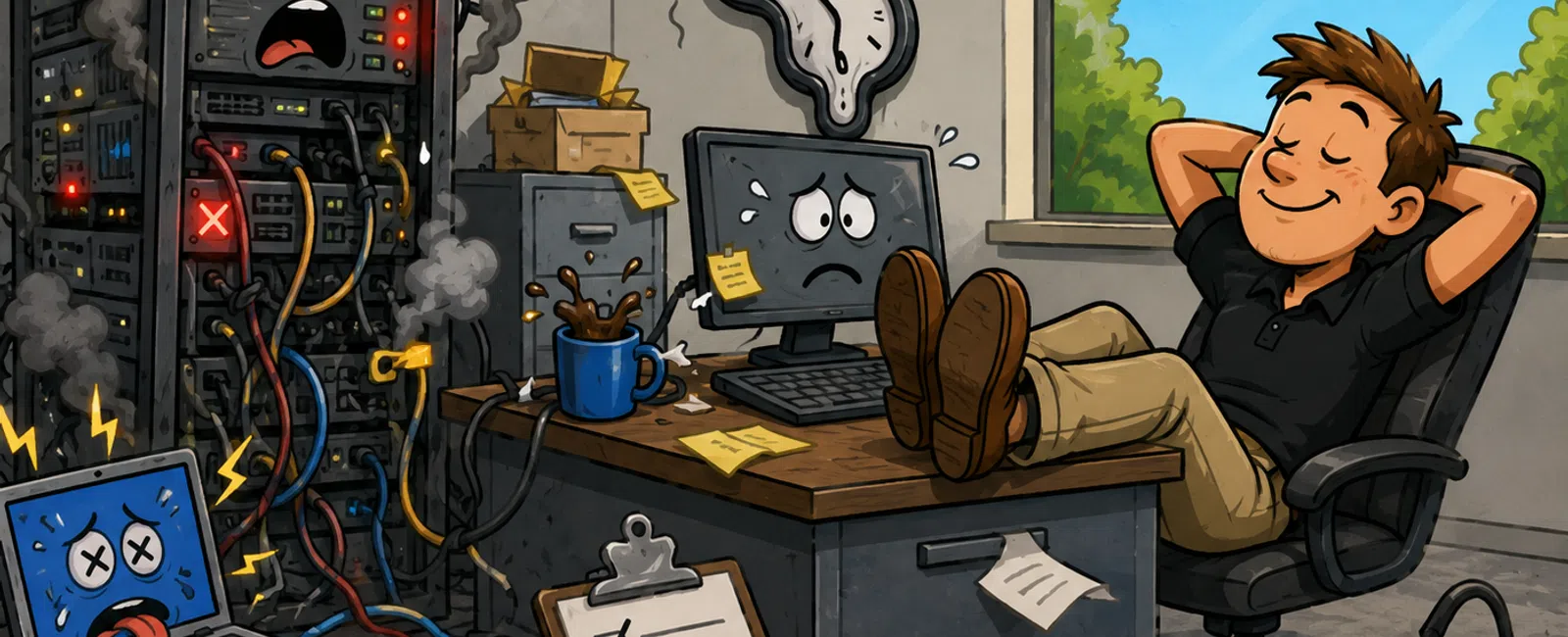
How "We'll Fix It Later" Quietly Becomes Your Next Operational Breakdown
It never starts as a crisis.
It starts with something small. A system slows down. A backup throws a
warning once. An update gets pushed because there's no good time this week.
Nothing is broken. So it waits.
That's how risk builds in well-run organizations—quietly, reasonably, and
without anyone feeling like they're making the wrong call.
But if your team has started adapting to systems instead of trusting
them, you are already past the point where this is optional.
The Pattern Most Teams Miss Until It's Costly
In the majority of environments we assess, this follows the same pattern.
People adjust before they escalate.
They wait longer for systems to respond.
They rerun reports.
They restart applications mid-day.
They ignore one-off alerts because "it seems fine now."
That behavior is the early warning sign.
In most environments, this drift begins after about 60-90 days of delayed
updates, unreviewed alerts, or untested backups. At that point, the system is
no longer stable—it is being held together by human workarounds.
And once that shift happens, failure doesn't build slowly.
It shows up all at once.
Why These Failures Actually Happen
These aren't rare. They're some of the most common failure points we see.
Silent backup failures
Backups appear to run successfully, but restores fail due to expired
credentials, broken permissions, or invalid recovery paths.
Performance degradation
Database fragmentation and resource contention creep in, especially in systems
handling ongoing reporting or sync loads. Nothing fails immediately—but
performance steadily declines.
Update hesitation
Teams delay updates to avoid breaking critical tools. Over time, those delays
create instability instead of preventing it.
Knowledge concentration
One person understands how something works. No one else has the steps. That
becomes a real risk the moment they're unavailable.
This isn't about bad decisions. It's about missing thresholds and
invisible accumulation.
One Example That Should Reset Your Assumptions
We worked with a ~40-person nonprofit where backup jobs had been
reporting "successful" for months.
Everything looked correct.
When they ran a restore test, it failed.
The issue wasn't the backup—it was an expired credential in the recovery
process. The system had been broken for months, and no alert flagged it.
If they had needed that backup during an incident, recovery would have
failed completely.
This is one of the most common failure points we see across environments.
The Accumulation Risk Stack
Most breakdowns follow the same pattern.
From bottom to top:
Layer 1: Visibility Gaps
Issues are only detected when users feel them
Layer 2: Delayed Maintenance
Updates and fixes keep getting postponed
Layer 3: Dependency Concentration
Critical knowledge sits with one person
Layer 4: Unrealistic Staffing Assumptions
Systems depend on specific people always being available
Two rules make this actionable:
Most disruptions happen when Layers 1-3 are present at the same time
If you have three or more layers, risk increases exponentially—not gradually
How Fast This Escalates
Once performance issues become visible to your team, failure often
follows within weeks—not months.
That's the window most teams miss.
What Stable Environments Actually Have in Place
Here is what "good" looks like when it's defined clearly:
Monitoring
Alerts are acknowledged within 5-10 minutes
Issues are identified before staff report them
Patching
Updates follow a defined schedule
Critical patches are not delayed beyond one cycle
Backups
Restore testing is performed at least quarterly
Critical systems are tested more frequently
Ownership
Every system has both a primary and backup owner
No system depends on one person's memory
Escalation
A written escalation process exists
Staff know exactly when and how to use it
This is not advanced maturity.
This is baseline stability.
What This Actually Costs You
When this breaks, the impact isn't a single outage.
It shows up as:
Lost staff time spent troubleshooting
Delayed documentation and billing
Repeated rework from failed systems
Slower workflows across your team
Internal frustration and reduced confidence
And externally, it's even more visible.
Your board sees risk.
Leadership sees inefficiency.
Staff feel friction.
Donors and clients experience inconsistency.
This is how trust erodes—quietly, over time.
10-Minute Operational Risk Check
Answer yes or no:
- Backups have
been restore-tested in the last 30 days
- Alerts trigger
before staff report problems
- Updates follow
a consistent schedule
- No update has
been delayed beyond two cycles
- Every system
has a primary and backup owner
- Recovery steps
are documented
- Staff know how
to escalate immediately
- Alerts are
reviewed consistently
- Backup warnings
are investigated
- A usable
escalation SOP exists
Scoring
0-2 "no" answers → Stable
3-5 → Moderate risk
6+ → High likelihood of disruption
If You're Overloaded, Fix This in Order
Start here:
- Backup restore
testing
- Monitoring
visibility
- Ownership
clarity
- Patch
consistency
This sequence removes the highest-risk gaps first.
What To Do Next Week
Run one real restore test
Confirm one critical system is actively monitored
Assign a backup owner to a key system
Write a one-page escalation process your team can follow
This is enough to reduce real risk immediately.
The Real Goal
You are not trying to eliminate every issue.
You are making sure problems show up early, stay small, and get handled
before your entire team feels them at once.
That's what stability actually looks like.
What To Do Now
Schedule your 10 minute discovery call. We'll walk through your backups,
monitoring, and ownership using the exact risk check above so you can see where
you stand in real terms. 911 IT will help you validate what's actually
stable—and what only looks that way right now.


