
The First Week Mistake That Quietly Breaks Your Control Environment
I've sat in enough audit rooms to tell you this isn't theoretical.
The first week of a new hire's employment is one of the most unstable
control windows your bank operates in. Systems are partially configured.
Processes are understood on paper, not in practice. People are trying to be
helpful before they know what "normal" looks like.
And that combination—incomplete structure and high willingness to act—is
exactly where control failures happen.
The problem is not that new employees make mistakes.
The problem is that your environment allows decisions to be made before
controls are fully enforced.
Where This Shows Up in Real Audits
In onboarding reviews, this pattern appears more often than teams expect.
What consistently comes up:
- Access exists
before role boundaries are fully enforced
- Approval chains
exist in policy, but not in execution
- High-risk
actions can still be initiated from email or chat
- Logs show
activity, but not validated authorization
- New employees
cannot clearly explain escalation steps
In one recent anonymized review, a payment workflow looked compliant on
paper. Dual approval existed. Validation procedures were documented.
But the actual execution told a different story:
- The request
originated in email
- Approval was
implied through a reply, not recorded in a system
- The new
employee processed the transaction inside the system—but the authorization
happened outside it
From an audit standpoint, that is not a process failure.
It is a control failure.
Because the system allowed a critical step to occur where it could not be
verified.
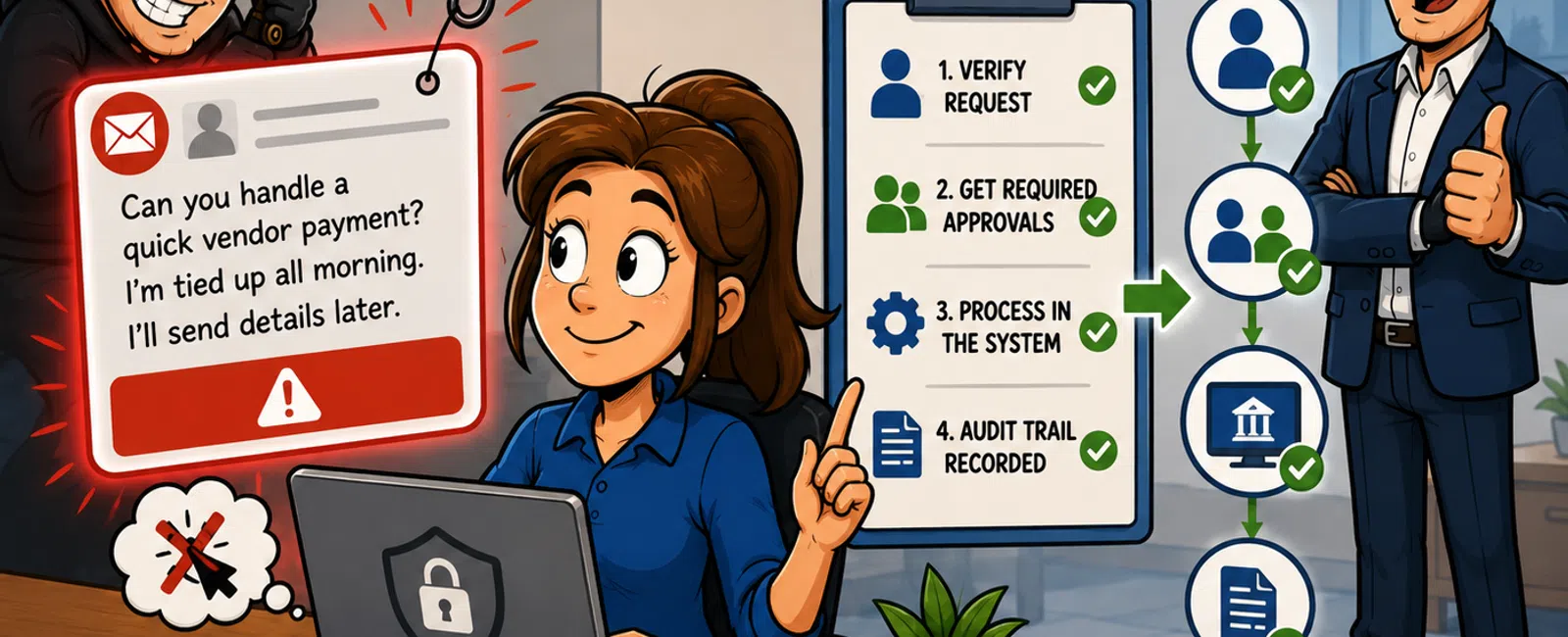
Example: How a First-Week Payment Request Should Actually Flow
A new employee receives an urgent message about a vendor payment.
Here is what execution should look like.
Trigger → Employee Action → System Enforcement → Audit Evidence
1. Request arrives (email or chat)
- Employee
action: Do not act on message alone
- System
enforcement: No payment workflow can begin outside approved system
- Audit evidence:
No transaction exists unless initiated in system of record
2. Identity validation
- Employee
action: Confirm requestor using internal directory or callback
- System
enforcement: Approval tied to authenticated user identity
- Audit evidence:
Verified user ID linked to approval action
3. Approval sequence
- Employee
action: Confirm required approvers exist in system
- System
enforcement: Dual approval required before execution
- Audit evidence:
Timestamped approval chain tied to roles
4. Transaction execution
- Employee
action: Process only inside approved platform
- System
enforcement: Logging captures who, what, when
- Audit evidence:
Full transaction record with audit trail
5. Supervisory visibility (Day 1-5)
- Employee
action: Route for review if within first week
- System
enforcement: Flagged transactions require oversight
- Audit evidence:
Secondary review documented
If any one of those steps occurs outside the system, the control is no
longer enforceable.
Second Scenario: Vendor Change Request Through a Third Party
This is where strong teams still get exposed.
A new hire receives a message referencing an MSP coordinating a vendor
banking update.
It sounds legitimate:
- The vendor is
real
- The MSP is
familiar
- The request
sounds operational
Here's where it breaks:
- The employee
assumes validation already occurred upstream
- The vendor
record is updated without independent verification
- The system logs
the change—but not the validation process
Now you have:
- A valid system
record
- An invalid
control sequence
And from an examiner's view, that is worse than an obvious phishing
attempt.
Because it shows structured systems, but unstructured execution.
Sample Control Policy Language
If you want to eliminate ambiguity, this needs to be explicit.
Use this as a baseline:
All payment requests, vendor banking changes, and sensitive data access
actions must originate and be completed within an approved system of record.
Email, chat, or verbal approvals are not valid authorization mechanisms.
This does two things:
- It removes
interpretation from the employee
- It aligns
policy directly with what can be audited
What Good vs Bad Audit Evidence Looks Like
This is where most teams see the difference immediately.
Good evidence
- Unique user ID
tied to action
- Timestamp for
each step
- Approval chain
recorded in system
- Role-based
authority clearly enforced
- Full
traceability from request to execution
Bad evidence
- "Approved via
email"
- Screenshot of a
chat message
- Shared account
activity
- Missing or
implied authorization
- Action exists,
but approval cannot be verified
The difference is not technical.
It is whether your system forces the right behavior, or allows a
shortcut.
Turn Your Checklist Into Enforcement
A checklist is passive. Enforcement is testable.
Use this model:
Control → How to verify → What failure looks like
No shared credentials
- Verify: Pull
recent login activity and map to named users
- Failure:
Actions exist, but you cannot attribute them
Role-based access
- Verify: Compare
permissions to job role before Day 1
- Failure: User
can perform actions outside scope
System-based approvals
- Verify: Sample
transactions and confirm approvals exist inside system
- Failure:
Approvals exist only in communication threads
Escalation clarity
- Verify: Ask
employee who they contact when unsure
- Failure:
Employee defaults to acting instead of asking
First-week supervision
- Verify:
Identify which actions require review
- Failure: New
hire completes high-risk tasks independently
How to Fix This Without Rebuilding Onboarding
You do not need more documentation. You need tighter control in the first
five days.
Day 0: What must be enforced (not optional)
- Named
credentials only
- MFA active
- Role-based
access fully defined
- Block external
email forwarding
- Restrict file
downloads to approved devices
- Disable use of
personal devices for sensitive actions
Day 1-2: Show real workflows
- Walk through
one payment and one vendor change scenario
- Show where
approvals actually live
- Define what
never happens via email or chat
Day 3-5: Controlled execution
- Allow
supervised actions only
- Require review
for high-risk activity
- Validate
behavior through logs, not outcomes
The goal is not training.
The goal is removing ambiguity before the employee has to make a judgment
call.
Give Your New Hire a Simple Script
Most first-week failures happen because people don't want to slow things
down.
Give them language that makes control the default:
"I'm still in my first week, so I need to validate this through the
standard process before I act. I'll confirm this in the approved system and
verify the request using our internal method."
That sentence protects the employee and the system at the same time.
What to Do Next Week
Take your last onboarding and walk three workflows backwards:
- Payment request
- Vendor change
- Data access
Ask:
- Where could
action start outside the system?
- Where did you
expect knowledge before exposure?
- Where would
logs show activity but not authorization?
- Where could a
third party or MSP introduce risk?
Fix only those points.
That is where your real exposure lives.
If you want to know whether your first-week controls would actually hold
up in an audit, schedule your 10 minute discovery call with 911 IT. We'll walk
your first five days against the exact failure points outlined here. You'll
leave with a clear answer on whether your onboarding holds under examination.


