
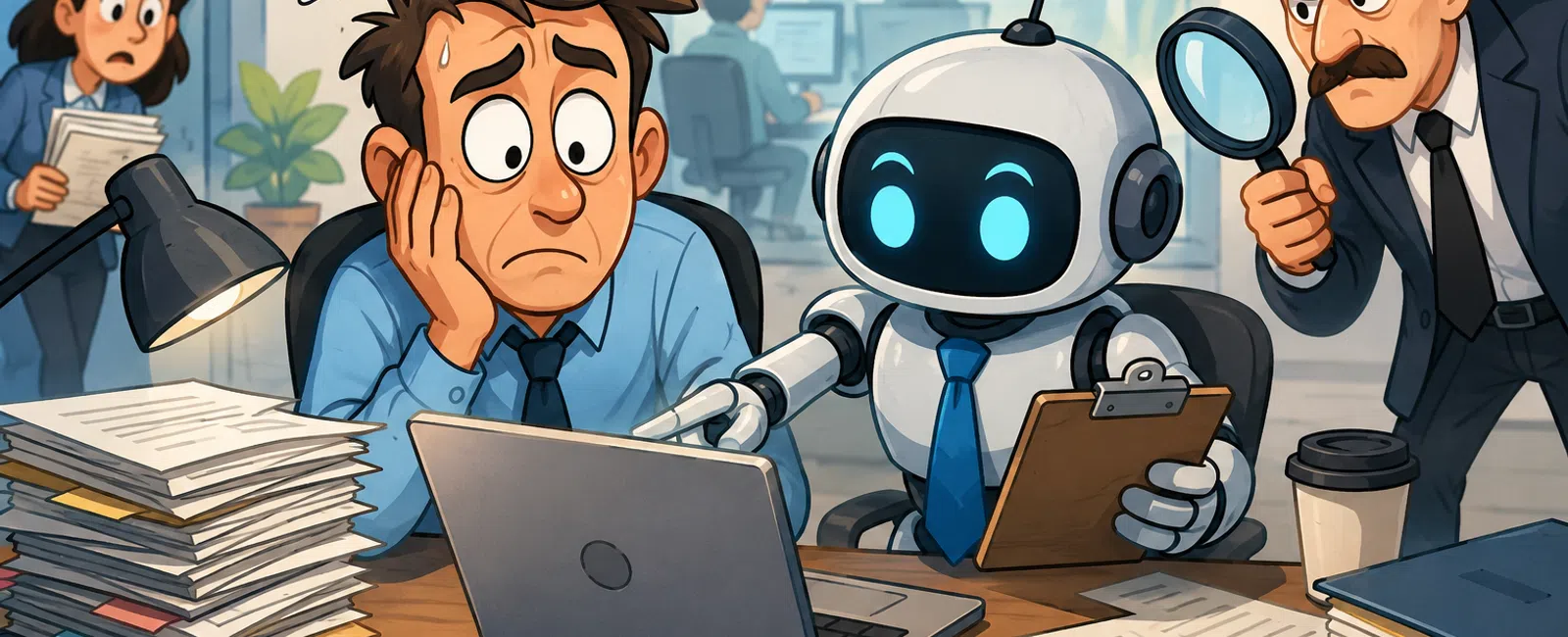
Your AI Intern Just Started. Here's How You Actually Supervise It.
I've sat in rooms where everything looked fine on paper.
Policies were written. Tools were listed. People were "aware."
Then an auditor asked a simple question:
"Walk me through exactly how this works."
That's usually where things go quiet.
If you're responsible for IT and compliance, you don't lose sleep over
policies.
You lose sleep over what happens between them.
And right now, AI is creating more of those "in between" moments than
most teams realize.
The Real Problem: AI Has No Control Flow
Most teams think they have AI under control because they've defined:
- Which tools are
allowed
- What data
shouldn't be shared
- That someone
should review outputs
But that's not control.
That's intent.
Control means you can trace exactly what happened—step by step—and prove
it.
In a regulated environment, that traceability is the difference between
confidence and exposure.
Example: How AI Use Should Actually Be Controlled
Let's walk one real scenario all the way through.
Scenario: Analyst uses AI to summarize a financial report before a
meeting
Step 1 — User Input
- Analyst copies
internal financial data
- System control:
- DLP scans
content before it leaves the environment
- If sensitive →
blocked or redirected
- Audit evidence:
- Log of
attempted data transfer
- Classification
tag applied to content
Step 2 — Tool Interaction
- Analyst uses an
approved AI tool
- System control:
- Tool is
authenticated (SSO)
- Usage is
logged per user
- Audit evidence:
- User ID tied
to session
- Timestamped
activity log
Step 3 — Output Generation
- AI generates
summary
- System control:
- Output is
tagged as AI-generated
- Stored only in
approved workspace
- Audit evidence:
- Version
history
- Source
attribution (AI vs human)
Step 4 — Approval
- Analyst submits
summary for internal use
- System control:
- Requires
second-person review before distribution
- Audit evidence:
- Approver
identity
- Time of
approval
Step 5 — Storage
- Approved
document saved
- System control:
- Stored in
compliant system with retention policy
- Audit evidence:
- Retention
classification
- Access logs
That's what control looks like.
Not a policy. A system.
The AI Control Flow (What Auditors Expect to See)
Every AI interaction should follow a pattern you can explain in under a
minute:
Trigger → User Action → System Control → Audit Evidence
Example Flow
- Paste data →
DLP blocks or logs it → Evidence exists
- Generate output
→ flagged as AI → evidence exists
- Share document
→ requires approval → evidence exists
- Make decision →
attributable to a person → evidence exists
If any step breaks, the whole chain breaks.
What Good vs Bad Audit Evidence Looks Like
Good Evidence
- AI usage logs
tied to named users
- Approved tool
list enforced technically (not just documented)
- Data
classification applied before AI interaction
- Review and
approval records for outputs
- Storage with
retention and access tracking
Bad Evidence
- "We use AI for
summaries sometimes"
- No visibility
into what data was entered
- No logs tied to
specific users
- Outputs treated
as final without validation
- No defined
ownership of decisions
Auditors don't test your intentions.
They test your evidence.
Second Scenario: Where This Breaks Fast
Let's take a different case.
Scenario: Marketing drafts client-facing content using AI
- AI generates a
polished piece with industry statistics
- No one
validates the data
- It goes out to
a client
The failure point isn't the AI.
It's the missing control:
- No requirement
to verify factual claims
- No attribution
of where data came from
- No
accountability for final content
AI didn't make the decision.
Someone trusted it without a checkpoint.
In my experience, this is one of the most common early failures in teams
that adopt AI quickly.
It looks like efficiency.
Until it isn't.
Why the "AI Intern" Analogy Actually Matters
Everyone likes the analogy. Few follow it through.
You wouldn't:
- Let an intern
publish client content without review
- Give them full
access to financial data on day one
- Assume their
first draft is accurate
But that's exactly how AI gets used.
If you wouldn't allow a human to do it without oversight,
AI shouldn't be allowed to either.
Same rules. Same controls. Same accountability.
Turn Your Checklist Into Enforcement
Most teams stop at:
- "Don't share
sensitive data"
- "Use approved
tools"
- "Review
outputs"
That's not enough.
Here's how to turn that into something real:
Control → What to Verify → What Failure Looks Like
Approved Tools
- Verify: Only
approved tools accessible through SSO
- Failure:
Employees using external tools with no visibility
Data Boundaries
- Verify: DLP
actively scanning and blocking
- Failure:
Sensitive data entered without detection
Output Validation
- Verify:
Approval required for external-facing content
- Failure: AI
output sent directly to clients
Logging
- Verify:
User-level AI activity logs exist
- Failure: No
audit trail of usage
Ownership
- Verify: Named
owner for AI governance
- Failure:
"Everyone is responsible" (which means no one is)
This is where most environments fall apart.
Not in policy. In enforcement.
What This Means for You
You're not trying to stop AI.
You're trying to make sure it doesn't create blind spots inside your
control environment.
Because in your world:
- Missed controls
turn into audit findings
- Audit findings
turn into regulator attention
- And that turns
into risk you can't ignore
You're already carrying enough of that.
AI shouldn't add to it.
What You Can Do This Week
Take one real use case.
Not theoretical. Not documented.
Something your team actually did this week.
Walk it through:
- Where did the
data go?
- What system saw
it?
- Who approved
the output?
- What evidence
exists?
If you can't answer one of those, you've found the gap.
That's where to start.
Schedule your 10 minute discovery call
Walk one real AI use case through this model first. If any step lacks
visibility or validation, that's your exposure. Schedule your 10 minute
discovery call with 911 IT and we'll map exactly where your control breaks.


