
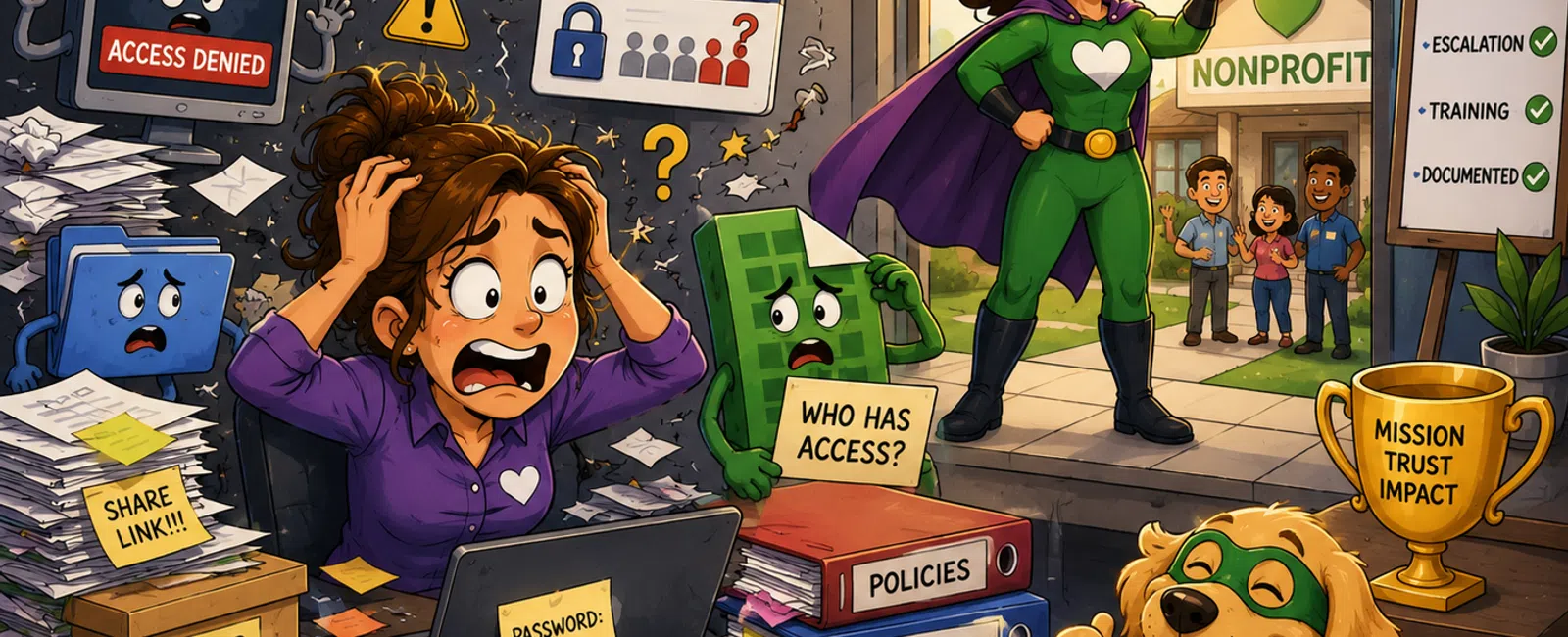
The Nonprofit Risk That Usually Starts With a Normal Workday
If you run operations at a nonprofit, you already know how this goes.
You are not just keeping systems moving. You are protecting donor trust,
staff continuity, client privacy, board confidence, and the mission itself. You
may not have "security owner" in your title, but the burden still lands on your
desk the moment something feels off. That is exactly why this problem gets
missed for so long: the work is real, the stakes are high, and the ownership is
often implied instead of defined.
The mistake is not that nonprofit teams do not care about security.
The mistake is that many teams still rely on good people, good
intentions, and "we would probably catch it" instead of a clearly owned
operating model. In smaller nonprofit environments, this is where things
usually break: not because the tools are absent, but because access, alerts,
escalation, and accountability were never translated into everyday behavior.
What This Looks Like in a Real Organization
Picture a counseling and family support nonprofit with three systems that
matter every day: Microsoft 365 for email and file sharing, a donor platform
for online giving, and a shared folder where staff keep finance and development
documents. That combination is common because nonprofits often rely on
connected systems for donations, CRM, email marketing, accounting, and
Microsoft 365 all at once.
A development coordinator exports a donor report from the fundraising
system and drops it into a shared folder so another team member can update a
campaign list. The share link is set too broadly. No one notices because the
folder has been used that way for months. Later that week, a staff member
receives what looks like a normal file-sharing email, signs in, and assumes it
is routine. Now you have two problems at once: donor data sitting in the wrong
place and account access that may no longer be trustworthy.
Nothing explodes in that moment.
What happens instead is slower and more stressful. Someone notices
unusual activity. Another person wonders whether the donor file was exposed.
Development asks whether campaign records were touched. Leadership asks whether
this affects donor trust. By the time it reaches the board chair, the real
issue is no longer just the file or the login. The issue is that nobody can
confidently answer who owned the folder, who was supposed to review the alert,
or what the escalation path was supposed to be. That is when a normal
operational issue becomes a leadership problem.
Where This Breaks in Real Systems
Here is the plain-English version.
In most nonprofit environments, the break point is not "cybersecurity" as
an abstract concept. It is one of three very specific system behaviors.
Microsoft 365
This is where permissions drift quietly. A folder created for one project gets
reused for another. Sharing links stay open longer than anyone intended. Teams
assume someone else knows who has access. Over time, SharePoint, OneDrive, and
Teams become a patchwork of inherited access instead of intentional access.
Nonprofits already want governance for SharePoint, OneDrive, and Teams sprawl
because this kind of drift creates both risk and confusion.
Donor platform
This is where "we do not store card data" gets mistaken for "we have no
responsibility." Nonprofits still need role-based access, audit trail
visibility, vendor due diligence, and clarity about who can export what. Donor
information is not just a fundraising asset. It is trust, reputation, and often
a board-level concern the moment access looks messy or undocumented.
Email
This is where routine work becomes the entry point. Staff click file-share
notifications, reuse passwords, or move quickly through inbox triage because
they are already overloaded. Nonprofits consistently care about phishing
defense, email protection, and security awareness training because the inbox is
still one of the easiest ways for an ordinary workday to turn into an incident.
What Happens When Something Looks Wrong
This part matters because most teams do not fail at prevention first.
They fail at response.
A suspicious login alert appears. Someone in operations sees it, but is
not sure whether IT owns it, leadership owns it, or the vendor owns it. A
development lead realizes a donor export may have been accessible more broadly
than intended. Someone searches old emails trying to remember how this was
handled last time. Meanwhile, nobody has confirmed whether access should be
revoked, whether passwords should be reset, whether outside support should be
called, or whether leadership needs to be briefed immediately.
That delay is the real operational cost.
The problem is not just suspicious activity. The problem is hesitation.
Nonprofits need a simple "what to do if" playbook, a local escalation path,
clear severity levels, and response times. Without those, the team burns hours
figuring out ownership during the same window when leadership most needs
clarity.
And once leadership is involved, the lens shifts fast.
The board is no longer asking, "Was this serious?" They are asking, "Can
we prove we understood the risk, controlled access, trained staff, and
documented our response?" That proof mindset shows up again and again in
nonprofit environments that need compliance binders, policy evidence, audit
records, and a way to show funders or board members that risk is being actively
managed.
The Operational Standard: What "Secure Enough" Actually Looks Like
You do not need a bigger policy binder first.
You need a minimum operating standard your team can actually run.
At minimum, one named person should own each of these behaviors:
- Access review: Someone
reviews who has access to donor data, shared folders, and admin accounts
on a defined schedule.
- Alert review: Someone checks
login, sharing, and admin activity alerts every business day.
- Escalation
trigger: The team knows exactly what triggers leadership notification,
vendor outreach, or account lockdown.
- Evidence trail: Policies,
training logs, and access decisions are documented where they can be
retrieved quickly.
- Data handling
rule: Staff know where donor and client data belongs and where it does
not belong.
- Incident
playbook: If something looks wrong, the first three actions are already
defined.
That is the difference between a security concept and an operating model.
It is also the difference between "we think we are covered" and "we can
show our work." Nonprofit leaders often want exactly that: a clear, simple way
to demonstrate that the organization is safe, compliant, and not one bad day
away from confusion.
Before and After
Before this gets fixed, the pattern usually looks like this: staff guess
at policy, donor data lives in too many places, file sharing grows messy over
time, and incident response depends on whoever happens to notice the problem
first. Operations carries the stress, leadership gets pulled in late, and the
board ends up asking for proof after the fact.
After it gets fixed, the environment feels noticeably different: access
has an owner, the team knows what "secure enough" means in daily work, alerts
are reviewed on purpose, escalation is defined, and leadership gets faster,
clearer answers when something needs attention. That is not just better
security. It is better operations.
What to Do Next Week
Do not start with every system.
Start with one.
Pick email or file sharing first. Then answer these five questions in
writing: Who owns access review? Who reviews alerts? What activity triggers
escalation? Where is the evidence stored? What is the first action if something
looks wrong? Nonprofits do not always need new tools to improve this. Many just
need to configure what they already have and assign ownership clearly.
If your team cannot answer those five questions quickly, that is your
signal. The gap is not awareness. The gap is operational control. And that is
fixable without turning your week into a full-blown systems project.
The Part Most Nonprofit Leaders Need to Hear
You are not overreacting if this feels heavy.
For nonprofit operations leaders, this burden is personal because the
consequences are personal. Client trust, donor confidence, and mission
continuity all sit downstream from decisions most people never even see. You
should not have to be the compliance officer, incident manager, and accidental
IT lead at the same time just to feel like the organization is covered.
Schedule your 10 minute discovery call. We will help you identify whether
your risk is really a tooling problem or an ownership problem, and what to
tighten first. If you want, 911 IT can keep it focused on one system so you
leave with a clear next step instead of a bigger project.


